PDFTests Originals

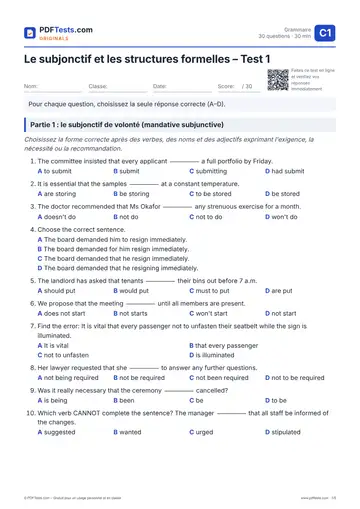
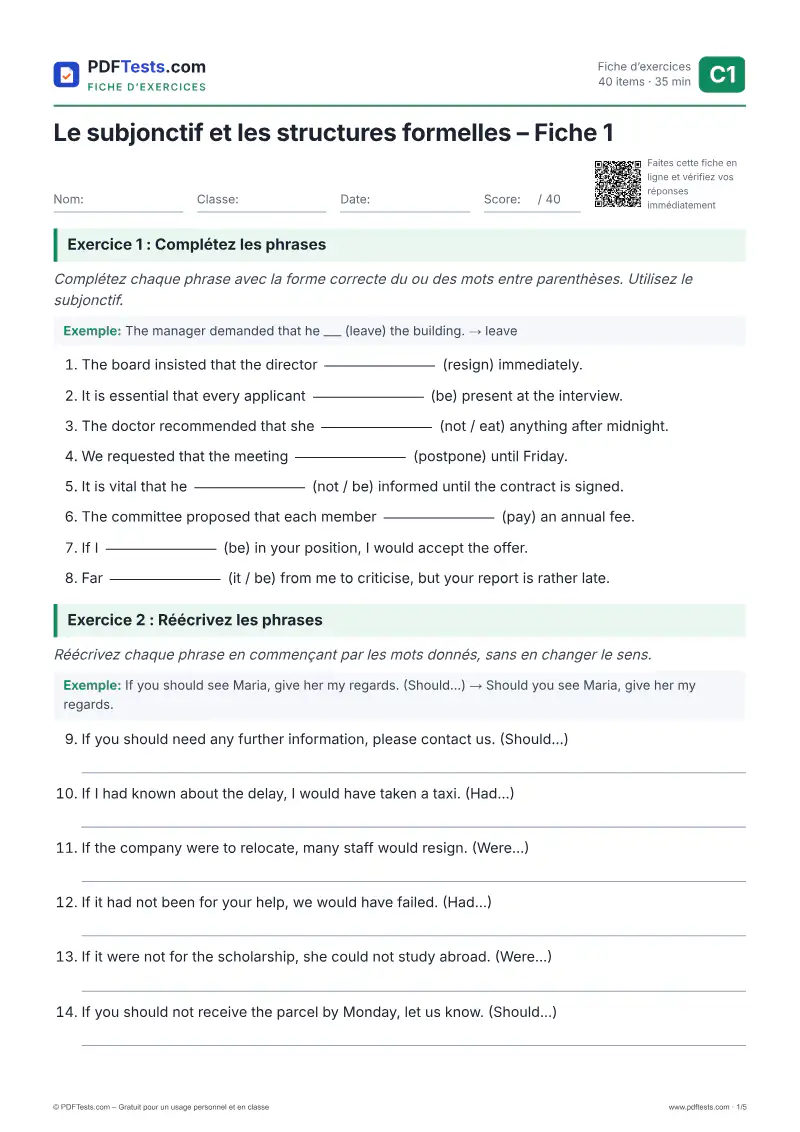
Le subjonctif et les structures formelles – Fiche 1

C1 Avancé FicheAnglais

Cette fiche permet de s'entraîner au subjonctif anglais et aux structures formelles qui s'y rattachent. Elle aborde le subjonctif mandatif (insist that he be), les formes négatives comme « that she not be », le subjonctif en were, les conditionnelles avec inversion (Should you…, Had I…, Were it not for…) ainsi que des expressions figées comme « lest », « come what may » et « so be it ». Elle s'adresse aux apprenants de niveau C1 qui préparent des examens avancés ou évoluent dans un cadre universitaire ou professionnel.
items
40
Durée
35 min
PDF
5 pages
Corrigé
Inclus
  • 100 % gratuit
  • Sans inscription
  • PDF A4 prêt à imprimer
Aperçu de la page 1 : Le subjonctif et les structures formelles – Fiche 1 Ouvrir le PDF

Faire la fiche en ligne

Tapez vos réponses puis cliquez sur « Vérifier mes réponses ». Les autres réponses correctes sont acceptées.

Exercice 1 : Complétez les phrases

Complétez chaque phrase avec la forme correcte du ou des mots entre parenthèses. Utilisez le subjonctif.

Exemple: The manager demanded that he ___ (leave) the building. → leave

  1. The board insisted that the director (resign) immediately.

  2. It is essential that every applicant (be) present at the interview.

  3. The doctor recommended that she (not / eat) anything after midnight.

  4. We requested that the meeting (postpone) until Friday.

  5. It is vital that he (not / be) informed until the contract is signed.

  6. The committee proposed that each member (pay) an annual fee.

  7. If I (be) in your position, I would accept the offer.

  8. Far (it / be) from me to criticise, but your report is rather late.

Exercice 2 : Réécrivez les phrases

Réécrivez chaque phrase en commençant par les mots donnés, sans en changer le sens.

Exemple: If you should see Maria, give her my regards. (Should…) → Should you see Maria, give her my regards.

  1. If you should need any further information, please contact us. (Should…)

  2. If I had known about the delay, I would have taken a taxi. (Had…)

  3. If the company were to relocate, many staff would resign. (Were…)

  4. If it had not been for your help, we would have failed. (Had…)

  5. If it were not for the scholarship, she could not study abroad. (Were…)

  6. If you should not receive the parcel by Monday, let us know. (Should…)

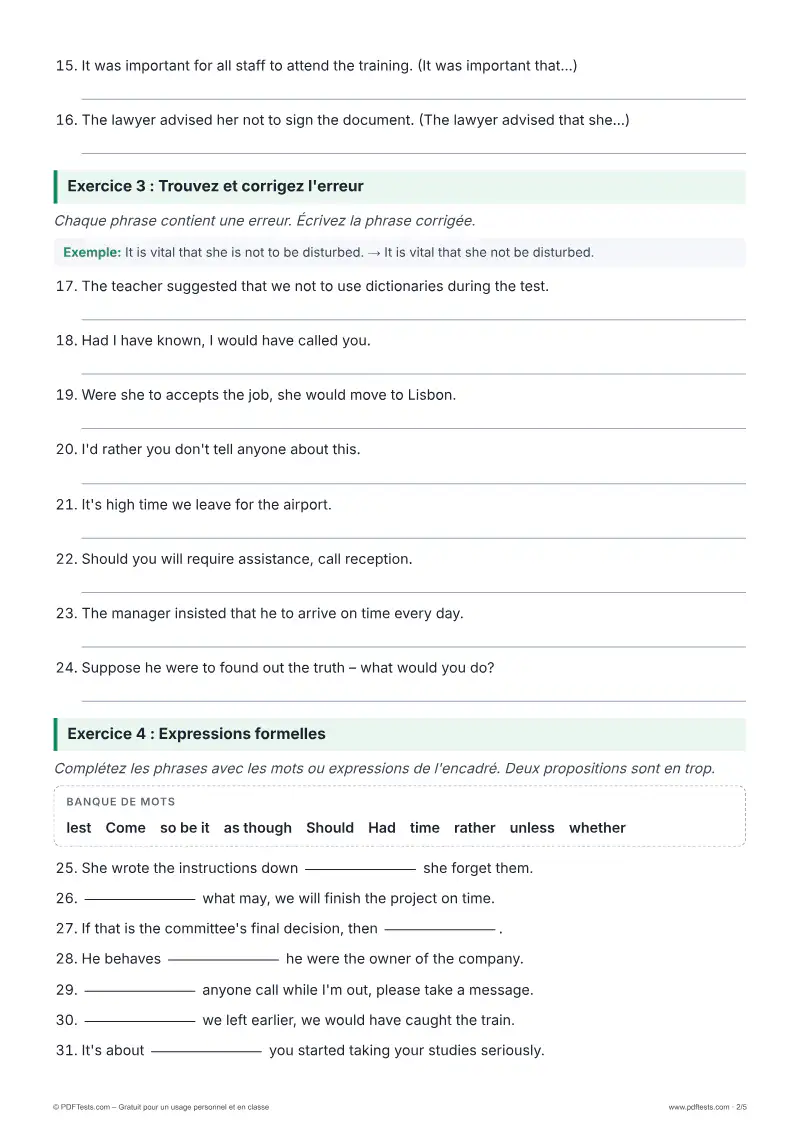
  7. It was important for all staff to attend the training. (It was important that…)

  8. The lawyer advised her not to sign the document. (The lawyer advised that she…)

Exercice 3 : Trouvez et corrigez l'erreur

Chaque phrase contient une erreur. Écrivez la phrase corrigée.

Exemple: It is vital that she is not to be disturbed. → It is vital that she not be disturbed.

  1. The teacher suggested that we not to use dictionaries during the test.

  2. Had I have known, I would have called you.

  3. Were she to accepts the job, she would move to Lisbon.

  4. I'd rather you don't tell anyone about this.

  5. It's high time we leave for the airport.

  6. Should you will require assistance, call reception.

  7. The manager insisted that he to arrive on time every day.

  8. Suppose he were to found out the truth – what would you do?

Exercice 4 : Expressions formelles

Complétez les phrases avec les mots ou expressions de l'encadré. Deux propositions sont en trop.

Banque de mots lestComeso be itas thoughShouldHadtimeratherunlesswhether

  1. She wrote the instructions down she forget them.

  2. what may, we will finish the project on time.

  3. If that is the committee's final decision, then .

  4. He behaves he were the owner of the company.

  5. anyone call while I'm out, please take a message.

  6. we left earlier, we would have caught the train.

  7. It's about you started taking your studies seriously.

  8. I would you didn't mention this to anyone.

Exercice 5 : Remettez les mots dans l'ordre

Remettez les mots dans le bon ordre pour former des phrases ou des questions.

Exemple: that / we / recommend / he / be / promoted → We recommend that he be promoted.

  1. that / it / essential / is / everyone / on time / be

  2. not / we / suggest / that / she / be / told

  3. Were / the / train / to / be / delayed / we / would / miss / the / connection

  4. Had / told / you / me / I / would / have / helped

  5. rather / I'd / you / here / didn't / smoke

  6. high / it's / time / went / we / home

  7. Is / it / necessary / that / he / be / present / ?

  8. Would / you / rather / I / didn't / come / ?

Cette page vous a-t-elle été utile ?

Signaler une erreur

Une mauvaise réponse, une faute de frappe ou une explication peu claire ? Dites-le-nous, nous corrigerons.

Aperçu

À propos de ce test

Fiche d'anglais C1 en PDF sur le subjonctif et les structures formelles : subjonctif mandatif, inversion, would rather, it's time, lest. Avec corrigé.

Thèmes abordés

Subjonctif mandatifSubjonctif en wereConditionnelles avec inversionWould rather / It's timeExpressions figées au subjonctif

Notes pour l’enseignant

Commencez par faire trouver aux élèves les verbes et adjectifs qui déclenchent le subjonctif (insist, recommend, essential, vital), puis faites remarquer que le verbe reste à la base verbale à toutes les personnes. Les erreurs fréquentes : ajouter un -s à la troisième personne, employer « to » après « not » (« that she not to go ») ou conserver « if » dans les conditionnelles avec inversion (« If had I known »). Rappelez que « should + infinitif » est une alternative courante au subjonctif en anglais britannique. En prolongement, demandez aux apprenants de rédiger un court e-mail formel ou un compte rendu de réunion utilisant au moins cinq de ces structures.

Tous les tests Anglais C1 →