PDFTests Originals

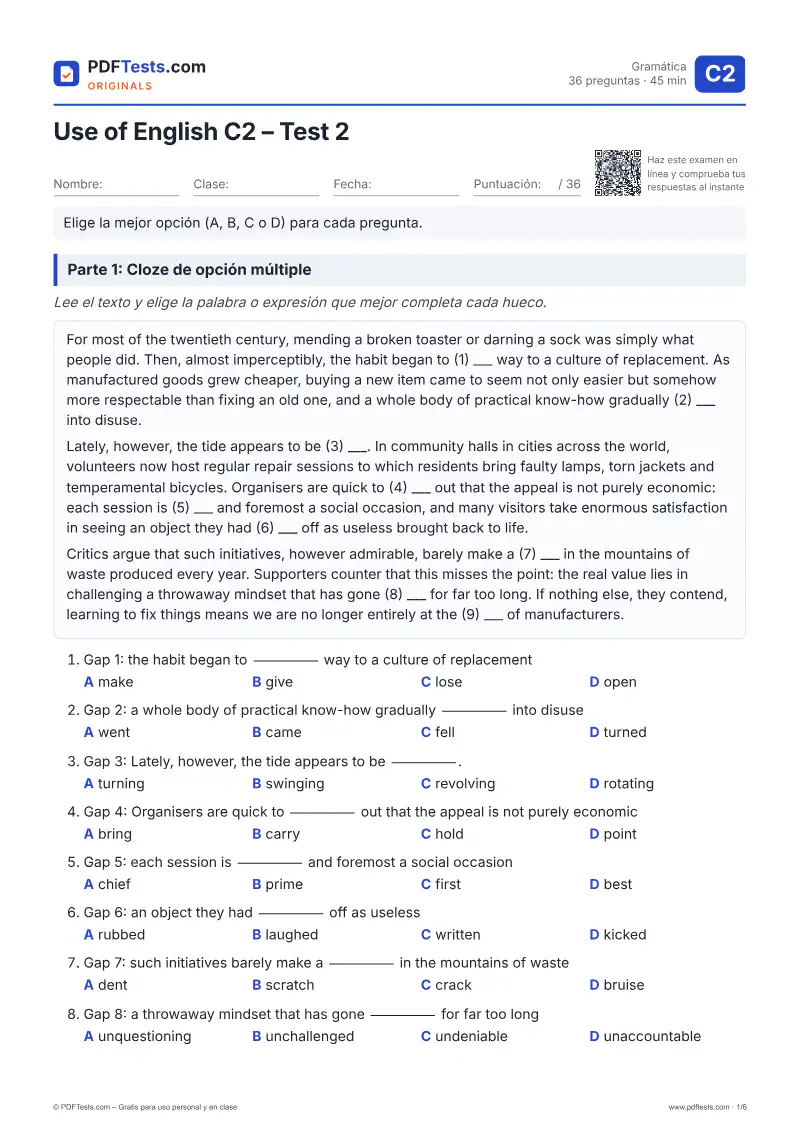
Use of English C2 – Test 2

C2 Maestría GramáticaInglés

Este test de Use of English de nivel C2 pone a prueba a los alumnos avanzados con 36 preguntas de opción múltiple al estilo de examen, repartidas en cuatro partes: un cloze léxico, un cloze gramatical, formación de palabras y transformaciones con palabra clave (key word transformations). Es ideal para quienes preparan exámenes de nivel Proficiency y para profesores que necesitan una prueba de práctica fiable e imprimible.
Preguntas
36
Tiempo
45 min
PDF
6 páginas
Soluciones
Incluidas
  • 100 % gratis
  • Sin registro
  • PDF A4 listo para imprimir
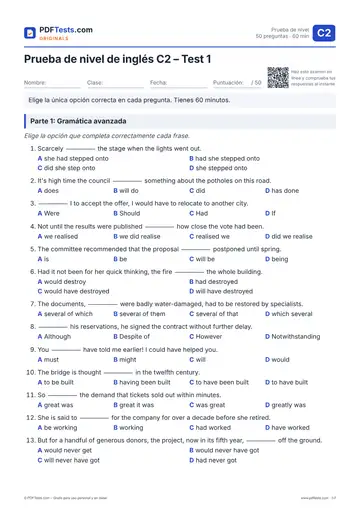
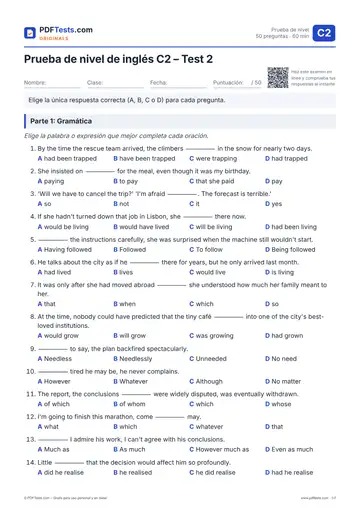
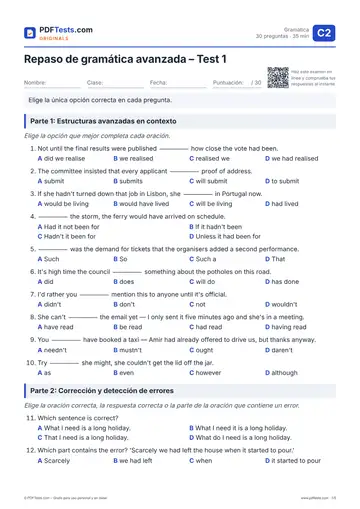
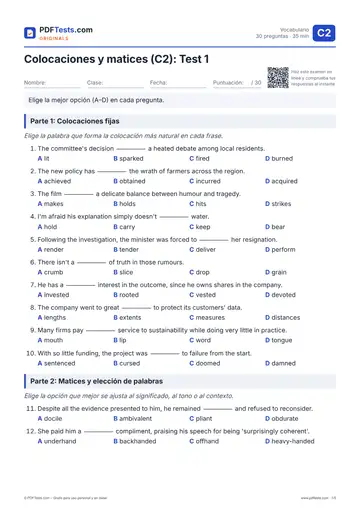
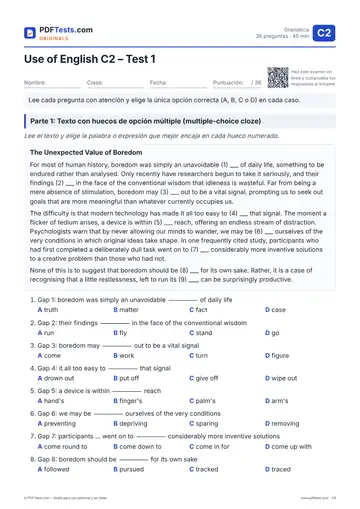
Vista previa de la página 1: Use of English C2 – Test 2 Abrir PDF
Use of English B1–C2 · todos los exámenes con formato de examen, tipos de tarea y consejos

Haz el examen en línea

Elige la mejor opción (A, B, C o D) para cada pregunta. Elige tus respuestas y pulsa «Comprobar respuestas».

Parte 1: Cloze de opción múltiple

Lee el texto y elige la palabra o expresión que mejor completa cada hueco.

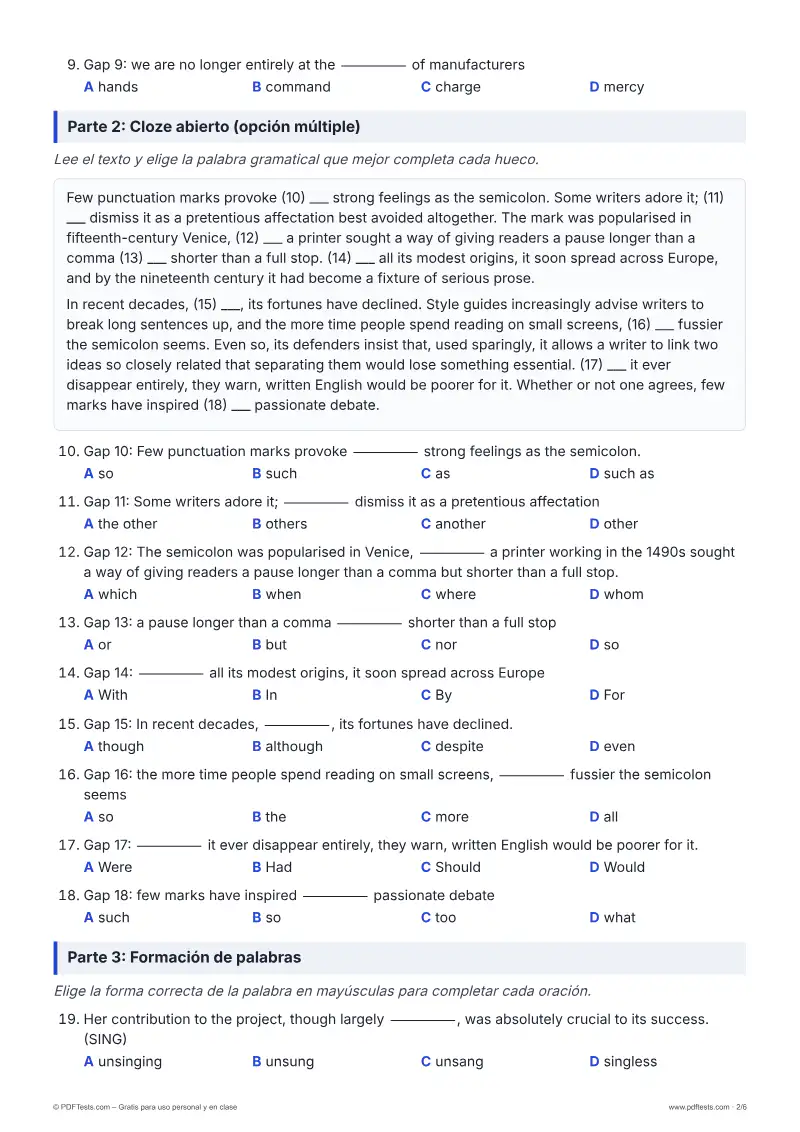
For most of the twentieth century, mending a broken toaster or darning a sock was simply what people did. Then, almost imperceptibly, the habit began to (1) ___ way to a culture of replacement. As manufactured goods grew cheaper, buying a new item came to seem not only easier but somehow more respectable than fixing an old one, and a whole body of practical know-how gradually (2) ___ into disuse.

Lately, however, the tide appears to be (3) ___. In community halls in cities across the world, volunteers now host regular repair sessions to which residents bring faulty lamps, torn jackets and temperamental bicycles. Organisers are quick to (4) ___ out that the appeal is not purely economic: each session is (5) ___ and foremost a social occasion, and many visitors take enormous satisfaction in seeing an object they had (6) ___ off as useless brought back to life.

Critics argue that such initiatives, however admirable, barely make a (7) ___ in the mountains of waste produced every year. Supporters counter that this misses the point: the real value lies in challenging a throwaway mindset that has gone (8) ___ for far too long. If nothing else, they contend, learning to fix things means we are no longer entirely at the (9) ___ of manufacturers.

  1. Gap 1: the habit began to _____ way to a culture of replacement

  2. Gap 2: a whole body of practical know-how gradually _____ into disuse

  3. Gap 3: Lately, however, the tide appears to be _____.

  4. Gap 4: Organisers are quick to _____ out that the appeal is not purely economic

  5. Gap 5: each session is _____ and foremost a social occasion

  6. Gap 6: an object they had _____ off as useless

  7. Gap 7: such initiatives barely make a _____ in the mountains of waste

  8. Gap 8: a throwaway mindset that has gone _____ for far too long

  9. Gap 9: we are no longer entirely at the _____ of manufacturers

Parte 2: Cloze abierto (opción múltiple)

Lee el texto y elige la palabra gramatical que mejor completa cada hueco.

Few punctuation marks provoke (10) ___ strong feelings as the semicolon. Some writers adore it; (11) ___ dismiss it as a pretentious affectation best avoided altogether. The mark was popularised in fifteenth-century Venice, (12) ___ a printer sought a way of giving readers a pause longer than a comma (13) ___ shorter than a full stop. (14) ___ all its modest origins, it soon spread across Europe, and by the nineteenth century it had become a fixture of serious prose.

In recent decades, (15) ___, its fortunes have declined. Style guides increasingly advise writers to break long sentences up, and the more time people spend reading on small screens, (16) ___ fussier the semicolon seems. Even so, its defenders insist that, used sparingly, it allows a writer to link two ideas so closely related that separating them would lose something essential. (17) ___ it ever disappear entirely, they warn, written English would be poorer for it. Whether or not one agrees, few marks have inspired (18) ___ passionate debate.

  1. Gap 10: Few punctuation marks provoke _____ strong feelings as the semicolon.

  2. Gap 11: Some writers adore it; _____ dismiss it as a pretentious affectation

  3. Gap 12: The semicolon was popularised in Venice, _____ a printer working in the 1490s sought a way of giving readers a pause longer than a comma but shorter than a full stop.

  4. Gap 13: a pause longer than a comma _____ shorter than a full stop

  5. Gap 14: _____ all its modest origins, it soon spread across Europe

  6. Gap 15: In recent decades, _____, its fortunes have declined.

  7. Gap 16: the more time people spend reading on small screens, _____ fussier the semicolon seems

  8. Gap 17: _____ it ever disappear entirely, they warn, written English would be poorer for it.

  9. Gap 18: few marks have inspired _____ passionate debate

Parte 3: Formación de palabras

Elige la forma correcta de la palabra en mayúsculas para completar cada oración.

  1. Her contribution to the project, though largely _____, was absolutely crucial to its success. (SING)

  2. The two parties remain _____ opposed on the question of funding. (DIAMETER)

  3. Rents in the city centre have become _____ high for most young people. (PROHIBIT)

  4. After weeks of fruitless discussion, the negotiations reached an _____ and talks were suspended. (PASS)

  5. The novelist has an _____ ability to capture the rhythms of everyday speech. (CANNY)

  6. The difference between the two versions is barely _____ to the untrained eye. (DISCERN)

  7. She argued her case with such _____ that even her fiercest critics were won over. (CONVINCE)

  8. The scheme was _____ from the outset, so nobody was surprised when it collapsed. (CONCEIVE)

  9. Once signed, the agreement is _____ and cannot be withdrawn under any circumstances. (REVOKE)

Parte 4: Transformaciones con palabra clave

Elige la oración que tiene el mismo significado que la primera, usa correctamente la palabra clave en mayúsculas y es gramaticalmente correcta.

  1. She had no idea that the police were watching her. (LITTLE)

  2. People say that the company is on the verge of bankruptcy. (REPUTED)

  3. Her performance was nowhere near as good as we had expected. (FELL)

  4. Everyone was surprised when he resigned. (CAME)

  5. I don't mind at all whether we eat in or go out. (DIFFERENCE)

  6. He has never really accepted that his career is over. (TERMS)

  7. There is absolutely no possibility of the project being finished by Friday. (QUESTION)

  8. The match was called off because the pitch was waterlogged. (ACCOUNT)

  9. I'm sure she didn't intend to upset anyone. (MEANT)

¿Te ha resultado útil esta página?

Informar de un error

¿Has visto una respuesta incorrecta, una errata o una explicación poco clara? Avísanos y lo corregiremos.

Practica con una ficha: Use of English C2 – Ficha 1

Vista previa

Sobre este examen

Este test de Use of English de nivel C2 pone a prueba a los alumnos avanzados con 36 preguntas de opción múltiple al estilo de examen, repartidas en cuatro partes: un cloze léxico, un cloze gramatical, formación de palabras y transformaciones con palabra clave (key word transformations). Es ideal para quienes preparan exámenes de nivel Proficiency y para profesores que necesitan una prueba de práctica fiable e imprimible.

Temas

Colocaciones y expresiones fijasPhrasal verbsPalabras gramaticales en contextoInversión y oraciones condicionalesFormación de palabrasTransformaciones con palabra clave

Cómo usar este examen

  1. Descarga el PDF e imprímelo, o haz el examen en línea más abajo.
  2. Responde todas las preguntas sin diccionario y sin prisas.
  3. Comprueba tus respuestas y apunta los temas que debes repasar.

Notas para el profesor

Puede usar el test como simulacro de examen cronometrado o trabajarlo parte por parte en clase. Las partes 1 y 3 se centran en colocaciones casi correctas y en errores de prefijos y sufijos, como unrevokable o prohibitive en lugar de prohibitively. Las partes 2 y 4 trabajan la inversión, las estructuras comparativas y las expresiones fijas en las que los alumnos suelen omitir un artículo o una preposición. Como actividad de seguimiento, pida a los alumnos que escriban sus propias transformaciones con las palabras clave de la parte 4.