PDFTests Originals

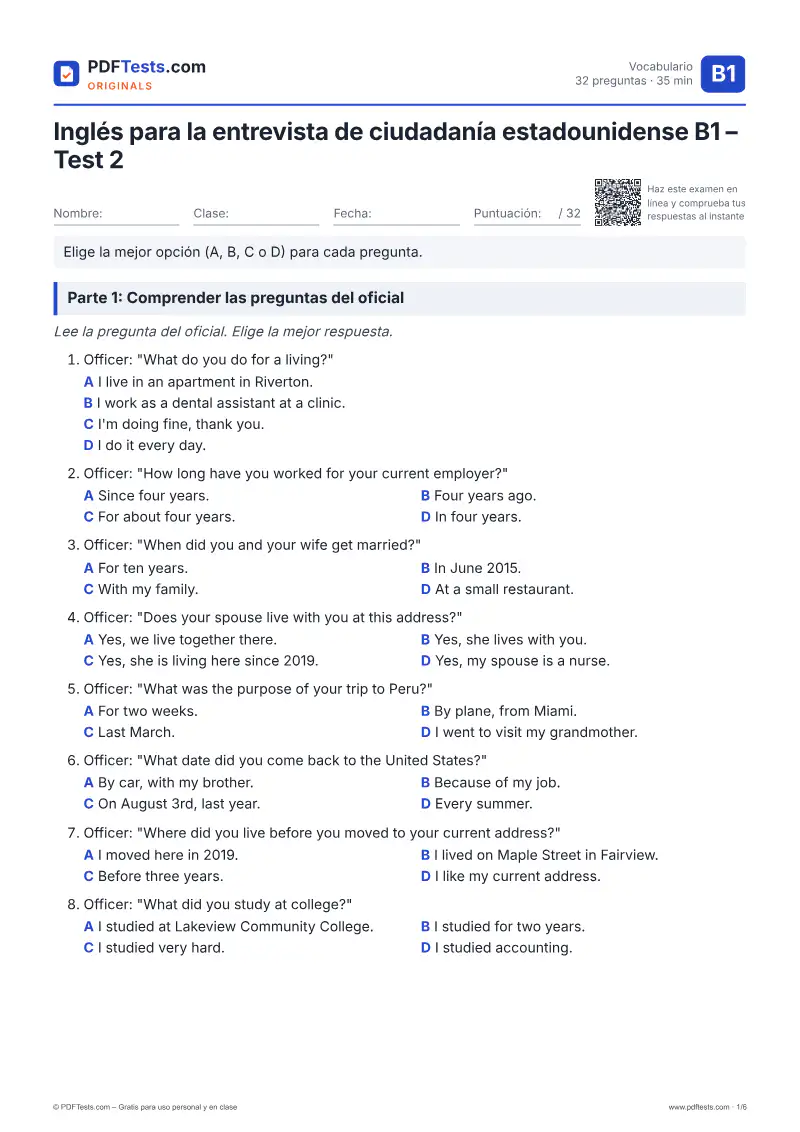
Inglés para la entrevista de ciudadanía estadounidense B1 – Test 2

B1 Intermedio VocabularioInglés

Este test de vocabulario de inglés de nivel B1 ayuda a preparar el lenguaje de la entrevista de naturalización en Estados Unidos. Trabaja la comprensión de las preguntas del oficial, el vocabulario clave del proceso de naturalización, formas educadas de pedir aclaraciones y una breve lectura sobre el día de la entrevista. Es ideal para adultos, clases de preparación para la ciudadanía y el estudio autónomo.
Preguntas
32
Tiempo
35 min
PDF
6 páginas
Soluciones
Incluidas
  • 100 % gratis
  • Sin registro
  • PDF A4 listo para imprimir
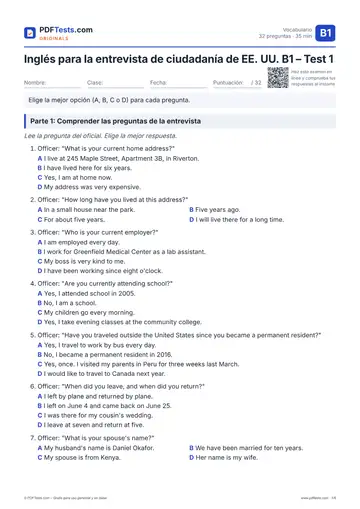
Vista previa de la página 1: Inglés para la entrevista de ciudadanía estadounidense B1 – Test 2 Abrir PDF
Examen de inglés de ciudadanía · todos los exámenes de práctica, niveles y consejos

Haz el examen en línea

Elige la mejor opción (A, B, C o D) para cada pregunta. Elige tus respuestas y pulsa «Comprobar respuestas».

Parte 1: Comprender las preguntas del oficial

Lee la pregunta del oficial. Elige la mejor respuesta.

  1. Officer: "What do you do for a living?"

  2. Officer: "How long have you worked for your current employer?"

  3. Officer: "When did you and your wife get married?"

  4. Officer: "Does your spouse live with you at this address?"

  5. Officer: "What was the purpose of your trip to Peru?"

  6. Officer: "What date did you come back to the United States?"

  7. Officer: "Where did you live before you moved to your current address?"

  8. Officer: "What did you study at college?"

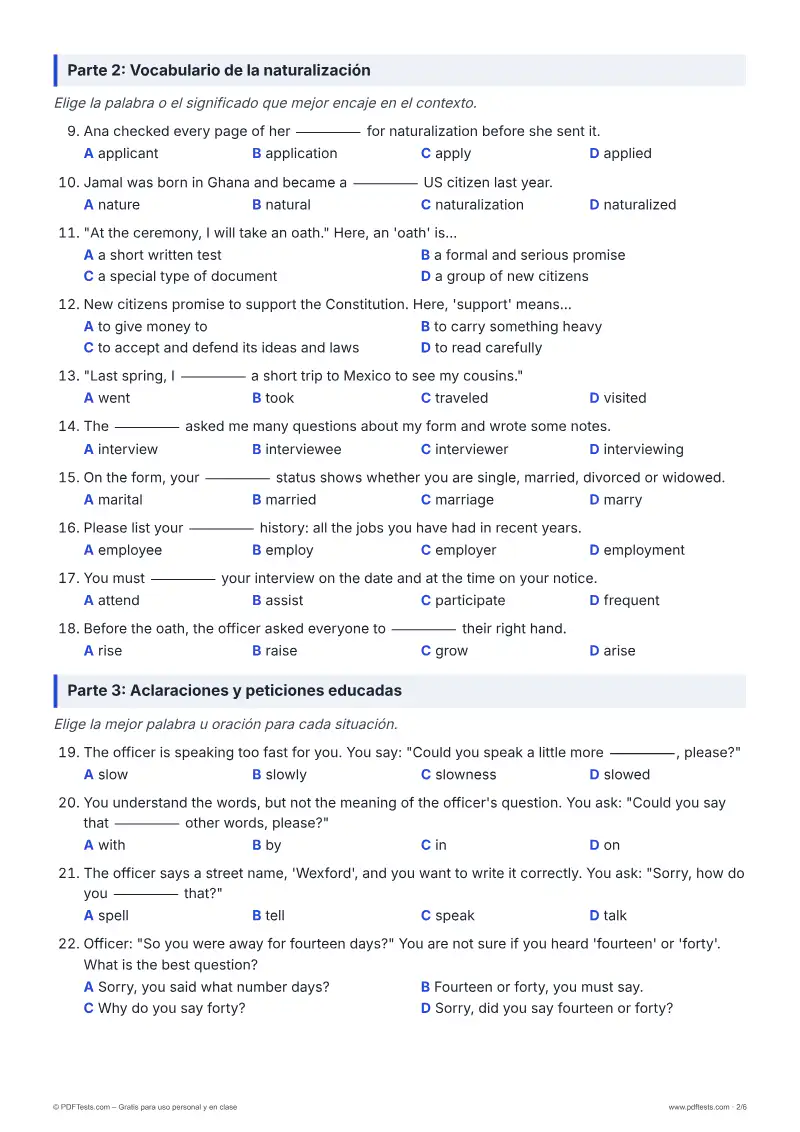
Parte 2: Vocabulario de la naturalización

Elige la palabra o el significado que mejor encaje en el contexto.

  1. Ana checked every page of her _____ for naturalization before she sent it.

  2. Jamal was born in Ghana and became a _____ US citizen last year.

  3. "At the ceremony, I will take an oath." Here, an 'oath' is…

  4. New citizens promise to support the Constitution. Here, 'support' means…

  5. "Last spring, I _____ a short trip to Mexico to see my cousins."

  6. The _____ asked me many questions about my form and wrote some notes.

  7. On the form, your _____ status shows whether you are single, married, divorced or widowed.

  8. Please list your _____ history: all the jobs you have had in recent years.

  9. You must _____ your interview on the date and at the time on your notice.

  10. Before the oath, the officer asked everyone to _____ their right hand.

Parte 3: Aclaraciones y peticiones educadas

Elige la mejor palabra u oración para cada situación.

  1. The officer is speaking too fast for you. You say: "Could you speak a little more _____, please?"

  2. You understand the words, but not the meaning of the officer's question. You ask: "Could you say that _____ other words, please?"

  3. The officer says a street name, 'Wexford', and you want to write it correctly. You ask: "Sorry, how do you _____ that?"

  4. Officer: "So you were away for fourteen days?" You are not sure if you heard 'fourteen' or 'forty'. What is the best question?

  5. Earlier in the interview, you gave the wrong apartment number. What do you say?

  6. You understand the question, but you are not sure what kind of information the officer wants. What do you say?

  7. "Would you mind _____ the last question, please?"

  8. You need a moment to remember the exact date of a trip. What do you say?

Parte 4: Lectura – El día de la entrevista de Amir

Lee el texto. Después elige la mejor respuesta a cada pregunta.

A week before his interview, Amir Haddad read his appointment notice again very carefully. It showed the date, the time and the address of the office, and it said which documents he needed to bring. He made a checklist and put a tick next to each item: the notice itself, his green card, his passport and a copy of his application.

Amir lives about forty minutes from the office, but he decided to leave home an hour and a half before his appointment. He knew that traffic in the morning can be heavy, and he also wanted time to find parking and go through security at the entrance. He arrived thirty minutes early and waited quietly with a book.

When his name was called, an officer took him to a small office. She asked him to raise his right hand and promise to tell the truth. Then she went through his application with him, one section at a time. She asked about his job at a furniture store, his address and a trip he had taken to visit his sister.

At one point, the officer used the word 'absences', and Amir did not understand. He felt a little nervous, but he politely asked her to explain. She smiled and said, "It means the times you were away from the United States." After that, Amir felt much calmer. He realized that the interview was a conversation, not a race to see how fast he could speak. Later he told a friend, "Just listen carefully, and don't be afraid to ask."

  1. Why did Amir read his appointment notice again a week before the interview?

  2. Which item was NOT on Amir's checklist?

  3. Why did Amir leave home an hour and a half before his appointment?

  4. What did the officer ask Amir about?

  5. In paragraph 4, 'absences' are…

  6. What advice does Amir give his friend?

¿Te ha resultado útil esta página?

Informar de un error

¿Has visto una respuesta incorrecta, una errata o una explicación poco clara? Avísanos y lo corregiremos.

Practica con una ficha: Inglés para la entrevista de ciudadanía estadounidense B1 – Ficha 1

Vista previa

Sobre este examen

Este test de vocabulario de inglés de nivel B1 ayuda a preparar el lenguaje de la entrevista de naturalización en Estados Unidos. Trabaja la comprensión de las preguntas del oficial, el vocabulario clave del proceso de naturalización, formas educadas de pedir aclaraciones y una breve lectura sobre el día de la entrevista. Es ideal para adultos, clases de preparación para la ciudadanía y el estudio autónomo.

Temas

Comprender las preguntas de la entrevistaVocabulario de la naturalizaciónFamilias de palabrasColocaciones (collocations)Pedir aclaraciones y hacer peticiones educadasComprensión lectora

Cómo usar este examen

  1. Descarga el PDF e imprímelo, o haz el examen en línea más abajo.
  2. Responde todas las preguntas sin diccionario y sin prisas.
  3. Comprueba tus respuestas y apunta los temas que debes repasar.

Notas para el profesor

Utilice este test cuando el alumnado ya haya practicado oralmente las preguntas típicas de la entrevista; después, los estudiantes pueden representar en parejas los ítems de la Parte 1 y la Parte 3. El test trabaja errores frecuentes como "since" frente a "for", la confusión entre pronombres interrogativos (when/where/what), las mezclas dentro de una misma familia de palabras (applicant/application, employer/employment) y falsos amigos como "assist" en lugar de "attend" (especialmente habitual entre hispanohablantes, por el parecido con "asistir"). Este test practica únicamente el idioma y no ofrece asesoramiento legal. Como actividad de seguimiento, pida al alumnado que redacte sus propias respuestas a las preguntas de la Parte 1 con datos reales o inventados.