PDFTests Originals

Anglais pour l'entretien de citoyenneté américaine B1 – Test 2

B1 Intermédiaire VocabulaireAnglais

Ce test de vocabulaire anglais de niveau B1 aide les apprenants à se préparer à la langue de l'entretien de naturalisation aux États-Unis. Il porte sur la compréhension des questions de l'agent, le vocabulaire clé de la procédure de naturalisation, les façons polies de demander des précisions et un court texte sur le jour de l'entretien. Il convient aux apprenants adultes, aux cours de préparation à la citoyenneté et au travail en autonomie.
Questions
32
Durée
35 min
PDF
6 pages
Corrigé
Inclus
  • 100 % gratuit
  • Sans inscription
  • PDF A4 prêt à imprimer
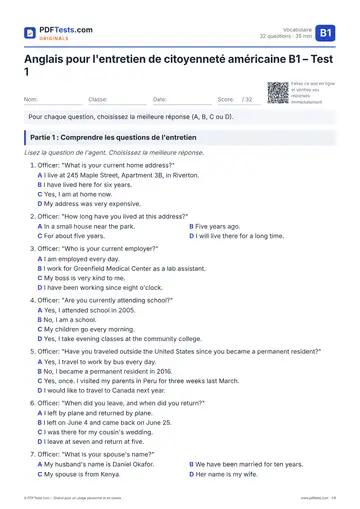
Aperçu de la page 1 : Anglais pour l'entretien de citoyenneté américaine B1 – Test 2 Ouvrir le PDF
Test d’anglais de citoyenneté (É.-U.) · tous les tests d’entraînement, niveaux et conseils

Faire le test en ligne

Pour chaque question, choisissez la meilleure réponse (A, B, C ou D). Choisissez vos réponses, puis cliquez sur « Vérifier mes réponses ».

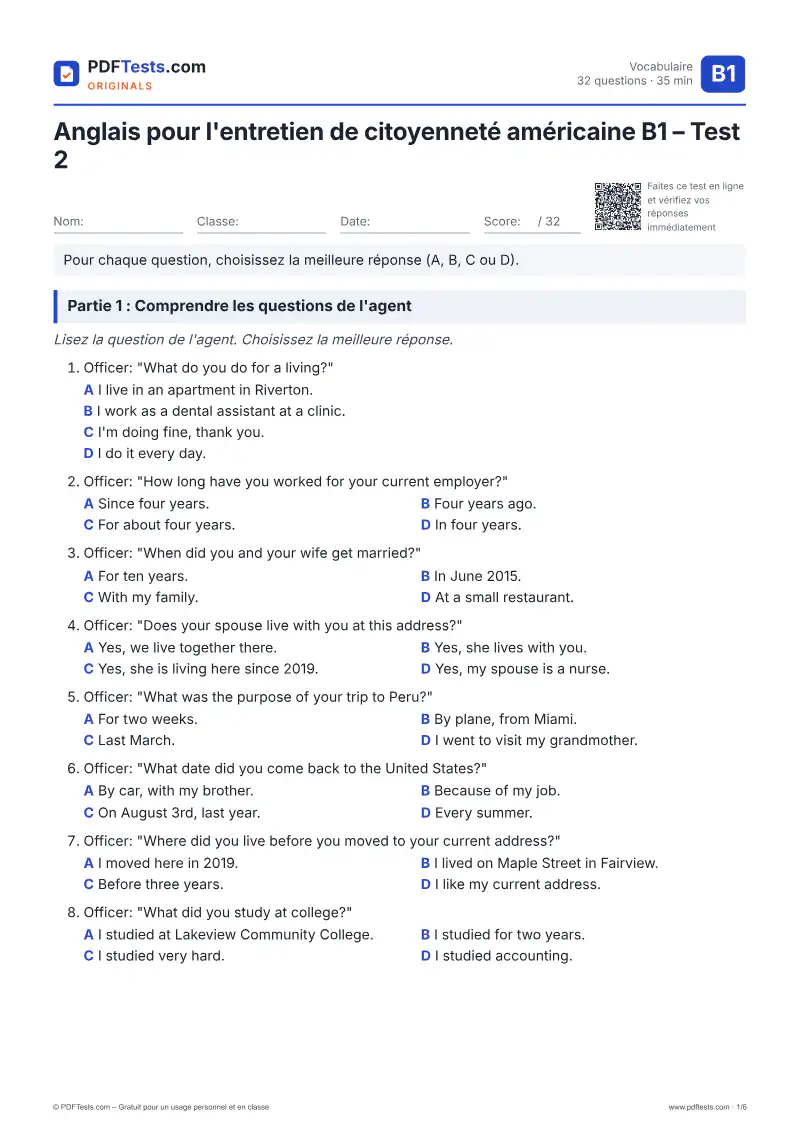
Partie 1 : Comprendre les questions de l'agent

Lisez la question de l'agent. Choisissez la meilleure réponse.

  1. Officer: "What do you do for a living?"

  2. Officer: "How long have you worked for your current employer?"

  3. Officer: "When did you and your wife get married?"

  4. Officer: "Does your spouse live with you at this address?"

  5. Officer: "What was the purpose of your trip to Peru?"

  6. Officer: "What date did you come back to the United States?"

  7. Officer: "Where did you live before you moved to your current address?"

  8. Officer: "What did you study at college?"

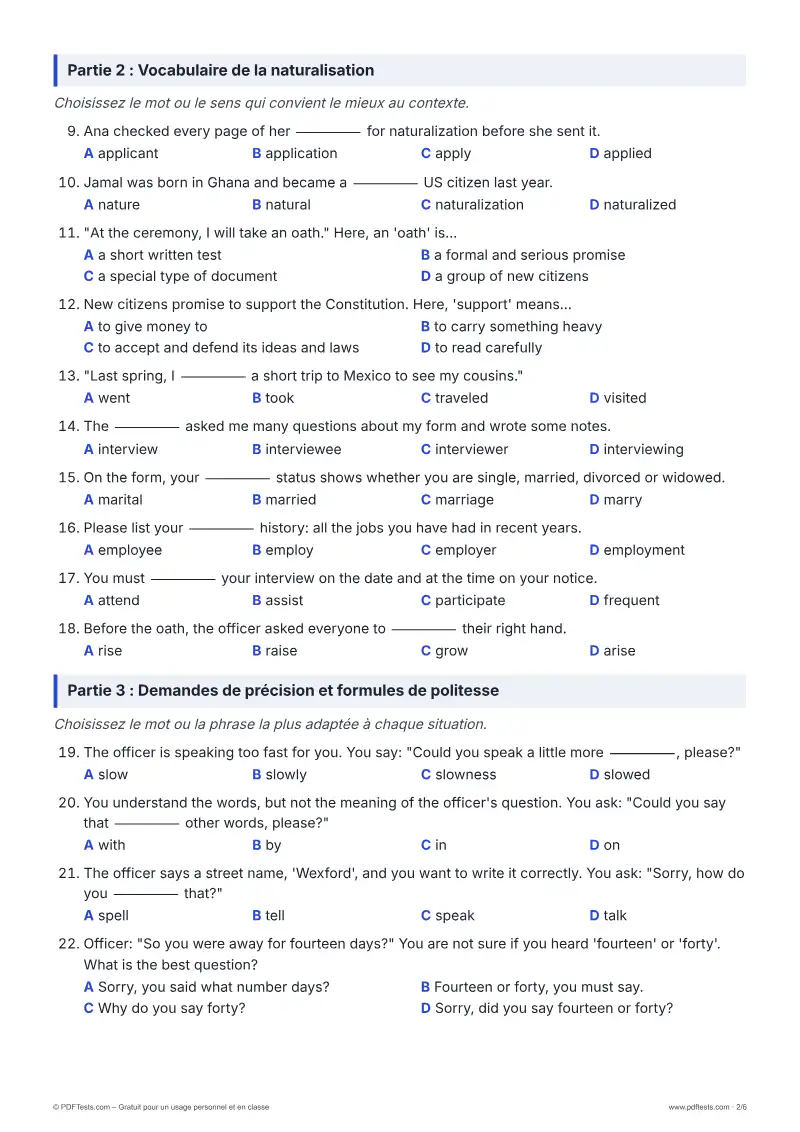
Partie 2 : Vocabulaire de la naturalisation

Choisissez le mot ou le sens qui convient le mieux au contexte.

  1. Ana checked every page of her _____ for naturalization before she sent it.

  2. Jamal was born in Ghana and became a _____ US citizen last year.

  3. "At the ceremony, I will take an oath." Here, an 'oath' is…

  4. New citizens promise to support the Constitution. Here, 'support' means…

  5. "Last spring, I _____ a short trip to Mexico to see my cousins."

  6. The _____ asked me many questions about my form and wrote some notes.

  7. On the form, your _____ status shows whether you are single, married, divorced or widowed.

  8. Please list your _____ history: all the jobs you have had in recent years.

  9. You must _____ your interview on the date and at the time on your notice.

  10. Before the oath, the officer asked everyone to _____ their right hand.

Partie 3 : Demandes de précision et formules de politesse

Choisissez le mot ou la phrase la plus adaptée à chaque situation.

  1. The officer is speaking too fast for you. You say: "Could you speak a little more _____, please?"

  2. You understand the words, but not the meaning of the officer's question. You ask: "Could you say that _____ other words, please?"

  3. The officer says a street name, 'Wexford', and you want to write it correctly. You ask: "Sorry, how do you _____ that?"

  4. Officer: "So you were away for fourteen days?" You are not sure if you heard 'fourteen' or 'forty'. What is the best question?

  5. Earlier in the interview, you gave the wrong apartment number. What do you say?

  6. You understand the question, but you are not sure what kind of information the officer wants. What do you say?

  7. "Would you mind _____ the last question, please?"

  8. You need a moment to remember the exact date of a trip. What do you say?

Partie 4 : Compréhension écrite – Le jour de l'entretien d'Amir

Lisez le texte. Puis choisissez la meilleure réponse à chaque question.

A week before his interview, Amir Haddad read his appointment notice again very carefully. It showed the date, the time and the address of the office, and it said which documents he needed to bring. He made a checklist and put a tick next to each item: the notice itself, his green card, his passport and a copy of his application.

Amir lives about forty minutes from the office, but he decided to leave home an hour and a half before his appointment. He knew that traffic in the morning can be heavy, and he also wanted time to find parking and go through security at the entrance. He arrived thirty minutes early and waited quietly with a book.

When his name was called, an officer took him to a small office. She asked him to raise his right hand and promise to tell the truth. Then she went through his application with him, one section at a time. She asked about his job at a furniture store, his address and a trip he had taken to visit his sister.

At one point, the officer used the word 'absences', and Amir did not understand. He felt a little nervous, but he politely asked her to explain. She smiled and said, "It means the times you were away from the United States." After that, Amir felt much calmer. He realized that the interview was a conversation, not a race to see how fast he could speak. Later he told a friend, "Just listen carefully, and don't be afraid to ask."

  1. Why did Amir read his appointment notice again a week before the interview?

  2. Which item was NOT on Amir's checklist?

  3. Why did Amir leave home an hour and a half before his appointment?

  4. What did the officer ask Amir about?

  5. In paragraph 4, 'absences' are…

  6. What advice does Amir give his friend?

Cette page vous a-t-elle été utile ?

Signaler une erreur

Une mauvaise réponse, une faute de frappe ou une explication peu claire ? Dites-le-nous, nous corrigerons.

S’entraîner avec une fiche: Anglais pour l'entretien de naturalisation américaine B1 – Fiche 1

Aperçu

À propos de ce test

Ce test de vocabulaire anglais de niveau B1 aide les apprenants à se préparer à la langue de l'entretien de naturalisation aux États-Unis. Il porte sur la compréhension des questions de l'agent, le vocabulaire clé de la procédure de naturalisation, les façons polies de demander des précisions et un court texte sur le jour de l'entretien. Il convient aux apprenants adultes, aux cours de préparation à la citoyenneté et au travail en autonomie.

Thèmes abordés

Comprendre les questions de l'entretienVocabulaire de la naturalisationFamilles de motsCollocationsDemandes de précision et formules de politesseCompréhension écrite

Comment utiliser ce test

  1. Téléchargez le PDF et imprimez-le, ou faites le test en ligne ci-dessous.
  2. Répondez à toutes les questions sans dictionnaire et sans vous presser.
  3. Vérifiez vos réponses et notez les points à revoir.

Notes pour l’enseignant

Proposez ce test après avoir fait pratiquer à l'oral les questions typiques de l'entretien ; ensuite, les apprenants peuvent jouer en binômes les situations des parties 1 et 3. Il cible des erreurs fréquentes comme « since » / « for », la confusion entre mots interrogatifs (when/where/what), les confusions au sein d'une même famille de mots (applicant/application, employer/employment) et les faux amis comme « assist » employé à la place de « attend » (piège typique pour les francophones, influencés par « assister à »). Ce test entraîne uniquement la langue et ne constitue en aucun cas un conseil juridique. En prolongement, demandez aux apprenants de rédiger leurs propres réponses aux questions de la partie 1, avec des informations réelles ou inventées.