PDFTests Originals

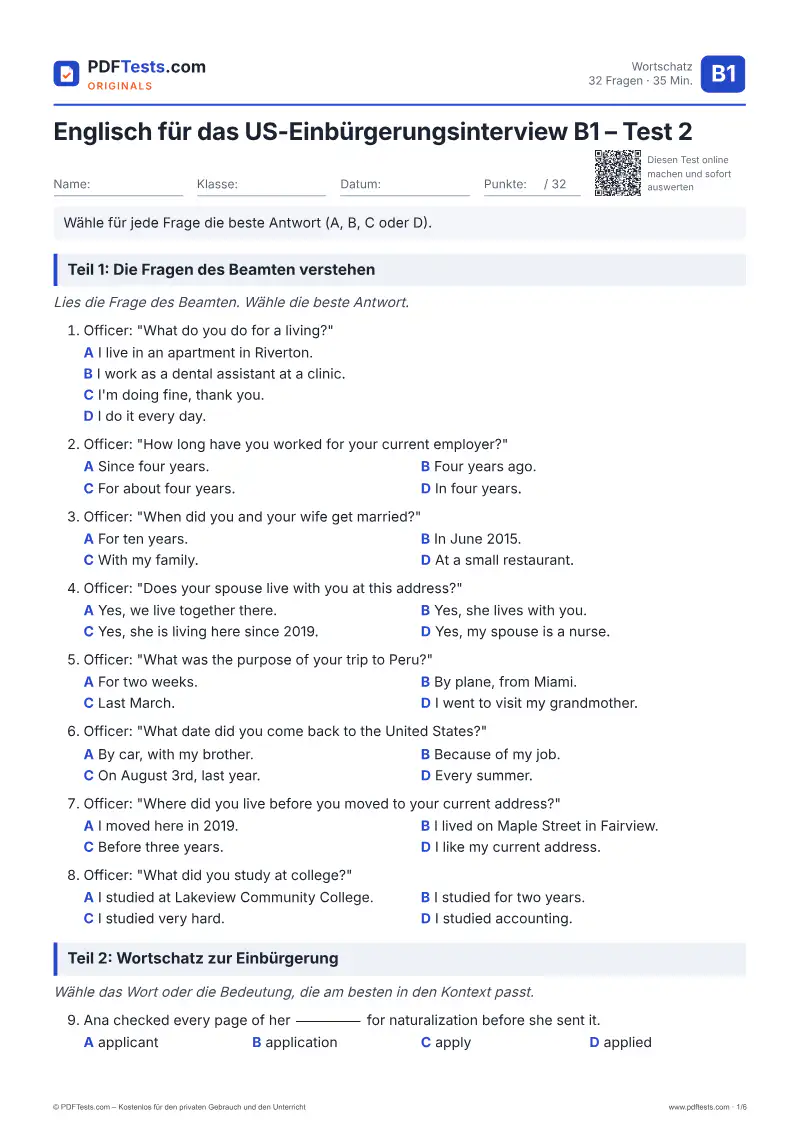
Englisch für das US-Einbürgerungsinterview B1 – Test 2

B1 Mittelstufe WortschatzEnglisch

Dieser Englisch-Wortschatztest auf Niveau B1 bereitet Lernende auf die Sprache des US-Einbürgerungsinterviews (naturalization interview) vor. Geübt werden das Verstehen der Fragen des Beamten, zentrale Begriffe aus dem Einbürgerungsverfahren, höfliche Formen des Nachfragens sowie ein kurzer Lesetext über den Tag des Interviews. Der Test eignet sich für erwachsene Lernende, Vorbereitungskurse zur Einbürgerung und das Selbststudium.
Fragen
32
Zeit
35 Min.
PDF
6 Seiten
Lösungen
Enthalten
  • 100 % kostenlos
  • Ohne Anmeldung
  • Druckfertiges A4-PDF
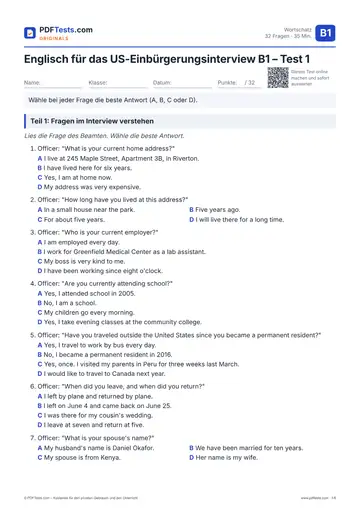
Vorschau von Seite 1: Englisch für das US-Einbürgerungsinterview B1 – Test 2 PDF öffnen
US-Einbürgerung: Englischtest · alle Übungstests, Niveaus und Tipps

Test online machen

Wähle für jede Frage die beste Antwort (A, B, C oder D). Wählen Sie Ihre Antworten und klicken Sie auf „Antworten prüfen“.

Teil 1: Die Fragen des Beamten verstehen

Lies die Frage des Beamten. Wähle die beste Antwort.

  1. Officer: "What do you do for a living?"

  2. Officer: "How long have you worked for your current employer?"

  3. Officer: "When did you and your wife get married?"

  4. Officer: "Does your spouse live with you at this address?"

  5. Officer: "What was the purpose of your trip to Peru?"

  6. Officer: "What date did you come back to the United States?"

  7. Officer: "Where did you live before you moved to your current address?"

  8. Officer: "What did you study at college?"

Teil 2: Wortschatz zur Einbürgerung

Wähle das Wort oder die Bedeutung, die am besten in den Kontext passt.

  1. Ana checked every page of her _____ for naturalization before she sent it.

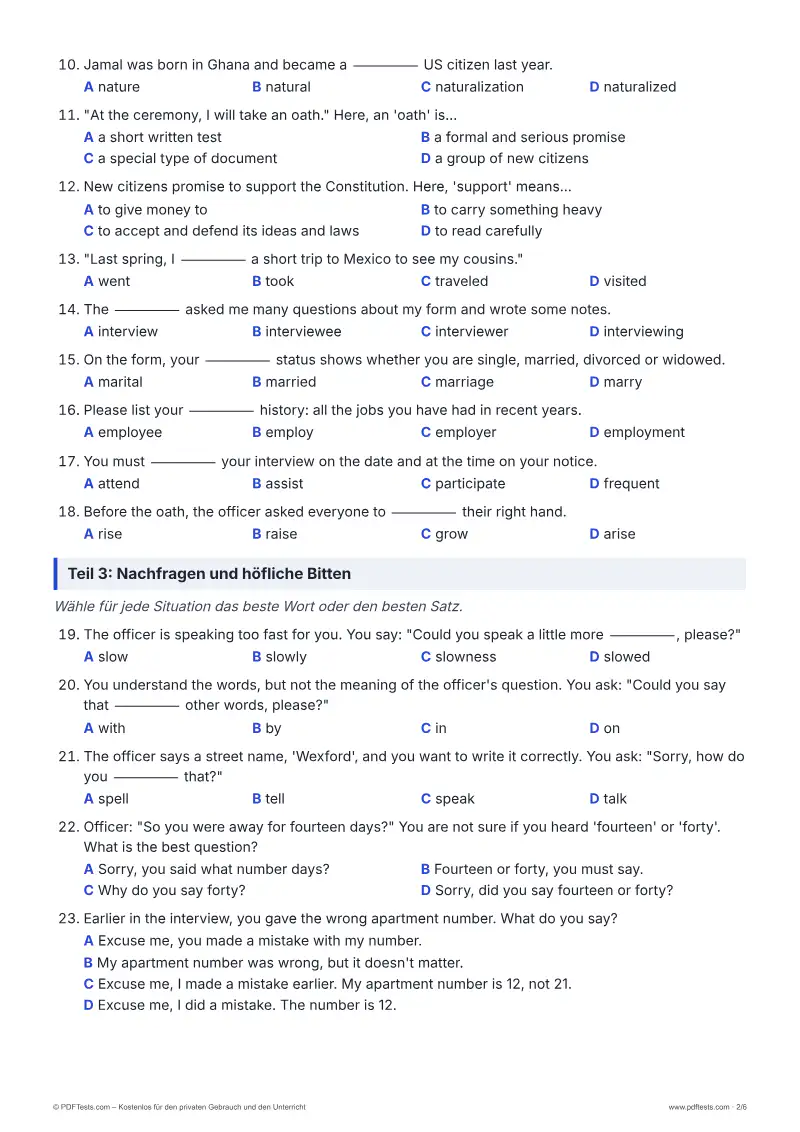
  2. Jamal was born in Ghana and became a _____ US citizen last year.

  3. "At the ceremony, I will take an oath." Here, an 'oath' is…

  4. New citizens promise to support the Constitution. Here, 'support' means…

  5. "Last spring, I _____ a short trip to Mexico to see my cousins."

  6. The _____ asked me many questions about my form and wrote some notes.

  7. On the form, your _____ status shows whether you are single, married, divorced or widowed.

  8. Please list your _____ history: all the jobs you have had in recent years.

  9. You must _____ your interview on the date and at the time on your notice.

  10. Before the oath, the officer asked everyone to _____ their right hand.

Teil 3: Nachfragen und höfliche Bitten

Wähle für jede Situation das beste Wort oder den besten Satz.

  1. The officer is speaking too fast for you. You say: "Could you speak a little more _____, please?"

  2. You understand the words, but not the meaning of the officer's question. You ask: "Could you say that _____ other words, please?"

  3. The officer says a street name, 'Wexford', and you want to write it correctly. You ask: "Sorry, how do you _____ that?"

  4. Officer: "So you were away for fourteen days?" You are not sure if you heard 'fourteen' or 'forty'. What is the best question?

  5. Earlier in the interview, you gave the wrong apartment number. What do you say?

  6. You understand the question, but you are not sure what kind of information the officer wants. What do you say?

  7. "Would you mind _____ the last question, please?"

  8. You need a moment to remember the exact date of a trip. What do you say?

Teil 4: Lesetext – Amirs Interviewtag

Lies den Text. Wähle dann für jede Frage die beste Antwort.

A week before his interview, Amir Haddad read his appointment notice again very carefully. It showed the date, the time and the address of the office, and it said which documents he needed to bring. He made a checklist and put a tick next to each item: the notice itself, his green card, his passport and a copy of his application.

Amir lives about forty minutes from the office, but he decided to leave home an hour and a half before his appointment. He knew that traffic in the morning can be heavy, and he also wanted time to find parking and go through security at the entrance. He arrived thirty minutes early and waited quietly with a book.

When his name was called, an officer took him to a small office. She asked him to raise his right hand and promise to tell the truth. Then she went through his application with him, one section at a time. She asked about his job at a furniture store, his address and a trip he had taken to visit his sister.

At one point, the officer used the word 'absences', and Amir did not understand. He felt a little nervous, but he politely asked her to explain. She smiled and said, "It means the times you were away from the United States." After that, Amir felt much calmer. He realized that the interview was a conversation, not a race to see how fast he could speak. Later he told a friend, "Just listen carefully, and don't be afraid to ask."

  1. Why did Amir read his appointment notice again a week before the interview?

  2. Which item was NOT on Amir's checklist?

  3. Why did Amir leave home an hour and a half before his appointment?

  4. What did the officer ask Amir about?

  5. In paragraph 4, 'absences' are…

  6. What advice does Amir give his friend?

War diese Seite hilfreich?

Fehler melden

Falsche Lösung, Tippfehler oder unklare Erklärung? Schreiben Sie uns, wir korrigieren es.

Mit einem Arbeitsblatt üben: Englisch für das US-Einbürgerungsinterview B1 – Arbeitsblatt 1

Vorschau

Über diesen Test

Dieser Englisch-Wortschatztest auf Niveau B1 bereitet Lernende auf die Sprache des US-Einbürgerungsinterviews (naturalization interview) vor. Geübt werden das Verstehen der Fragen des Beamten, zentrale Begriffe aus dem Einbürgerungsverfahren, höfliche Formen des Nachfragens sowie ein kurzer Lesetext über den Tag des Interviews. Der Test eignet sich für erwachsene Lernende, Vorbereitungskurse zur Einbürgerung und das Selbststudium.

Themen

Interviewfragen verstehenWortschatz zur EinbürgerungWortfamilienKollokationenNachfragen und höfliche BittenLeseverstehen

So nutzen Sie diesen Test

  1. Laden Sie das PDF herunter und drucken Sie es aus – oder machen Sie den Test unten online.
  2. Beantworten Sie alle Fragen ohne Wörterbuch und ohne Zeitdruck.
  3. Prüfen Sie Ihre Antworten und notieren Sie, was Sie wiederholen sollten.

Hinweise für Lehrkräfte

Setzen Sie diesen Test ein, nachdem die Lernenden typische Interviewfragen mündlich geübt haben; im Anschluss können die Aufgaben aus Teil 1 und Teil 3 in Partnerarbeit als Rollenspiel durchgespielt werden. Der Test greift häufige Fehler auf, etwa "since" vs. "for", die Verwechslung von Fragewörtern (when/where/what), Verwechslungen innerhalb von Wortfamilien (applicant/application, employer/employment) sowie falsche Freunde wie "assist" statt "attend". Der Test dient ausschließlich der Sprachübung und stellt keine Rechtsberatung dar. Als Vertiefung können die Lernenden eigene Antworten auf die Fragen aus Teil 1 schreiben – mit echten oder erfundenen Angaben.