PDFTests Originals

Inglés para la entrevista de ciudadanía de EE. UU. B1 – Test 1

B1 Intermedio VocabularioInglés

Este test de vocabulario de nivel B1 ayuda a practicar el inglés que se usa en la entrevista de naturalización de Estados Unidos. Incluye la comprensión de las preguntas del oficial, el vocabulario clave del proceso de solicitud, formas corteses de pedir que te repitan algo o de corregir un dato, y una breve lectura sobre el día de la entrevista. Está pensado para estudiantes adultos y para profesores de clases de ciudadanía o de inglés como lengua extranjera.
Preguntas
32
Tiempo
35 min
PDF
6 páginas
Soluciones
Incluidas
  • 100 % gratis
  • Sin registro
  • PDF A4 listo para imprimir
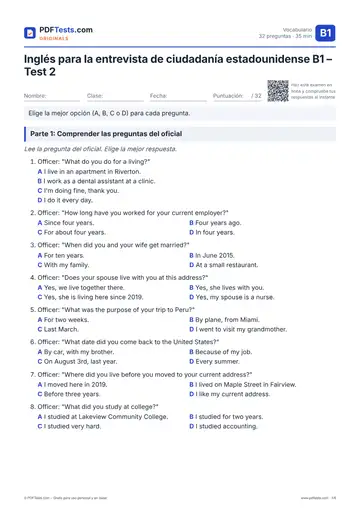
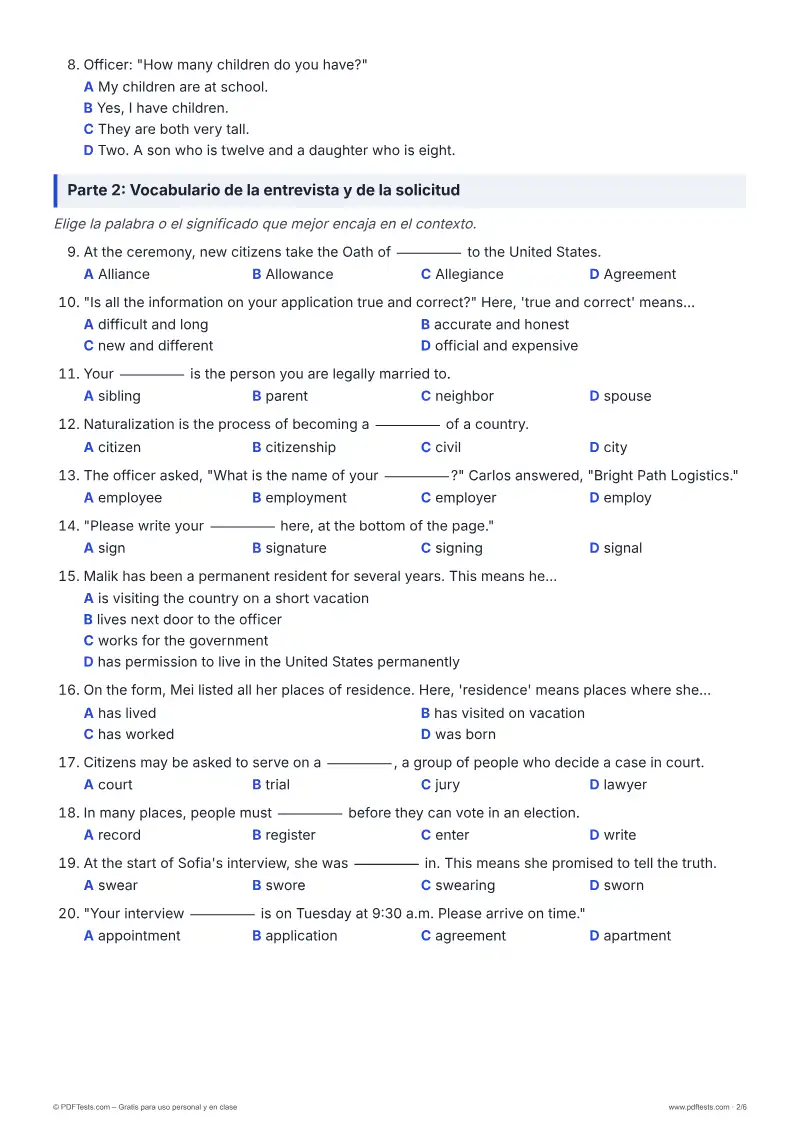
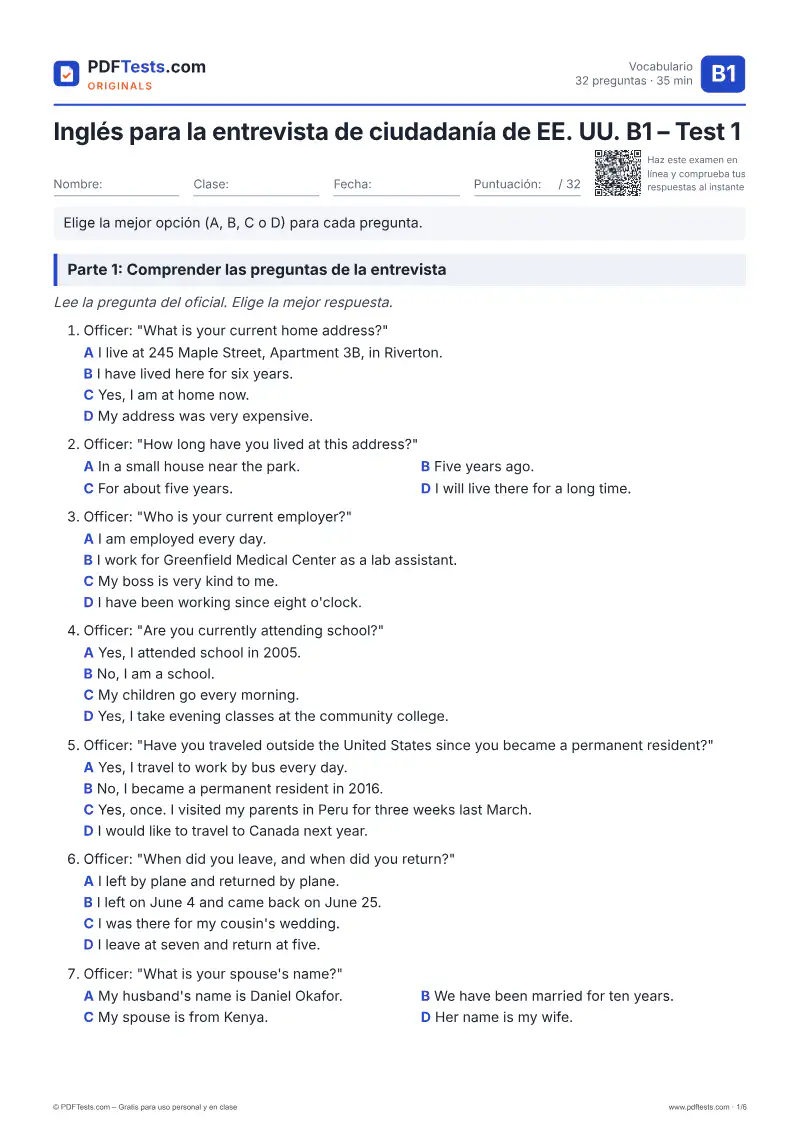
Vista previa de la página 1: Inglés para la entrevista de ciudadanía de EE. UU. B1 – Test 1 Abrir PDF
Examen de inglés de ciudadanía · todos los exámenes de práctica, niveles y consejos

Haz el examen en línea

Elige la mejor opción (A, B, C o D) para cada pregunta. Elige tus respuestas y pulsa «Comprobar respuestas».

Parte 1: Comprender las preguntas de la entrevista

Lee la pregunta del oficial. Elige la mejor respuesta.

  1. Officer: "What is your current home address?"

  2. Officer: "How long have you lived at this address?"

  3. Officer: "Who is your current employer?"

  4. Officer: "Are you currently attending school?"

  5. Officer: "Have you traveled outside the United States since you became a permanent resident?"

  6. Officer: "When did you leave, and when did you return?"

  7. Officer: "What is your spouse's name?"

  8. Officer: "How many children do you have?"

Parte 2: Vocabulario de la entrevista y de la solicitud

Elige la palabra o el significado que mejor encaja en el contexto.

  1. At the ceremony, new citizens take the Oath of _____ to the United States.

  2. "Is all the information on your application true and correct?" Here, 'true and correct' means…

  3. Your _____ is the person you are legally married to.

  4. Naturalization is the process of becoming a _____ of a country.

  5. The officer asked, "What is the name of your _____?" Carlos answered, "Bright Path Logistics."

  6. "Please write your _____ here, at the bottom of the page."

  7. Malik has been a permanent resident for several years. This means he…

  8. On the form, Mei listed all her places of residence. Here, 'residence' means places where she…

  9. Citizens may be asked to serve on a _____, a group of people who decide a case in court.

  10. In many places, people must _____ before they can vote in an election.

  11. At the start of Sofia's interview, she was _____ in. This means she promised to tell the truth.

  12. "Your interview _____ is on Tuesday at 9:30 a.m. Please arrive on time."

Parte 3: Pedir aclaraciones y peticiones corteses

Elige la opción más adecuada o correcta para cada situación.

  1. The officer speaks very quickly and you miss the question. You say: "I'm sorry, could you _____ that, please?"

  2. You do not understand the word 'reside' in the officer's question. What is the most polite and correct way to ask?

  3. Officer: "So you moved to Oakdale in 2018, correct?" (You actually moved there in 2017.) What do you say?

  4. Find the sentence with a mistake.

  5. Officer: "Your date of birth is April 9, 1988?" You agree. You say: "Yes, _____."

  6. Officer: "Do you understand the question?" You do not understand it fully. What do you say?

  7. You want to check what the officer is asking: "When you say 'trips', do you _____ all trips, even short ones?"

Parte 4: Lectura – Preparándose para el día de la entrevista

Lee el texto. Después elige la mejor respuesta para cada pregunta.

When Sofia Reyes received her appointment notice, she read it carefully twice. The letter showed the date, the time and the address of the office. It also listed the documents she needed to bring. That evening, she put everything into one folder: the notice, her permanent resident card, her passport and copies of some other papers. She did not want to search for anything on the morning of the interview.

The night before, Sofia checked the bus timetable and went to bed early. She left home with plenty of time and arrived at the office about thirty minutes before her appointment. At the front desk, she showed her notice and waited until someone called her name.

The officer was polite and spoke clearly. First, he asked Sofia to stand and promise to tell the truth. Then they sat down, and he asked questions about the information on her application: her address, her job, her trips abroad and her family. When Sofia did not understand one question, she asked, "Could you repeat that, please?" The officer said it again more slowly.

Afterwards, Sofia told her friend, "It felt like a serious but friendly conversation. Being organized helped me stay calm."

  1. Why did Sofia put everything into one folder?

  2. What did Sofia do the night before the interview?

  3. When did Sofia arrive at the office?

  4. What did the officer do first?

  5. In the last paragraph, 'organized' is closest in meaning to…

¿Te ha resultado útil esta página?

Informar de un error

¿Has visto una respuesta incorrecta, una errata o una explicación poco clara? Avísanos y lo corregiremos.

Practica con una ficha: Inglés para la entrevista de ciudadanía estadounidense B1 – Ficha 1

Vista previa

Sobre este examen

Este test de vocabulario de nivel B1 ayuda a practicar el inglés que se usa en la entrevista de naturalización de Estados Unidos. Incluye la comprensión de las preguntas del oficial, el vocabulario clave del proceso de solicitud, formas corteses de pedir que te repitan algo o de corregir un dato, y una breve lectura sobre el día de la entrevista. Está pensado para estudiantes adultos y para profesores de clases de ciudadanía o de inglés como lengua extranjera.

Temas

Preguntas de la entrevistaVocabulario de la naturalizaciónFamilias de palabrasPedir aclaracionesConfirmar y corregir informaciónComprensión lectora

Cómo usar este examen

  1. Descarga el PDF e imprímelo, o haz el examen en línea más abajo.
  2. Responde todas las preguntas sin diccionario y sin prisas.
  3. Comprueba tus respuestas y apunta los temas que debes repasar.

Notas para el profesor

Utilice este test después de practicar en voz alta preguntas y respuestas al estilo de la entrevista; como actividad oral de seguimiento, los alumnos pueden leerse por parejas las preguntas del oficial. El test trabaja errores típicos como responder a «how long» con «ago», confundir palabras de la misma familia (employer/employee, sign/signature, swear/sworn) y formular peticiones de aclaración poco corteses o gramaticalmente incorrectas. Se trata únicamente de práctica lingüística y no constituye asesoramiento jurídico, así que remita a los alumnos a las fuentes oficiales para cualquier información sobre el procedimiento.