PDFTests Originals

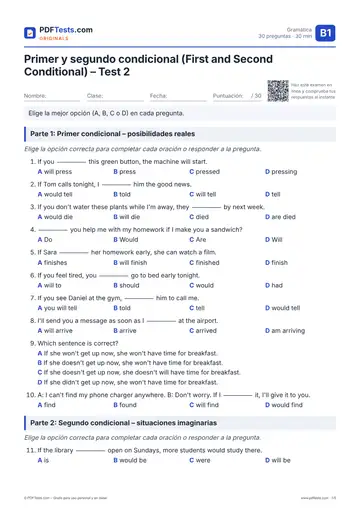
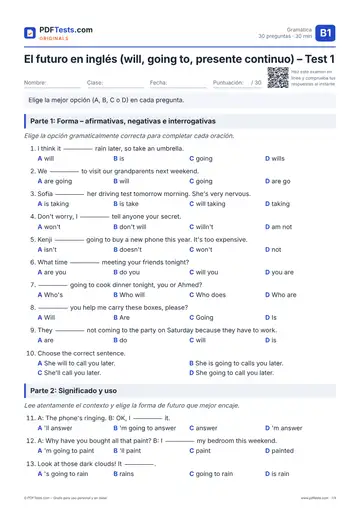
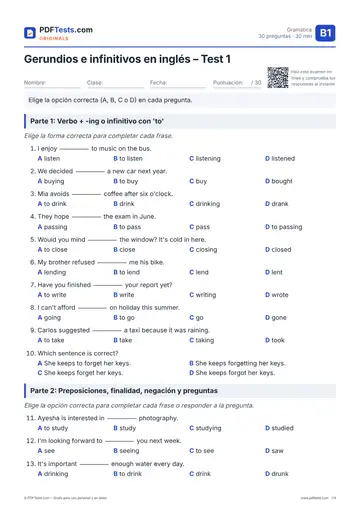
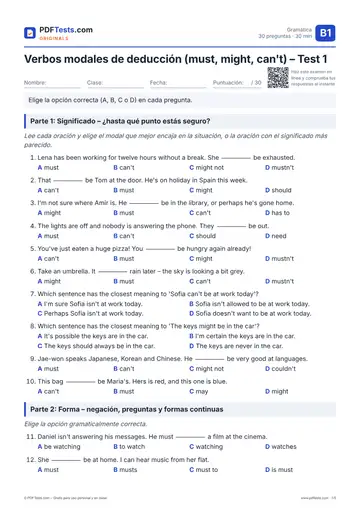
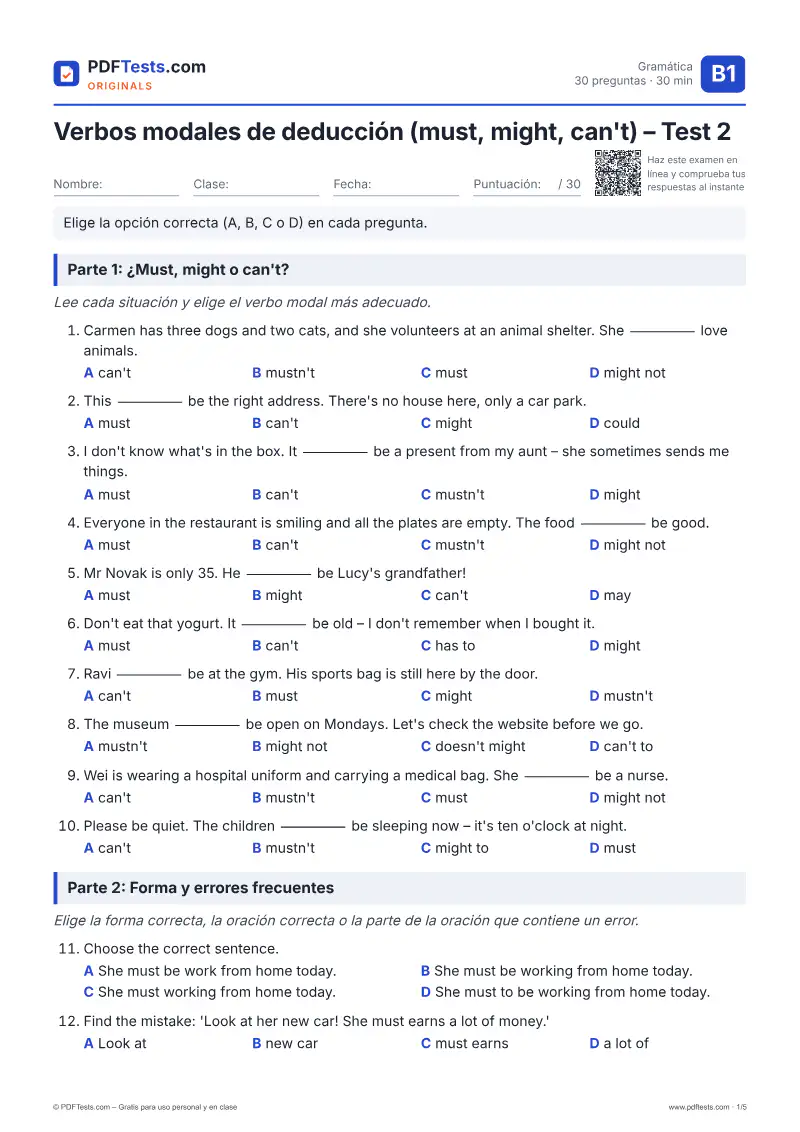
Verbos modales de deducción (must, might, can't) – Test 2

B1 Intermedio GramáticaInglés

Este test de gramática de nivel B1 comprueba si el alumnado sabe usar must, might y can't para hacer suposiciones y deducciones sobre el presente, con un breve repaso de las deducciones en pasado. Trabaja el significado, la forma, la negación, las preguntas y errores típicos como usar "mustn't" para expresar certeza negativa. Es ideal para alumnos de nivel intermedio, para repasar en clase o para estudiar por cuenta propia.
Preguntas
30
Tiempo
30 min
PDF
5 páginas
Soluciones
Incluidas
  • 100 % gratis
  • Sin registro
  • PDF A4 listo para imprimir
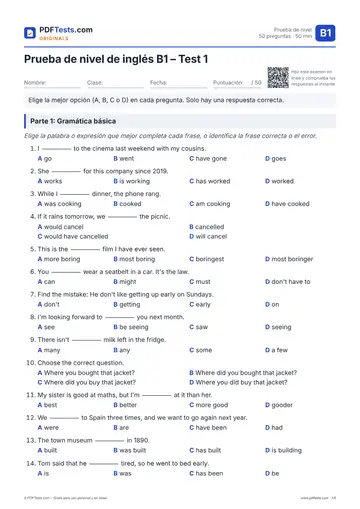
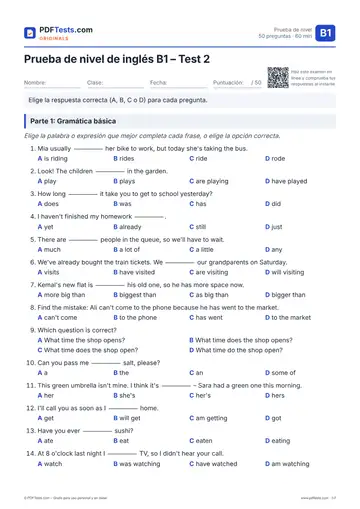
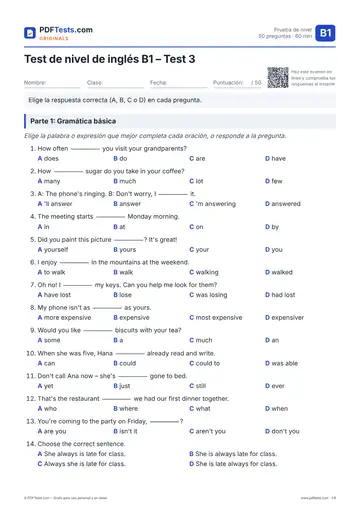
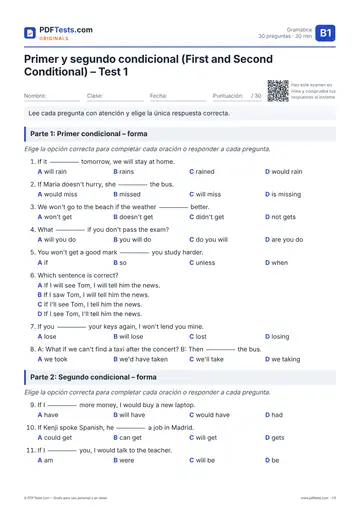
Vista previa de la página 1: Verbos modales de deducción (must, might, can't) – Test 2 Abrir PDF

Haz el examen en línea

Elige la opción correcta (A, B, C o D) en cada pregunta. Elige tus respuestas y pulsa «Comprobar respuestas».

Parte 1: ¿Must, might o can't?

Lee cada situación y elige el verbo modal más adecuado.

  1. Carmen has three dogs and two cats, and she volunteers at an animal shelter. She _____ love animals.

  2. This _____ be the right address. There's no house here, only a car park.

  3. I don't know what's in the box. It _____ be a present from my aunt – she sometimes sends me things.

  4. Everyone in the restaurant is smiling and all the plates are empty. The food _____ be good.

  5. Mr Novak is only 35. He _____ be Lucy's grandfather!

  6. Don't eat that yogurt. It _____ be old – I don't remember when I bought it.

  7. Ravi _____ be at the gym. His sports bag is still here by the door.

  8. The museum _____ be open on Mondays. Let's check the website before we go.

  9. Wei is wearing a hospital uniform and carrying a medical bag. She _____ be a nurse.

  10. Please be quiet. The children _____ be sleeping now – it's ten o'clock at night.

Parte 2: Forma y errores frecuentes

Elige la forma correcta, la oración correcta o la parte de la oración que contiene un error.

  1. Choose the correct sentence.

  2. Find the mistake: 'Look at her new car! She must earns a lot of money.'

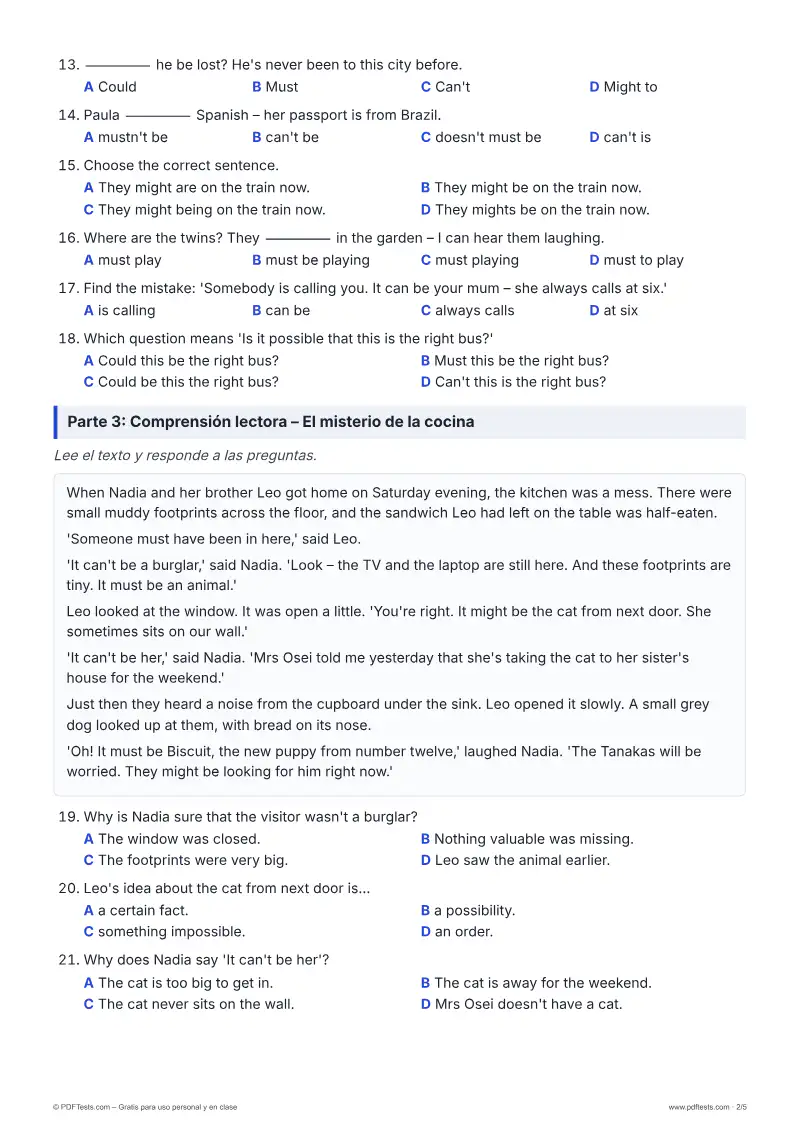
  3. _____ he be lost? He's never been to this city before.

  4. Paula _____ Spanish – her passport is from Brazil.

  5. Choose the correct sentence.

  6. Where are the twins? They _____ in the garden – I can hear them laughing.

  7. Find the mistake: 'Somebody is calling you. It can be your mum – she always calls at six.'

  8. Which question means 'Is it possible that this is the right bus?'

Parte 3: Comprensión lectora – El misterio de la cocina

Lee el texto y responde a las preguntas.

When Nadia and her brother Leo got home on Saturday evening, the kitchen was a mess. There were small muddy footprints across the floor, and the sandwich Leo had left on the table was half-eaten.

'Someone must have been in here,' said Leo.

'It can't be a burglar,' said Nadia. 'Look – the TV and the laptop are still here. And these footprints are tiny. It must be an animal.'

Leo looked at the window. It was open a little. 'You're right. It might be the cat from next door. She sometimes sits on our wall.'

'It can't be her,' said Nadia. 'Mrs Osei told me yesterday that she's taking the cat to her sister's house for the weekend.'

Just then they heard a noise from the cupboard under the sink. Leo opened it slowly. A small grey dog looked up at them, with bread on its nose.

'Oh! It must be Biscuit, the new puppy from number twelve,' laughed Nadia. 'The Tanakas will be worried. They might be looking for him right now.'

  1. Why is Nadia sure that the visitor wasn't a burglar?

  2. Leo's idea about the cat from next door is…

  3. Why does Nadia say 'It can't be her'?

  4. 'It must be Biscuit' means…

  5. Which sentence from the text is a guess about something that is possibly happening at the moment?

  6. The footprints were very small, so the visitor _____ be a person.

Parte 4: Respuestas, significado y deducciones en pasado

Elige la respuesta más adecuada o la opción correcta para completar cada oración.

  1. A: Kemal has just run a marathon. B: _____

  2. A: Is that Grace's sister? They look exactly the same! B: _____

  3. A: Who's that woman talking to the head teacher? B: I don't know. She _____ be a new teacher, or maybe she's a parent.

  4. Yusuf studied every day, but he still failed the exam. The exam _____ very difficult.

  5. Fatima already knows about the meeting. She _____ my email.

  6. Your friend tells you some surprising news, and you say 'You can't be serious!' You mean…

¿Te ha resultado útil esta página?

Informar de un error

¿Has visto una respuesta incorrecta, una errata o una explicación poco clara? Avísanos y lo corregiremos.

Practica con una ficha: Verbos modales de deducción (must, might, can't) – Ficha 1

Vista previa

Sobre este examen

Este test de gramática de nivel B1 comprueba si el alumnado sabe usar must, might y can't para hacer suposiciones y deducciones sobre el presente, con un breve repaso de las deducciones en pasado. Trabaja el significado, la forma, la negación, las preguntas y errores típicos como usar "mustn't" para expresar certeza negativa. Es ideal para alumnos de nivel intermedio, para repasar en clase o para estudiar por cuenta propia.

Temas

Verbos modales de deducciónmust para expresar certezamight para expresar posibilidadcan't para expresar imposibilidadmust be + -ingPreguntas con couldDeducción en pasado con must haveErrores frecuentes

Cómo usar este examen

  1. Descarga el PDF e imprímelo, o haz el examen en línea más abajo.
  2. Responde todas las preguntas sin diccionario y sin prisas.
  3. Comprueba tus respuestas y apunta los temas que debes repasar.

Notas para el profesor

Utiliza este test después de presentar must, might y can't para expresar deducción, o como repaso antes de pasar a los modales en pasado. Se centra en errores habituales del nivel B1: usar mustn't en lugar de can't para la certeza negativa, añadir "to" o una terminación verbal después de un modal, usar "can" para una posibilidad concreta y confundir deducción con obligación. Como actividad de seguimiento, muestra a los alumnos imágenes o situaciones misteriosas y pídeles que hagan deducciones con cada modal y que justifiquen su grado de certeza.