PDFTests Originals

Voz pasiva en presente y pasado simple (Passive Voice) – Test 1

B1 Intermedio GramáticaInglés

Este test de gramática B1 comprueba si sabes formar y usar la voz pasiva en presente simple (Present Simple) y pasado simple (Past Simple). Incluye oraciones afirmativas, negativas, preguntas, el complemento agente con 'by' y la elección entre voz activa y pasiva. Está pensado para estudiantes de nivel intermedio y para profesores que buscan una forma rápida e imprimible de repasar esta estructura clave.
Preguntas
30
Tiempo
30 min
PDF
5 páginas
Soluciones
Incluidas
  • 100 % gratis
  • Sin registro
  • PDF A4 listo para imprimir
Vista previa de la página 1: Voz pasiva en presente y pasado simple (Passive Voice) – Test 1 Abrir PDF

Haz el examen en línea

Elige la opción correcta (A, B, C o D) en cada pregunta. Elige tus respuestas y pulsa «Comprobar respuestas».

Parte 1: Formación de la pasiva

Elige la forma pasiva correcta para completar cada oración.

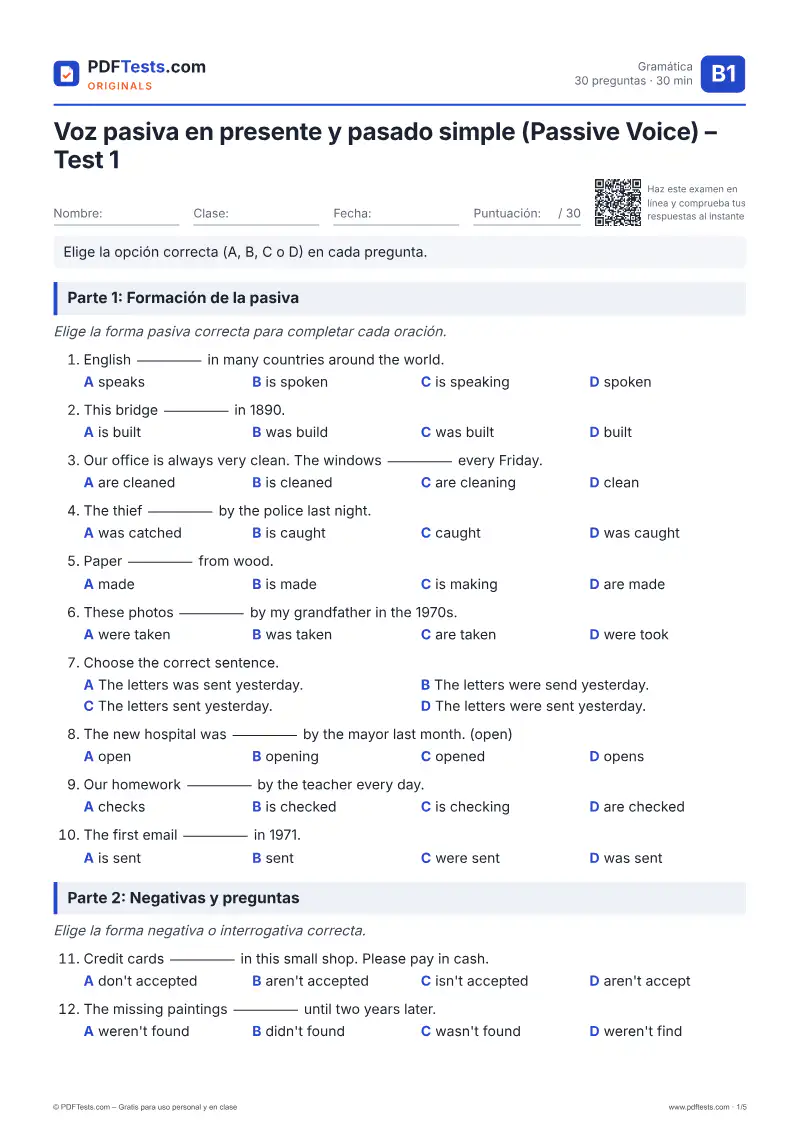
  1. English _____ in many countries around the world.

  2. This bridge _____ in 1890.

  3. Our office is always very clean. The windows _____ every Friday.

  4. The thief _____ by the police last night.

  5. Paper _____ from wood.

  6. These photos _____ by my grandfather in the 1970s.

  7. Choose the correct sentence.

  8. The new hospital was _____ by the mayor last month. (open)

  9. Our homework _____ by the teacher every day.

  10. The first email _____ in 1971.

Parte 2: Negativas y preguntas

Elige la forma negativa o interrogativa correcta.

  1. Credit cards _____ in this small shop. Please pay in cash.

  2. The missing paintings _____ until two years later.

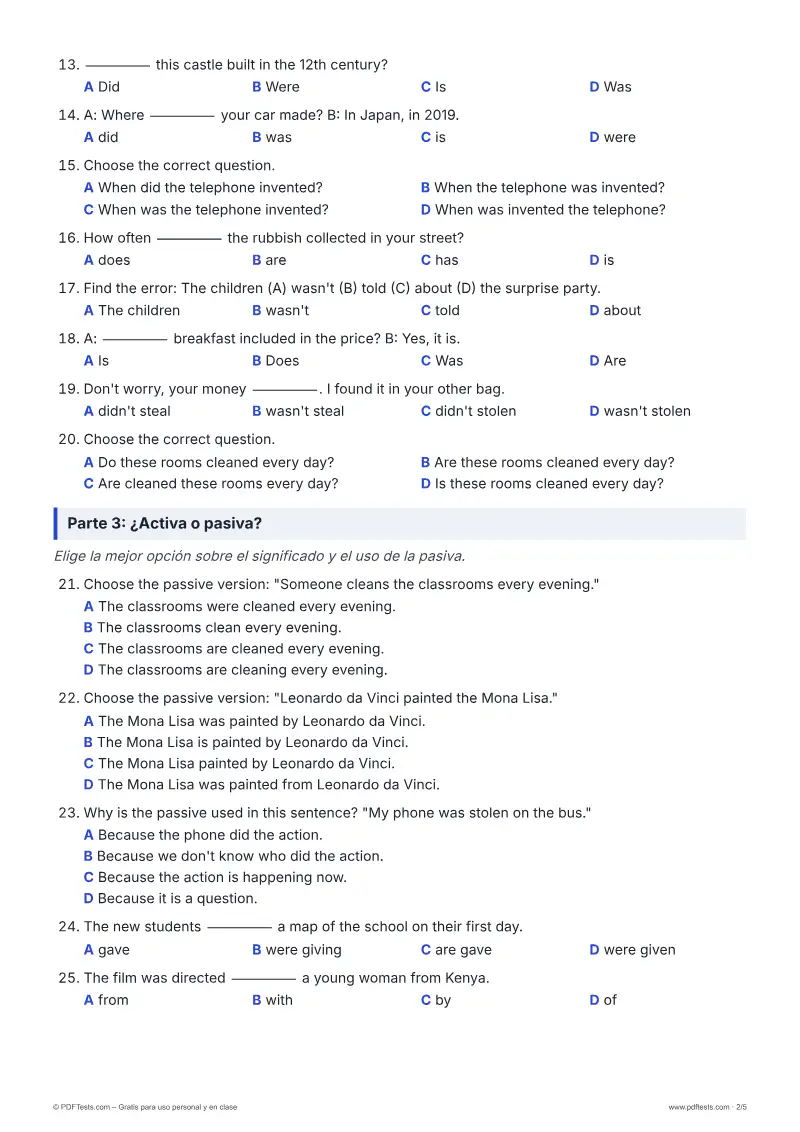
  3. _____ this castle built in the 12th century?

  4. A: Where _____ your car made? B: In Japan, in 2019.

  5. Choose the correct question.

  6. How often _____ the rubbish collected in your street?

  7. Find the error: The children (A) wasn't (B) told (C) about (D) the surprise party.

  8. A: _____ breakfast included in the price? B: Yes, it is.

  9. Don't worry, your money _____. I found it in your other bag.

  10. Choose the correct question.

Parte 3: ¿Activa o pasiva?

Elige la mejor opción sobre el significado y el uso de la pasiva.

  1. Choose the passive version: "Someone cleans the classrooms every evening."

  2. Choose the passive version: "Leonardo da Vinci painted the Mona Lisa."

  3. Why is the passive used in this sentence? "My phone was stolen on the bus."

  4. The new students _____ a map of the school on their first day.

  5. The film was directed _____ a young woman from Kenya.

Parte 4: La pasiva en contexto

Lee el texto y elige la opción correcta para cada hueco numerado.

The Old Clock Tower

The clock tower in the centre of our town (1) ___ in 1865. In those days, the clock (2) ___ by hand every morning by a local man called Tomás.

Today, the clock is electric, so it (3) ___ by hand any more. The tower is very popular with visitors. It (4) ___ by thousands of tourists every year, and in summer, guided tours (5) ___ in four languages.

  1. Gap (1)

  2. Gap (2)

  3. Gap (3)

  4. Gap (4)

  5. Gap (5)

Vista previa

Sobre este examen

Este test de gramática B1 comprueba si sabes formar y usar la voz pasiva en presente simple (Present Simple) y pasado simple (Past Simple). Incluye oraciones afirmativas, negativas, preguntas, el complemento agente con 'by' y la elección entre voz activa y pasiva. Está pensado para estudiantes de nivel intermedio y para profesores que buscan una forma rápida e imprimible de repasar esta estructura clave.

Temas

Pasiva en presente simplePasiva en pasado simpleNegativas en pasivaPreguntas en pasivaVoz activa o pasivaEl complemento agente con 'by'Participios pasados (past participles)

Cómo usar este examen

  1. Descarga el PDF e imprímelo, o haz el examen en línea más abajo.
  2. Responde todas las preguntas sin diccionario y sin prisas.
  3. Comprueba tus respuestas y apunta los temas que debes repasar.

Notas para el profesor

Utiliza este test después de explicar la pasiva en presente y pasado simple, o como prueba diagnóstica antes de un repaso. Se centra en los errores típicos del nivel B1: omitir el verbo 'be', la concordancia incorrecta (was/were, is/are), usar 'do/did' en negativas y preguntas en pasiva, añadir la terminación regular a participios irregulares (p. ej., 'catched') y usar 'from' en lugar de 'by'. Como actividad de seguimiento, pide a los alumnos que escriban cinco datos sobre su ciudad o su país usando la voz pasiva.