PDFTests Originals

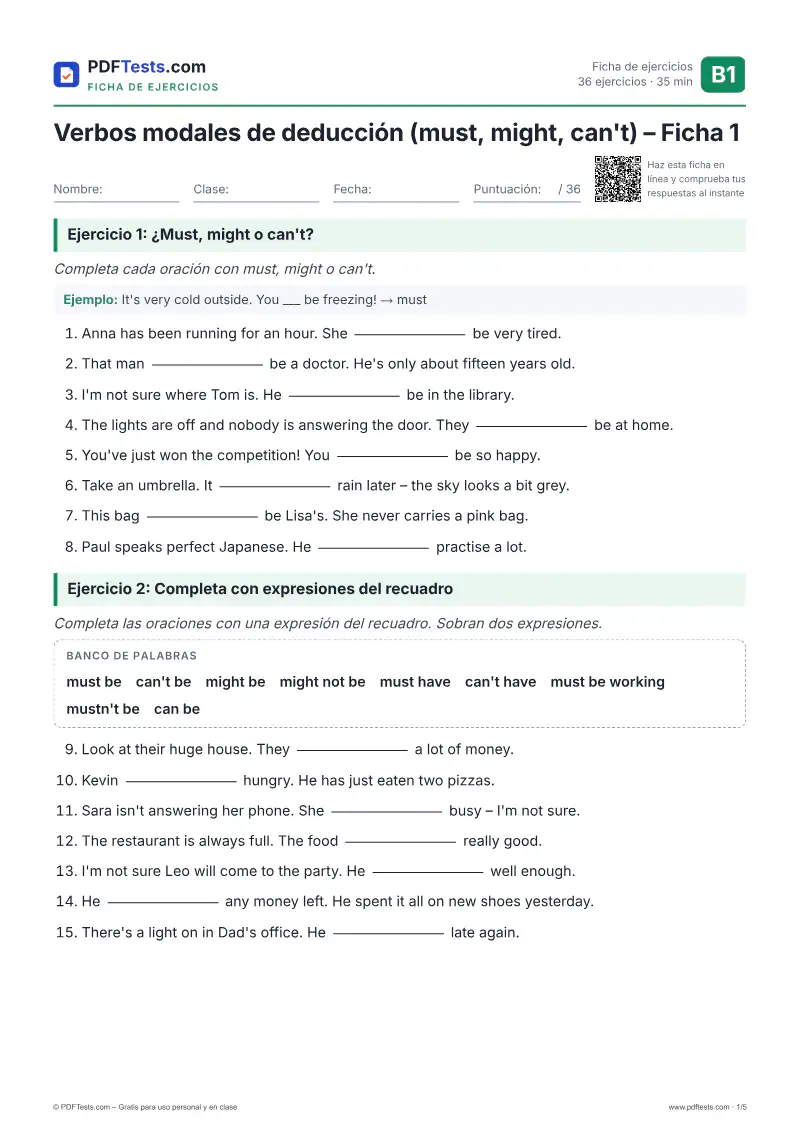
Verbos modales de deducción (must, might, can't) – Ficha 1

B1 Intermedio FichaInglés

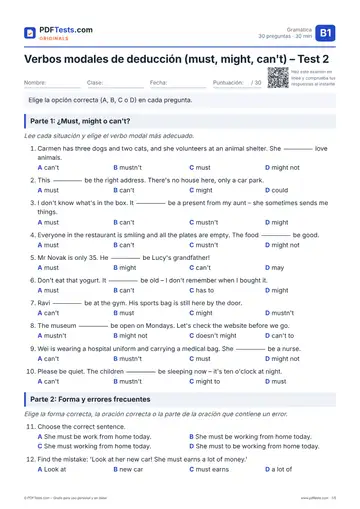
Esta ficha de nivel B1 sirve para practicar el uso de must, might y can't para hacer deducciones sobre el presente: expresar certeza, expresar duda y decir que algo es imposible. El alumnado completa, reescribe, corrige y ordena oraciones, incluidas oraciones negativas, formas continuas y preguntas. Es adecuada tanto para trabajar en clase como para el estudio autónomo.
ejercicios
36
Tiempo
35 min
PDF
5 páginas
Soluciones
Incluidas
  • 100 % gratis
  • Sin registro
  • PDF A4 listo para imprimir
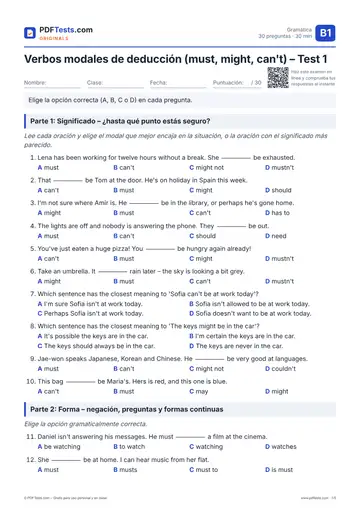
Vista previa de la página 1: Verbos modales de deducción (must, might, can't) – Ficha 1 Abrir PDF

Haz la ficha en línea

Escribe tus respuestas y pulsa «Comprobar respuestas». Se aceptan otras respuestas correctas.

Ejercicio 1: ¿Must, might o can't?

Completa cada oración con must, might o can't.

Ejemplo: It's very cold outside. You ___ be freezing! → must

  1. Anna has been running for an hour. She be very tired.

  2. That man be a doctor. He's only about fifteen years old.

  3. I'm not sure where Tom is. He be in the library.

  4. The lights are off and nobody is answering the door. They be at home.

  5. You've just won the competition! You be so happy.

  6. Take an umbrella. It rain later – the sky looks a bit grey.

  7. This bag be Lisa's. She never carries a pink bag.

  8. Paul speaks perfect Japanese. He practise a lot.

Ejercicio 2: Completa con expresiones del recuadro

Completa las oraciones con una expresión del recuadro. Sobran dos expresiones.

Banco de palabras must becan't bemight bemight not bemust havecan't havemust be workingmustn't becan be

  1. Look at their huge house. They a lot of money.

  2. Kevin hungry. He has just eaten two pizzas.

  3. Sara isn't answering her phone. She busy – I'm not sure.

  4. The restaurant is always full. The food really good.

  5. I'm not sure Leo will come to the party. He well enough.

  6. He any money left. He spent it all on new shoes yesterday.

  7. There's a light on in Dad's office. He late again.

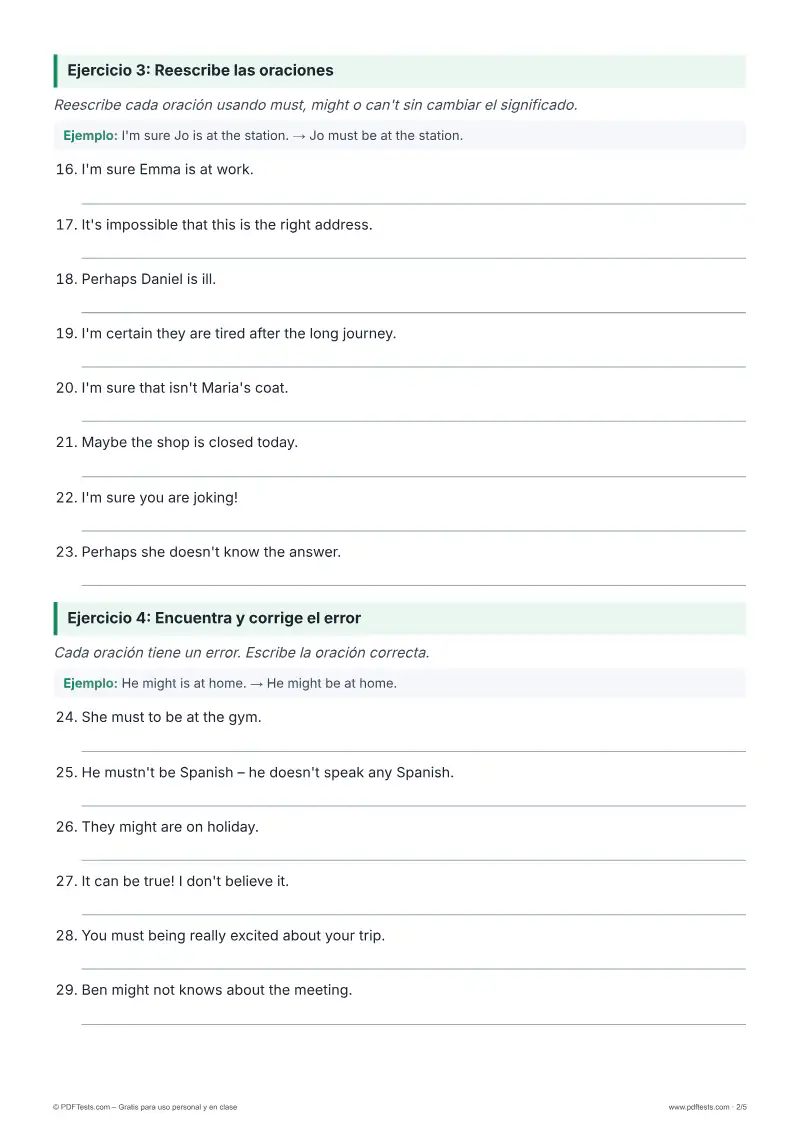
Ejercicio 3: Reescribe las oraciones

Reescribe cada oración usando must, might o can't sin cambiar el significado.

Ejemplo: I'm sure Jo is at the station. → Jo must be at the station.

  1. I'm sure Emma is at work.

  2. It's impossible that this is the right address.

  3. Perhaps Daniel is ill.

  4. I'm certain they are tired after the long journey.

  5. I'm sure that isn't Maria's coat.

  6. Maybe the shop is closed today.

  7. I'm sure you are joking!

  8. Perhaps she doesn't know the answer.

Ejercicio 4: Encuentra y corrige el error

Cada oración tiene un error. Escribe la oración correcta.

Ejemplo: He might is at home. → He might be at home.

  1. She must to be at the gym.

  2. He mustn't be Spanish – he doesn't speak any Spanish.

  3. They might are on holiday.

  4. It can be true! I don't believe it.

  5. You must being really excited about your trip.

  6. Ben might not knows about the meeting.

  7. That can't is the right bus.

Ejercicio 5: Ordena las palabras

Ordena las palabras para formar oraciones o preguntas.

Ejemplo: be / she / must / late → She must be late.

  1. be / must / tired / you

  2. be / can't / he / serious

  3. might / at / she / home / be

  4. the / keys / be / might / in / car / the

  5. must / they / a lot / be / studying

  6. who / be / that / might

¿Te ha resultado útil esta página?

Informar de un error

¿Has visto una respuesta incorrecta, una errata o una explicación poco clara? Avísanos y lo corregiremos.

Vista previa

Sobre este examen

Ficha de inglés B1 en PDF sobre los modales de deducción must, might y can't: cinco ejercicios imprimibles con soluciones sobre forma, significado y preguntas.

Temas

Verbos modales de deducciónmust para expresar certezamight para expresar posibilidadcan't para expresar imposibilidadModal + infinitivo sin toDeducciones sobre el presente

Notas para el profesor

Empiece mostrando una imagen y preguntando a los alumnos qué must, might o can't ser cierto sobre ella. Después, trabaje los ejercicios pasando de la práctica controlada a la más libre. Los errores típicos son añadir 'to' o '-s' después del modal y usar 'mustn't' en lugar de 'can't' para expresar imposibilidad. Como actividad de ampliación, los alumnos pueden describir un objeto misterioso o la foto de la habitación de un desconocido usando los tres modales.

Todos los exámenes de Inglés B1 →