PDFTests Originals

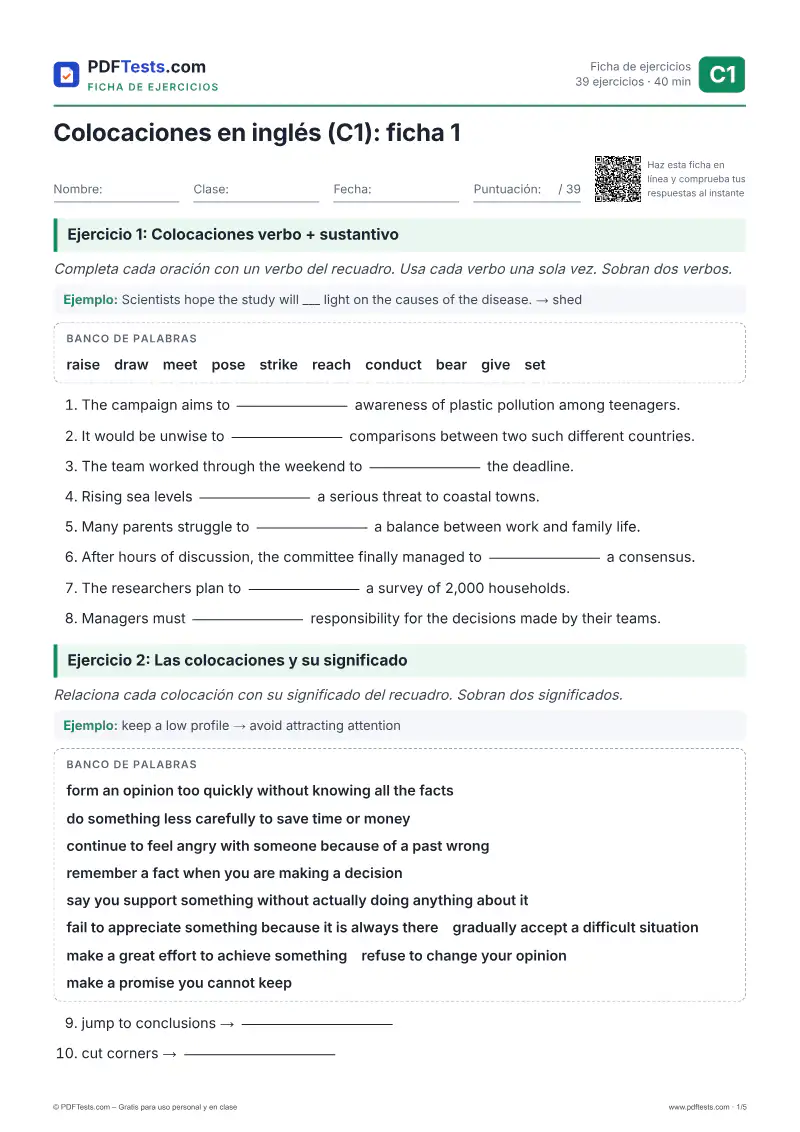
Colocaciones en inglés (C1): ficha 1

C1 Avanzado FichaInglés

Esta ficha de nivel C1 practica colocaciones frecuentes del inglés en contexto, como 'strike a balance', 'jump to conclusions' y 'an overwhelming majority'. El alumnado trabaja el significado, las combinaciones naturales de palabras y la formación de palabras a lo largo de cinco ejercicios que avanzan de la práctica controlada a una práctica más libre. Resulta adecuada para estudiantes de nivel intermedio alto y avanzado que preparan exámenes oficiales o quieren expresarse en inglés con más naturalidad y precisión.
ejercicios
39
Tiempo
40 min
PDF
5 páginas
Soluciones
Incluidas
  • 100 % gratis
  • Sin registro
  • PDF A4 listo para imprimir
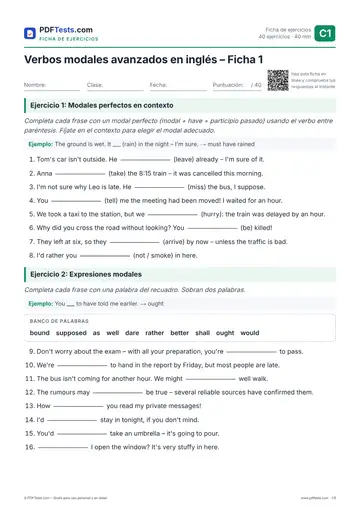
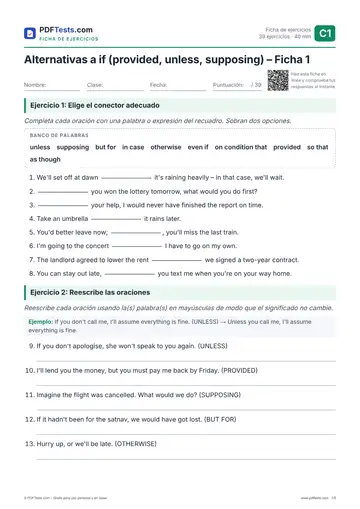
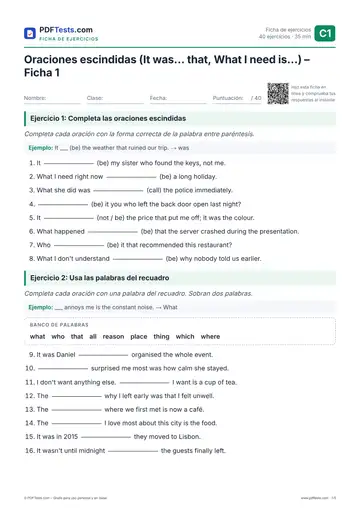
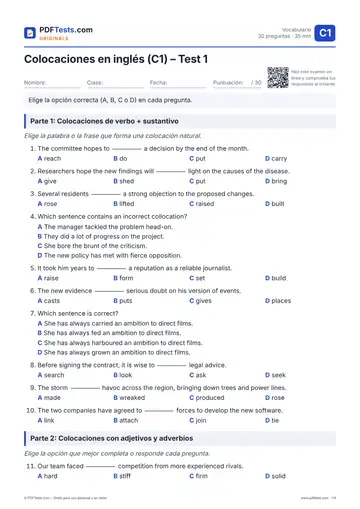
Vista previa de la página 1: Colocaciones en inglés (C1): ficha 1 Abrir PDF

Haz la ficha en línea

Escribe tus respuestas y pulsa «Comprobar respuestas». Se aceptan otras respuestas correctas.

Ejercicio 1: Colocaciones verbo + sustantivo

Completa cada oración con un verbo del recuadro. Usa cada verbo una sola vez. Sobran dos verbos.

Ejemplo: Scientists hope the study will ___ light on the causes of the disease. → shed

Banco de palabras raisedrawmeetposestrikereachconductbeargiveset

  1. The campaign aims to awareness of plastic pollution among teenagers.

  2. It would be unwise to comparisons between two such different countries.

  3. The team worked through the weekend to the deadline.

  4. Rising sea levels a serious threat to coastal towns.

  5. Many parents struggle to a balance between work and family life.

  6. After hours of discussion, the committee finally managed to a consensus.

  7. The researchers plan to a survey of 2,000 households.

  8. Managers must responsibility for the decisions made by their teams.

Ejercicio 2: Las colocaciones y su significado

Relaciona cada colocación con su significado del recuadro. Sobran dos significados.

Ejemplo: keep a low profile → avoid attracting attention

Banco de palabras form an opinion too quickly without knowing all the factsdo something less carefully to save time or moneycontinue to feel angry with someone because of a past wrongremember a fact when you are making a decisionsay you support something without actually doing anything about itfail to appreciate something because it is always theregradually accept a difficult situationmake a great effort to achieve somethingrefuse to change your opinionmake a promise you cannot keep

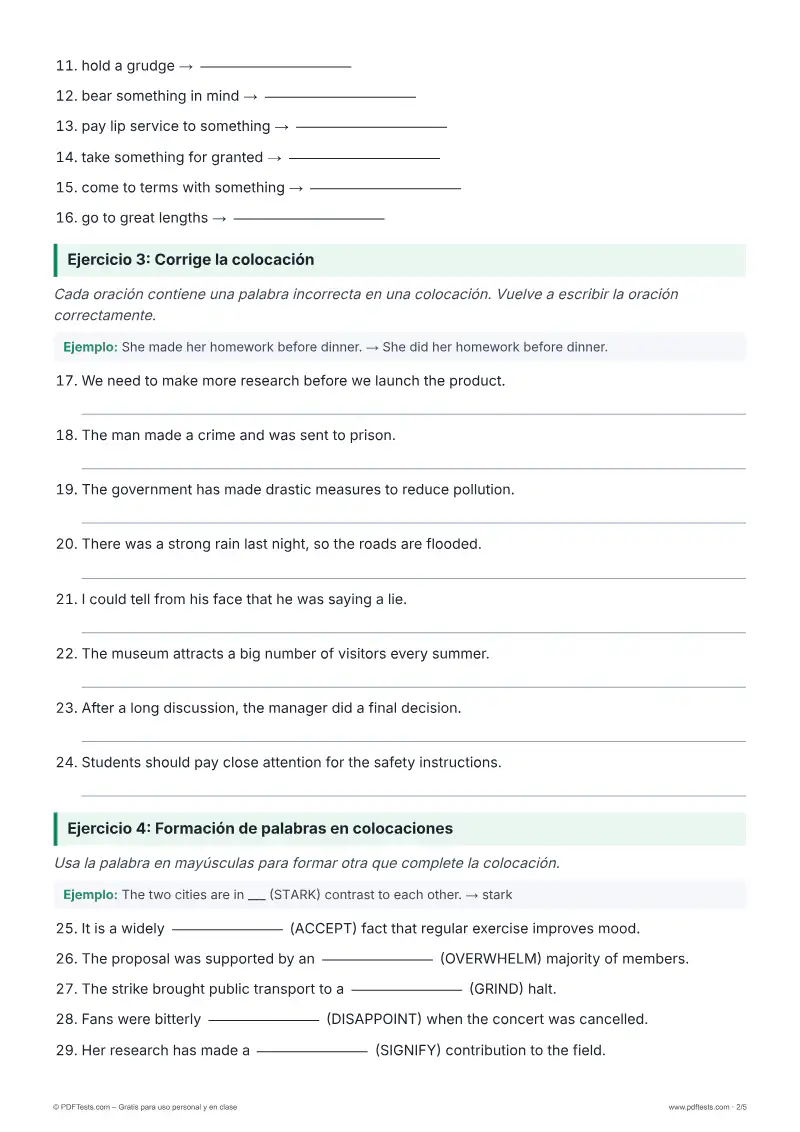
  1. jump to conclusions

  2. cut corners

  3. hold a grudge

  4. bear something in mind

  5. pay lip service to something

  6. take something for granted

  7. come to terms with something

  8. go to great lengths

Ejercicio 3: Corrige la colocación

Cada oración contiene una palabra incorrecta en una colocación. Vuelve a escribir la oración correctamente.

Ejemplo: She made her homework before dinner. → She did her homework before dinner.

  1. We need to make more research before we launch the product.

  2. The man made a crime and was sent to prison.

  3. The government has made drastic measures to reduce pollution.

  4. There was a strong rain last night, so the roads are flooded.

  5. I could tell from his face that he was saying a lie.

  6. The museum attracts a big number of visitors every summer.

  7. After a long discussion, the manager did a final decision.

  8. Students should pay close attention for the safety instructions.

Ejercicio 4: Formación de palabras en colocaciones

Usa la palabra en mayúsculas para formar otra que complete la colocación.

Ejemplo: The two cities are in ___ (STARK) contrast to each other. → stark

  1. It is a widely (ACCEPT) fact that regular exercise improves mood.

  2. The proposal was supported by an (OVERWHELM) majority of members.

  3. The strike brought public transport to a (GRIND) halt.

  4. Fans were bitterly (DISAPPOINT) when the concert was cancelled.

  5. Her research has made a (SIGNIFY) contribution to the field.

  6. In this storm, it is highly (LIKE) that the match will go ahead.

  7. After years of neglect, the old castle has fallen into (REPAIR).

  8. It is important to draw a clear (DISTINGUISH) between facts and opinions.

Ejercicio 5: Reescribe con una colocación

Vuelve a escribir cada oración usando la palabra entre paréntesis de modo que el significado no cambie.

Ejemplo: He wants to avoid attracting attention. (PROFILE) → He wants to keep a low profile.

  1. Remember that the shop closes early on Sundays. (MIND)

  2. The new rules will start to apply in January. (FORCE)

  3. I think you are forming an opinion too quickly. (CONCLUSIONS)

  4. She eventually accepted that she had lost her job. (TERMS)

  5. He made a huge effort to keep the project a secret. (LENGTHS)

  6. Many people don't appreciate clean water because it is always available. (GRANTED)

  7. The two sides finally agreed. (CONSENSUS)

¿Te ha resultado útil esta página?

Informar de un error

¿Has visto una respuesta incorrecta, una errata o una explicación poco clara? Avísanos y lo corregiremos.

Vista previa

Sobre este examen

Ficha de inglés C1 en PDF sobre colocaciones: verbo + sustantivo, significados, formación de palabras y corrección de errores. Con soluciones.

Temas

Colocaciones verbo + sustantivoColocaciones adverbio + adjetivoColocaciones y su significadoFormación de palabrasErrores frecuentes con colocaciones

Notas para el profesor

Empiece con el ejercicio 1 como actividad de calentamiento y, después, pida que comparen sus respuestas del ejercicio 2 por parejas antes de corregirlo con toda la clase. Un error habitual es traducir las colocaciones literalmente desde la lengua materna, lo que da lugar a fallos como 'make research' o 'say a lie'; por eso conviene fijarse especialmente en el verbo de cada combinación. Como actividad de ampliación, pida al alumnado que escriba un breve párrafo de opinión sobre un tema de su elección en el que utilice al menos seis colocaciones de la ficha.

Todos los exámenes de Inglés C1 →