PDFTests Originals

Elipsis y sustitución – Ficha 1

C1 Avanzado FichaInglés

Esta ficha de nivel C1 practica cómo los hablantes avanzados evitan la repetición mediante la sustitución (so, not, one/ones, do so) y la elipsis (auxiliares, respuestas cortas, el 'to' aislado). Está pensada para alumnos de nivel intermedio alto y avanzado que quieren expresarse en inglés de forma más natural y concisa, tanto oralmente como por escrito.
ejercicios
39
Tiempo
35 min
PDF
5 páginas
Soluciones
Incluidas
  • 100 % gratis
  • Sin registro
  • PDF A4 listo para imprimir
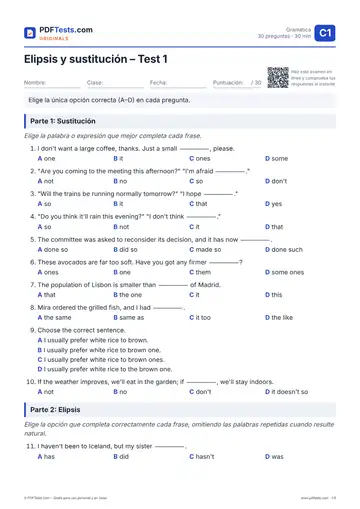
Vista previa de la página 1: Elipsis y sustitución – Ficha 1 Abrir PDF

Haz la ficha en línea

Escribe tus respuestas y pulsa «Comprobar respuestas». Se aceptan otras respuestas correctas.

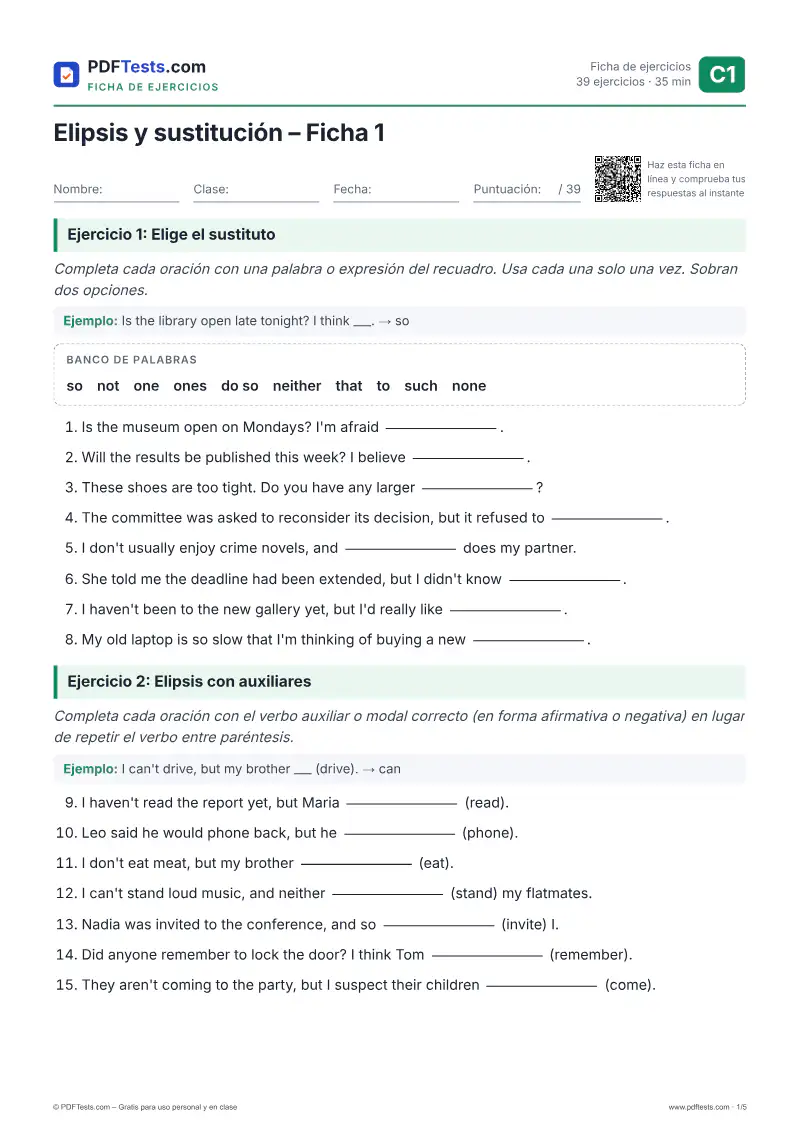
Ejercicio 1: Elige el sustituto

Completa cada oración con una palabra o expresión del recuadro. Usa cada una solo una vez. Sobran dos opciones.

Ejemplo: Is the library open late tonight? I think ___. → so

Banco de palabras sonotoneonesdo soneitherthattosuchnone

  1. Is the museum open on Mondays? I'm afraid .

  2. Will the results be published this week? I believe .

  3. These shoes are too tight. Do you have any larger ?

  4. The committee was asked to reconsider its decision, but it refused to .

  5. I don't usually enjoy crime novels, and does my partner.

  6. She told me the deadline had been extended, but I didn't know .

  7. I haven't been to the new gallery yet, but I'd really like .

  8. My old laptop is so slow that I'm thinking of buying a new .

Ejercicio 2: Elipsis con auxiliares

Completa cada oración con el verbo auxiliar o modal correcto (en forma afirmativa o negativa) en lugar de repetir el verbo entre paréntesis.

Ejemplo: I can't drive, but my brother ___ (drive). → can

  1. I haven't read the report yet, but Maria (read).

  2. Leo said he would phone back, but he (phone).

  3. I don't eat meat, but my brother (eat).

  4. I can't stand loud music, and neither (stand) my flatmates.

  5. Nadia was invited to the conference, and so (invite) I.

  6. Did anyone remember to lock the door? I think Tom (remember).

  7. They aren't coming to the party, but I suspect their children (come).

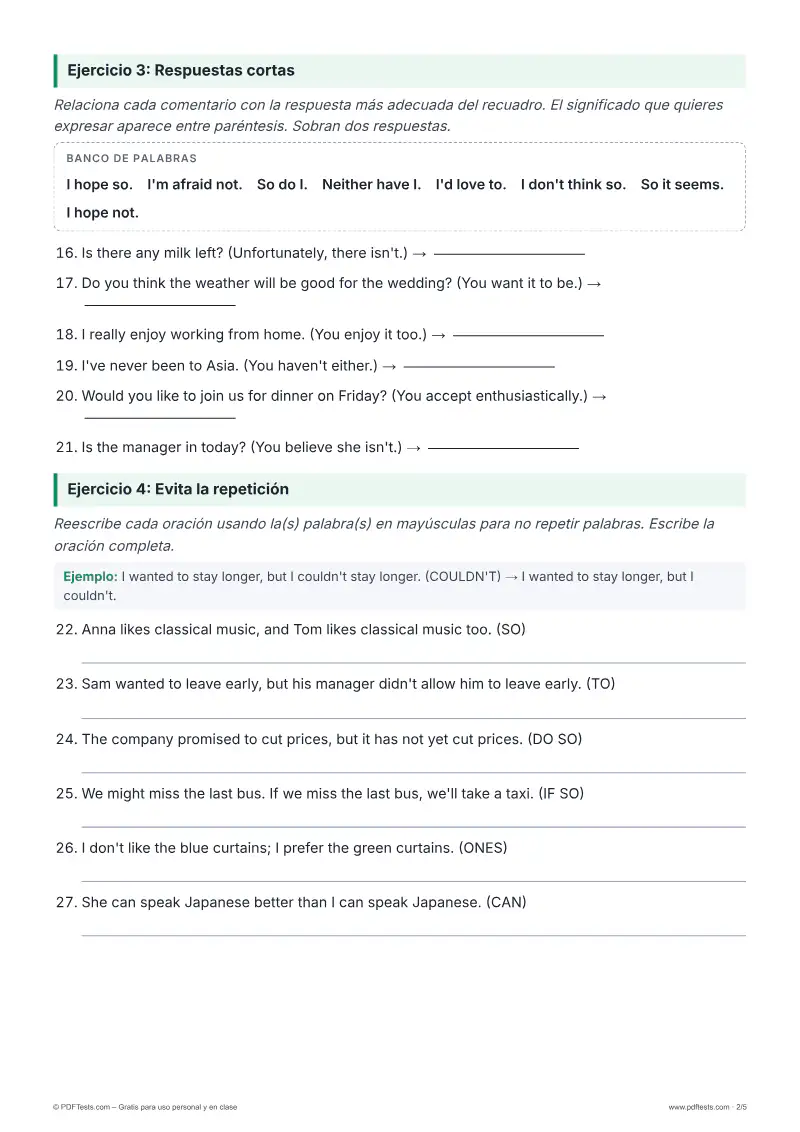
Ejercicio 3: Respuestas cortas

Relaciona cada comentario con la respuesta más adecuada del recuadro. El significado que quieres expresar aparece entre paréntesis. Sobran dos respuestas.

Banco de palabras I hope so.I'm afraid not.So do I.Neither have I.I'd love to.I don't think so.So it seems.I hope not.

  1. Is there any milk left? (Unfortunately, there isn't.)

  2. Do you think the weather will be good for the wedding? (You want it to be.)

  3. I really enjoy working from home. (You enjoy it too.)

  4. I've never been to Asia. (You haven't either.)

  5. Would you like to join us for dinner on Friday? (You accept enthusiastically.)

  6. Is the manager in today? (You believe she isn't.)

Ejercicio 4: Evita la repetición

Reescribe cada oración usando la(s) palabra(s) en mayúsculas para no repetir palabras. Escribe la oración completa.

Ejemplo: I wanted to stay longer, but I couldn't stay longer. (COULDN'T) → I wanted to stay longer, but I couldn't.

  1. Anna likes classical music, and Tom likes classical music too. (SO)

  2. Sam wanted to leave early, but his manager didn't allow him to leave early. (TO)

  3. The company promised to cut prices, but it has not yet cut prices. (DO SO)

  4. We might miss the last bus. If we miss the last bus, we'll take a taxi. (IF SO)

  5. I don't like the blue curtains; I prefer the green curtains. (ONES)

  6. She can speak Japanese better than I can speak Japanese. (CAN)

Ejercicio 5: Encuentra el error

Cada oración contiene un error de elipsis o sustitución. Escribe la oración corregida.

Ejemplo: I'd like to come, but I can't to. → I'd like to come, but I can't.

  1. I don't know if it will snow tonight, but I don't hope so.

  2. I've never seen the Northern Lights, and neither my sister has.

  3. I haven't visited Rome yet, but I'd really like.

  4. My parents don't speak French, and so do I.

  5. Jo can't swim, but her brother does.

  6. Kate had already eaten, but I haven't.

Ejercicio 6: Ordena las palabras

Ordena las palabras para formar oraciones. Añade la puntuación necesaria.

Ejemplo: so / I / hope → I hope so.

  1. never / I've / tried / skiing / but / I'd / love / to

  2. not / if / we'll / have / to / cancel / the / trip

  3. so / did / most / of / her / friends / my / sister / passed / the / exam / and

  4. do / you / want / the / large / box / or / the / small / one

  5. he / said / he / would / apologise / but / he / never / did

  6. think / I / don't / so / but / I / may / be / wrong

¿Te ha resultado útil esta página?

Informar de un error

¿Has visto una respuesta incorrecta, una errata o una explicación poco clara? Avísanos y lo corregiremos.

Vista previa

Sobre este examen

Ficha de inglés C1 en PDF sobre elipsis y sustitución: so, not, one/ones, do so, auxiliares, neither y to. Ejercicios imprimibles con soluciones.

Temas

Sustitución con so y notOne y onesDo soElipsis con verbos auxiliaresRespuestas cortas: so do I / neither have IElipsis después de to

Notas para el profesor

Empiece con el ejercicio de relacionar como calentamiento rápido por parejas y pase después a los ejercicios controlados de completar huecos antes de los de reescritura y ordenación. Entre los errores típicos están decir 'I don't hope so' en lugar de 'I hope not', elegir un auxiliar o un tiempo verbal incorrecto después de so/neither y omitir 'to' en 'I'd like to'. Como actividad de ampliación, pida a los alumnos que escriban un breve diálogo de ocho líneas en el que usen al menos cinco de las estructuras sin repetir ningún sintagma verbal.

Todos los exámenes de Inglés C1 →