PDFTests Originals

Compréhension écrite – Test 5

B1 Intermédiaire Compréhension écriteAnglais

Ce test de compréhension écrite de niveau B1 comprend trois textes originaux de genres différents : une page d'information sur une nuit au musée, un article de magazine consacré à un club de lecture silencieuse et une courte histoire humoristique. Les 20 questions évaluent la compréhension globale, la compréhension détaillée, l'inférence et le vocabulaire en contexte. Il s'adresse aux apprenants de niveau intermédiaire qui préparent un examen B1, ainsi qu'à toute personne souhaitant s'entraîner à lire attentivement.
Questions
20
Durée
35 min
PDF
5 pages
Corrigé
Inclus
  • 100 % gratuit
  • Sans inscription
  • PDF A4 prêt à imprimer
Aperçu de la page 1 : Compréhension écrite – Test 5 Ouvrir le PDF

Faire le test en ligne

Lisez attentivement chaque texte et choisissez la bonne réponse (A, B, C ou D) pour chaque question. Choisissez vos réponses, puis cliquez sur « Vérifier mes réponses ».

Partie 1 : Texte informatif

Lisez les informations sur un événement au musée et répondez aux questions 1 à 7.

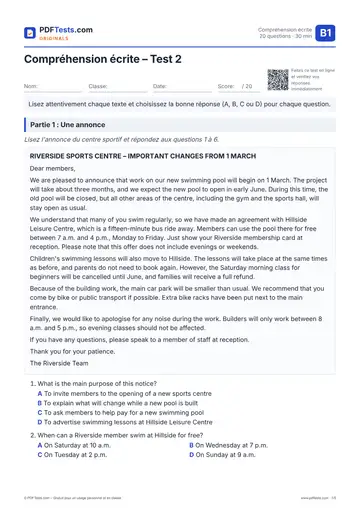
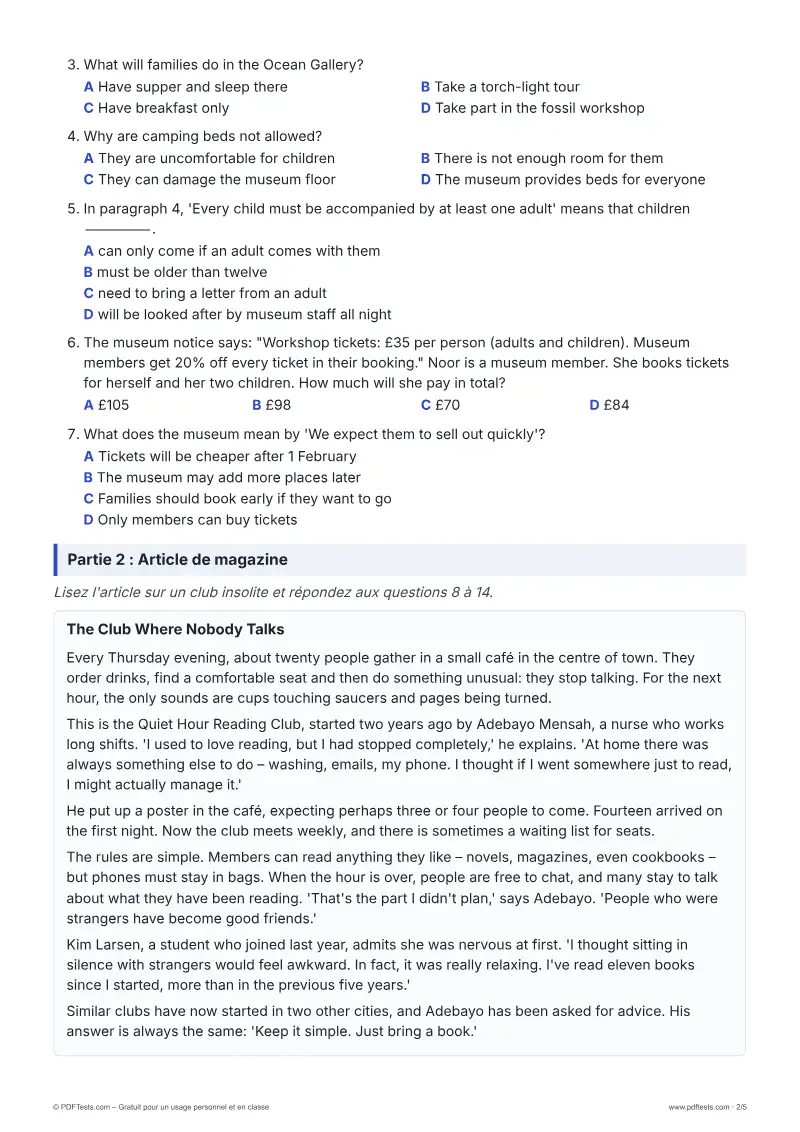
Sleepover at the Museum – Information for Families

On Saturday 14 March, the City Natural History Museum is opening its doors after dark for a special family sleepover. This is the first time we have held an event like this, and places are limited to 40 families.

The evening begins at 6.30 p.m. with a torch-light tour of the dinosaur hall, led by one of our scientists. After that, children can take part in a fossil workshop, where they will make a copy of a real fossil to take home. A light supper of soup, sandwiches and fruit will be served at 8 p.m. in the Ocean Gallery, under our famous whale skeleton.

At 9.30 p.m. there will be a quiet story time, and lights go out at 10.30 p.m. Families will sleep on the floor of the Ocean Gallery, so please bring sleeping bags, pillows and anything else you need to feel comfortable. Camping beds are not allowed because of the lack of space. Breakfast is included, and the event ends at 9 a.m. on Sunday.

The sleepover is suitable for children aged 6 to 12. Every child must be accompanied by at least one adult, and each adult can bring a maximum of three children. Tickets cost £35 per person, and museum members receive a 20% discount.

Please note that the museum building can get cold at night, even with the heating on, so warm clothes are strongly recommended. If your child has any allergies, let us know when you book so that our kitchen team can prepare a suitable meal.

Tickets can be booked online from 1 February. We expect them to sell out quickly.

  1. Why has the museum published this text?

  2. What will children do in the fossil workshop?

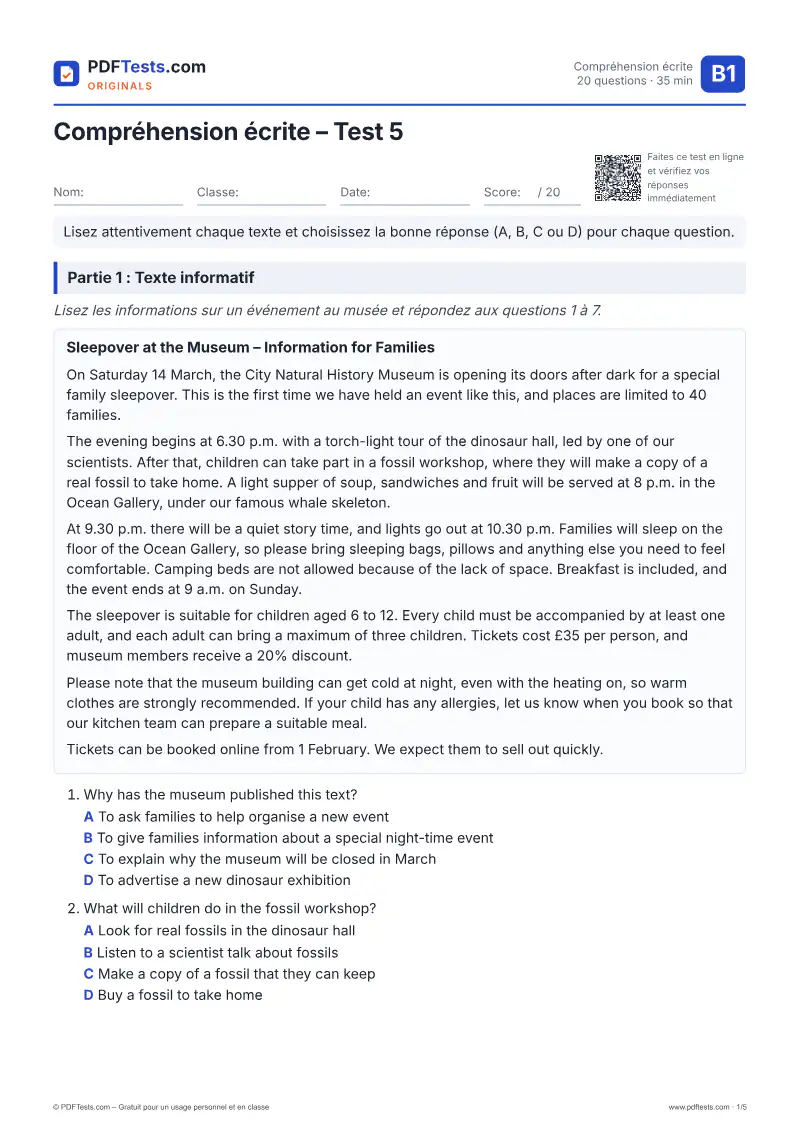
  3. What will families do in the Ocean Gallery?

  4. Why are camping beds not allowed?

  5. In paragraph 4, 'Every child must be accompanied by at least one adult' means that children _____.

  6. The museum notice says: "Workshop tickets: £35 per person (adults and children). Museum members get 20% off every ticket in their booking." Noor is a museum member. She books tickets for herself and her two children. How much will she pay in total?

  7. What does the museum mean by 'We expect them to sell out quickly'?

Partie 2 : Article de magazine

Lisez l'article sur un club insolite et répondez aux questions 8 à 14.

The Club Where Nobody Talks

Every Thursday evening, about twenty people gather in a small café in the centre of town. They order drinks, find a comfortable seat and then do something unusual: they stop talking. For the next hour, the only sounds are cups touching saucers and pages being turned.

This is the Quiet Hour Reading Club, started two years ago by Adebayo Mensah, a nurse who works long shifts. 'I used to love reading, but I had stopped completely,' he explains. 'At home there was always something else to do – washing, emails, my phone. I thought if I went somewhere just to read, I might actually manage it.'

He put up a poster in the café, expecting perhaps three or four people to come. Fourteen arrived on the first night. Now the club meets weekly, and there is sometimes a waiting list for seats.

The rules are simple. Members can read anything they like – novels, magazines, even cookbooks – but phones must stay in bags. When the hour is over, people are free to chat, and many stay to talk about what they have been reading. 'That's the part I didn't plan,' says Adebayo. 'People who were strangers have become good friends.'

Kim Larsen, a student who joined last year, admits she was nervous at first. 'I thought sitting in silence with strangers would feel awkward. In fact, it was really relaxing. I've read eleven books since I started, more than in the previous five years.'

Similar clubs have now started in two other cities, and Adebayo has been asked for advice. His answer is always the same: 'Keep it simple. Just bring a book.'

  1. Which sentence best describes the Quiet Hour Reading Club?

  2. Why did Adebayo start the club?

  3. What do we learn from paragraph 3?

  4. Which of these are members NOT allowed to do during the Quiet Hour?

  5. When Adebayo says 'That's the part I didn't plan', he is talking about _____.

  6. In paragraph 5, 'awkward' is closest in meaning to _____.

  7. What does Adebayo's advice 'Keep it simple. Just bring a book.' suggest?

Partie 3 : Nouvelle

Lisez l'histoire et répondez aux questions 15 à 20.

The Voice in the Kitchen

When her neighbour Mr Castillo went to visit his sister for a week, Ines agreed to look after his parrot, Pepe. 'He's no trouble,' Mr Castillo promised, handing her a bag of seeds and a long list of instructions. 'Just don't believe everything he says.'

Ines laughed. She didn't think much about the comment until the second night. She was lying in bed reading when she heard a deep voice from the kitchen: 'Who's there? Who's there?'

She froze. Her heart was beating so loudly she could hear it. Slowly, she picked up her phone, ready to call for help, and crept down the hall. The kitchen light was off. Then the voice came again, followed by a loud whistle.

Ines switched on the light. Pepe was sitting on top of his cage, looking very pleased with himself. Somehow he had opened the little door, and he had knocked a pile of plates onto the floor.

'That was you?' she said, and the parrot answered, 'Who's there?' in exactly the same deep voice.

The next morning, Ines sent Mr Castillo a message. He replied with three laughing faces. 'Sorry! That's my voice. He learned it from me when I answer the door. I should have warned you he can open the cage. Put a clothes peg on the door.'

For the rest of the week, the peg stayed on, and Pepe stayed inside. When Mr Castillo came home, Ines handed him the cage with a smile. 'He was no trouble,' she said. 'Well, almost.'

  1. Why was Ines looking after Pepe?

  2. What did Mr Castillo probably mean by 'Just don't believe everything he says'?

  3. In paragraph 3, 'crept down the hall' means that Ines _____.

  4. What had really happened in the kitchen?

  5. Why did the voice sound deep, like a man's?

  6. What does Ines's final comment 'Well, almost' suggest?

Cette page vous a-t-elle été utile ?

Signaler une erreur

Une mauvaise réponse, une faute de frappe ou une explication peu claire ? Dites-le-nous, nous corrigerons.

Aperçu

À propos de ce test

Ce test de compréhension écrite de niveau B1 comprend trois textes originaux de genres différents : une page d'information sur une nuit au musée, un article de magazine consacré à un club de lecture silencieuse et une courte histoire humoristique. Les 20 questions évaluent la compréhension globale, la compréhension détaillée, l'inférence et le vocabulaire en contexte. Il s'adresse aux apprenants de niveau intermédiaire qui préparent un examen B1, ainsi qu'à toute personne souhaitant s'entraîner à lire attentivement.

Thèmes abordés

Compréhension globaleCompréhension détailléeInférenceVocabulaire en contexteAnnonces et textes informatifsArticles de magazineNouvelles

Comment utiliser ce test

  1. Téléchargez le PDF et imprimez-le, ou faites le test en ligne ci-dessous.
  2. Répondez à toutes les questions sans dictionnaire et sans vous presser.
  3. Vérifiez vos réponses et notez les points à revoir.

Notes pour l’enseignant

Prévoyez environ 35 minutes et incitez les élèves à lire chaque texte une première fois pour en saisir le sens général avant de répondre. Plusieurs questions ciblent des erreurs fréquentes au niveau B1 : choisir une réponse parce qu'elle reprend des mots du texte, mal interpréter des conditions (âges, limites, réductions) et ne pas tenir compte du ton du narrateur ou du locuteur. En prolongement, demandez aux élèves de souligner dans le texte les indices qui justifient chaque réponse, ou de rédiger une courte annonce ou une petite histoire dans le même style.