PDFTests Originals

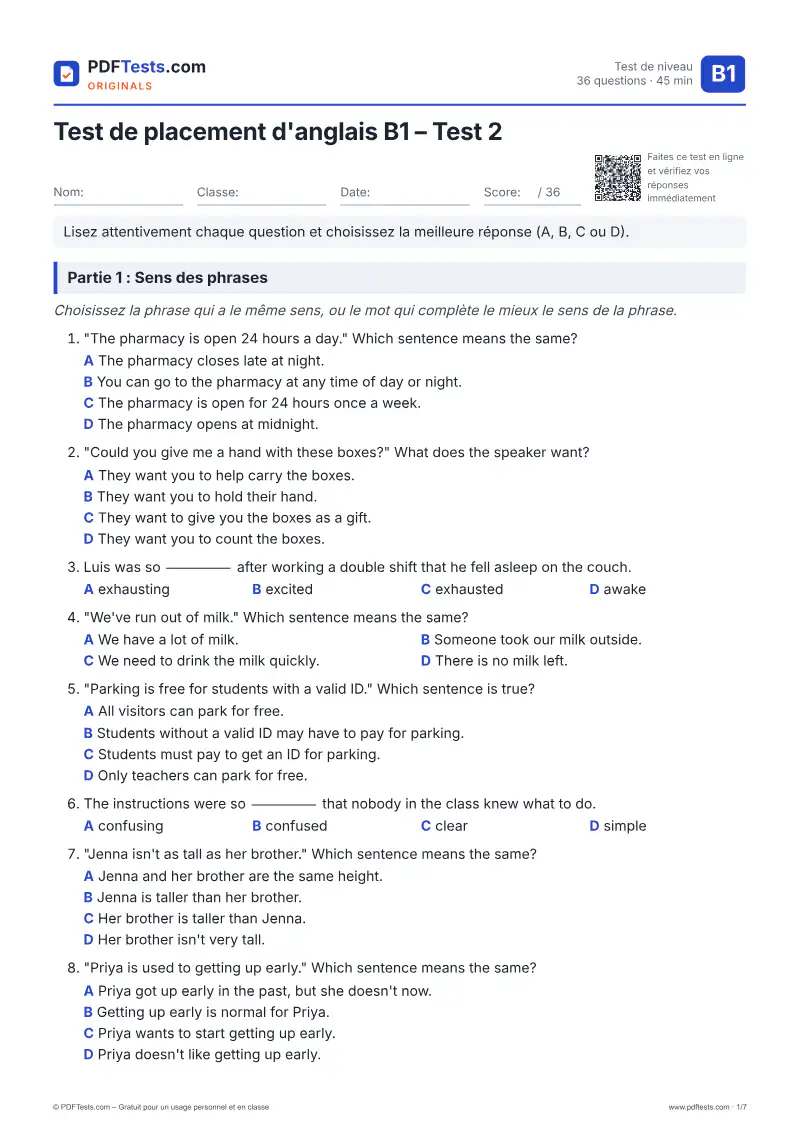
Test de placement d'anglais B1 – Test 2

B1 Intermédiaire Test de niveauAnglais

Ce test de placement d'anglais de niveau B1 permet de vérifier si des apprenants adultes ou étudiants maîtrisent solidement le niveau intermédiaire. Il porte sur le sens des phrases, les points de grammaire essentiels du B1 et deux courts textes sur la vie quotidienne aux États-Unis. Il convient aux apprenants qui préparent un test de placement d'anglais (ESL) dans une université ou un centre de formation pour adultes, ainsi qu'aux enseignants qui souhaitent évaluer rapidement le niveau de leur groupe.
Questions
36
Durée
45 min
PDF
7 pages
Corrigé
Inclus
  • 100 % gratuit
  • Sans inscription
  • PDF A4 prêt à imprimer
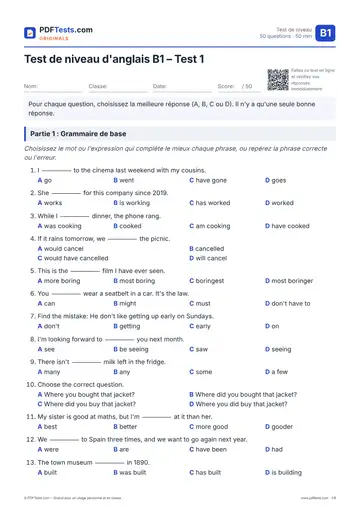
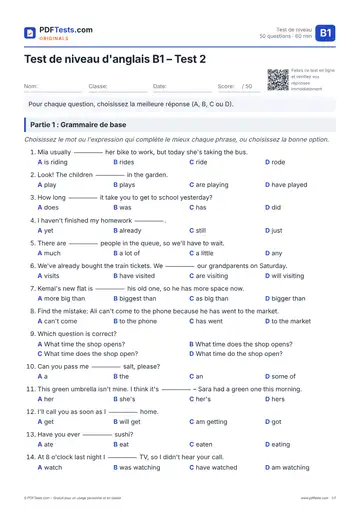
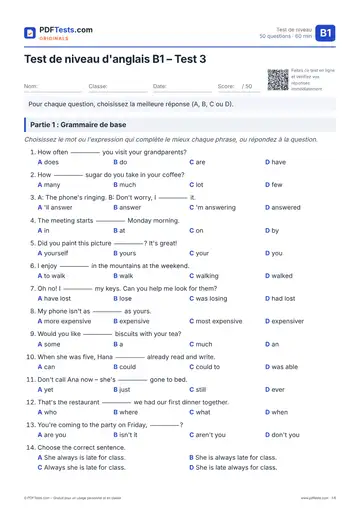
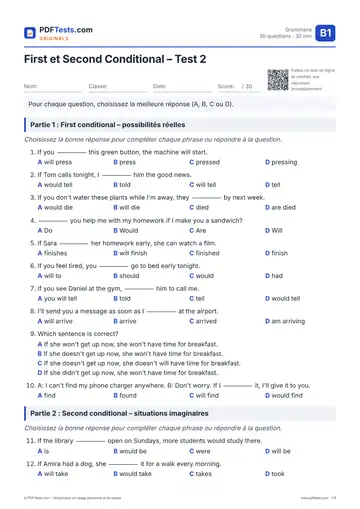
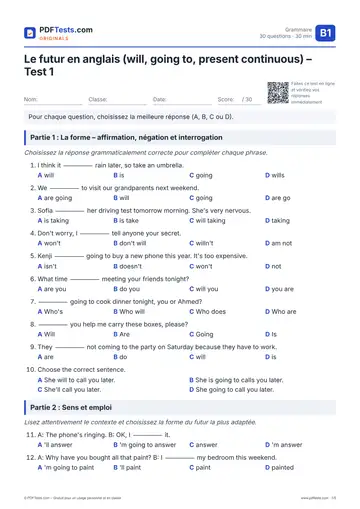
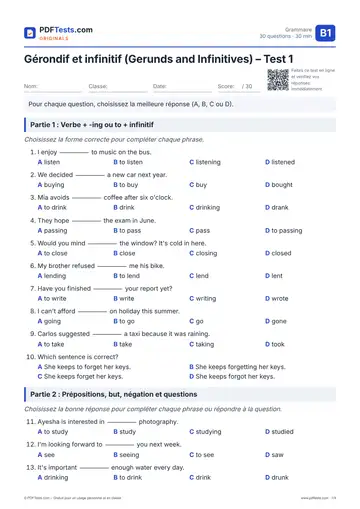
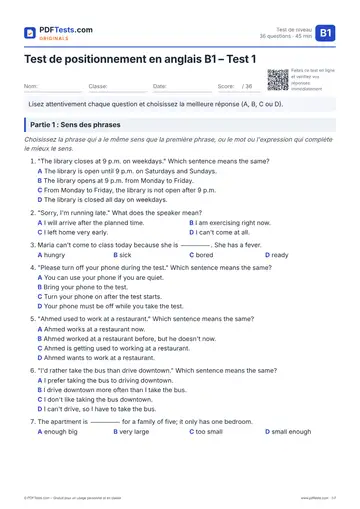
Aperçu de la page 1 : Test de placement d'anglais B1 – Test 2 Ouvrir le PDF
Test de placement ESL · tous les tests d’entraînement, niveaux et conseils

Faire le test en ligne

Lisez attentivement chaque question et choisissez la meilleure réponse (A, B, C ou D). Choisissez vos réponses, puis cliquez sur « Vérifier mes réponses ».

Partie 1 : Sens des phrases

Choisissez la phrase qui a le même sens, ou le mot qui complète le mieux le sens de la phrase.

  1. "The pharmacy is open 24 hours a day." Which sentence means the same?

  2. "Could you give me a hand with these boxes?" What does the speaker want?

  3. Luis was so _____ after working a double shift that he fell asleep on the couch.

  4. "We've run out of milk." Which sentence means the same?

  5. "Parking is free for students with a valid ID." Which sentence is true?

  6. The instructions were so _____ that nobody in the class knew what to do.

  7. "Jenna isn't as tall as her brother." Which sentence means the same?

  8. "Priya is used to getting up early." Which sentence means the same?

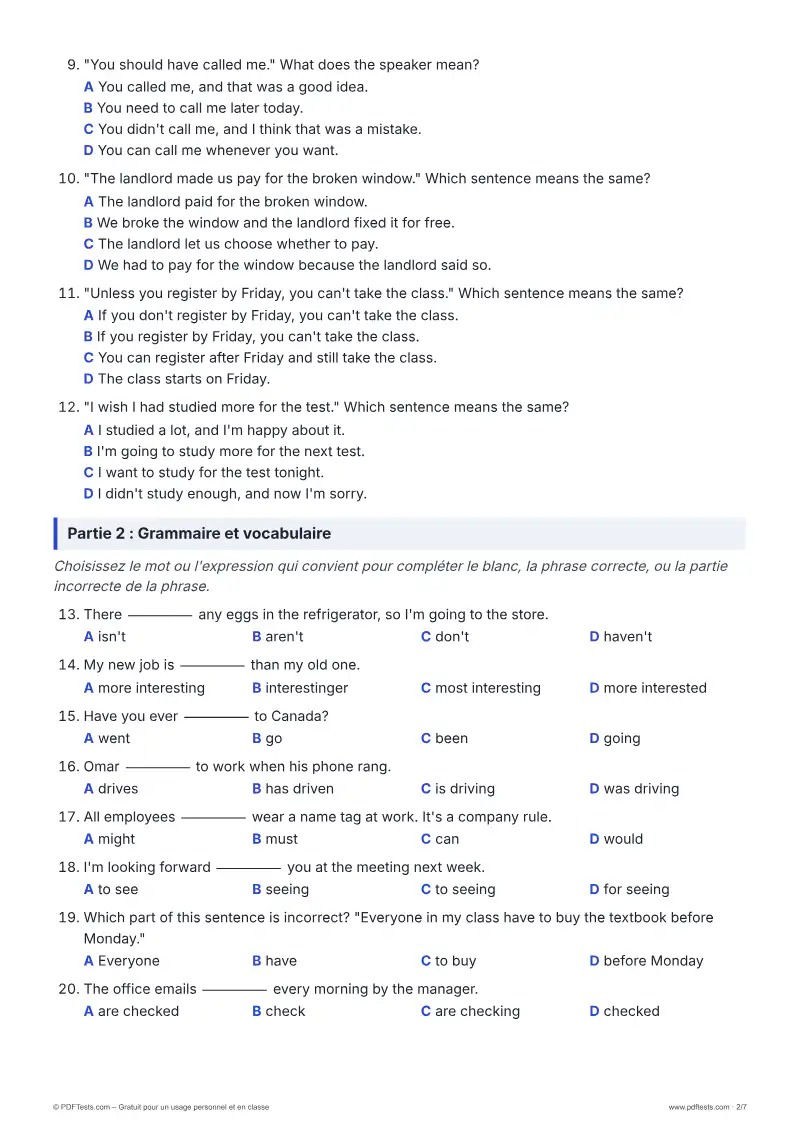
  9. "You should have called me." What does the speaker mean?

  10. "The landlord made us pay for the broken window." Which sentence means the same?

  11. "Unless you register by Friday, you can't take the class." Which sentence means the same?

  12. "I wish I had studied more for the test." Which sentence means the same?

Partie 2 : Grammaire et vocabulaire

Choisissez le mot ou l'expression qui convient pour compléter le blanc, la phrase correcte, ou la partie incorrecte de la phrase.

  1. There _____ any eggs in the refrigerator, so I'm going to the store.

  2. My new job is _____ than my old one.

  3. Have you ever _____ to Canada?

  4. Omar _____ to work when his phone rang.

  5. All employees _____ wear a name tag at work. It's a company rule.

  6. I'm looking forward _____ you at the meeting next week.

  7. Which part of this sentence is incorrect? "Everyone in my class have to buy the textbook before Monday."

  8. The office emails _____ every morning by the manager.

  9. If I _____ you, I would talk to your manager about the schedule.

  10. This is the restaurant _____ we had our first date.

  11. Sam told me that he _____ his new job the day before.

  12. Which sentence is correct?

Partie 3 : Compréhension écrite – Avis aux résidents

Lisez l'avis et répondez aux questions.

NOTICE TO ALL RESIDENTS – MAPLE COURT APARTMENTS

Dear Residents,

On Wednesday, October 16, the city will repair a water pipe under Elm Street. Because of this work, there will be no water in the building from 9:00 a.m. to 3:00 p.m. Please fill some bottles with water the night before, and do not use dishwashers or washing machines during this time.

The laundry room will also be closed all day on Wednesday so that our maintenance team can clean the machines. It will open again on Thursday at 7:00 a.m. We are sorry for any inconvenience.

We would also like to remind you that the parking lot will be repainted on Saturday, October 19. All cars must be moved to the street by 8:00 a.m. Cars that are still in the lot will be towed at the owner's expense.

If you have any questions, please call the management office at (555) 014-2290, Monday through Friday, 8:30 a.m. to 5:00 p.m., or leave a note in the box next to the mailboxes.

Thank you,

Gloria Mendez, Building Manager

  1. Why will there be no water in the building on Wednesday?

  2. What does the manager ask residents to do the night before the water is turned off?

  3. When can residents use the laundry room again?

  4. A car is still in the parking lot at 9:00 a.m. on Saturday. What will probably happen?

  5. In the sentence "Cars that are still in the lot will be towed at the owner's expense," the phrase "at the owner's expense" means:

  6. A resident has a question on Sunday. What can they do?

Partie 4 : Compréhension écrite – Une nouvelle conductrice

Lisez le texte et répondez aux questions.

When Rosa Delgado moved to Phoenix with her two children, she quickly learned that life without a car was difficult. The bus stop was a twenty-minute walk from her apartment, and in summer the temperature often reached 110 degrees. Getting to her job at a medical office and taking the kids to school took hours every day.

Rosa had driven a little in her home country, but she had never had a license. In Arizona, she first needed to pass a written test about traffic laws. The test was available in Spanish, but Rosa decided to take it in English. "I wanted to understand the road signs, and the police if they ever stopped me," she explains. Every night after the children went to bed, she studied the driver's manual with a dictionary next to her. She failed the written test the first time by just two questions, but she passed easily three weeks later.

The driving test was harder. A coworker, Mei, offered to let Rosa practice in her car on Sunday mornings, when the streets were quiet. Mei was patient, but she also told Rosa honestly when she made mistakes, especially with parking. After two months of practice, Rosa passed the road test on her first try.

Today Rosa drives to work in fifteen minutes. She has also started giving rides to two neighbors who don't have cars. "Someone helped me, so now I help other people," she says. "And my English got better, too. I never expected that from a driving test."

  1. Why was life difficult for Rosa when she first arrived in Phoenix?

  2. Why did Rosa decide to take the written test in English?

  3. What happened the first time Rosa took the written test?

  4. Why did Rosa and Mei practice on Sunday mornings?

  5. What can we infer about Mei?

  6. Which title best fits the text?

Cette page vous a-t-elle été utile ?

Signaler une erreur

Une mauvaise réponse, une faute de frappe ou une explication peu claire ? Dites-le-nous, nous corrigerons.

Aperçu

À propos de ce test

Ce test de placement d'anglais de niveau B1 permet de vérifier si des apprenants adultes ou étudiants maîtrisent solidement le niveau intermédiaire. Il porte sur le sens des phrases, les points de grammaire essentiels du B1 et deux courts textes sur la vie quotidienne aux États-Unis. Il convient aux apprenants qui préparent un test de placement d'anglais (ESL) dans une université ou un centre de formation pour adultes, ainsi qu'aux enseignants qui souhaitent évaluer rapidement le niveau de leur groupe.

Thèmes abordés

Sens des phrasesVocabulaire en contexteTemps verbauxModaux et phrases conditionnellesVoix passive et discours indirectGérondif et infinitifCompréhension écrite

Comment utiliser ce test

  1. Téléchargez le PDF et imprimez-le, ou faites le test en ligne ci-dessous.
  2. Répondez à toutes les questions sans dictionnaire et sans vous presser.
  3. Vérifiez vos réponses et notez les points à revoir.

Notes pour l’enseignant

Prévoyez environ 45 minutes, sans dictionnaire. Un score de 29/36 ou plus indique que l'apprenant maîtrise solidement le niveau B1 ; entre 20 et 28, il travaille au niveau B1 mais a besoin de s'entraîner davantage ; en dessous de 20, une orientation vers le niveau A2 est conseillée. Les questions ciblent des erreurs fréquentes : confusion entre « used to » et « be used to », accord du verbe avec « everyone », « look forward to + -ing » et emploi du past perfect au discours indirect. En prolongement, demandez aux apprenants de corriger les options fausses de la partie 2 et d'expliquer pourquoi elles sont incorrectes.