PDFTests Originals

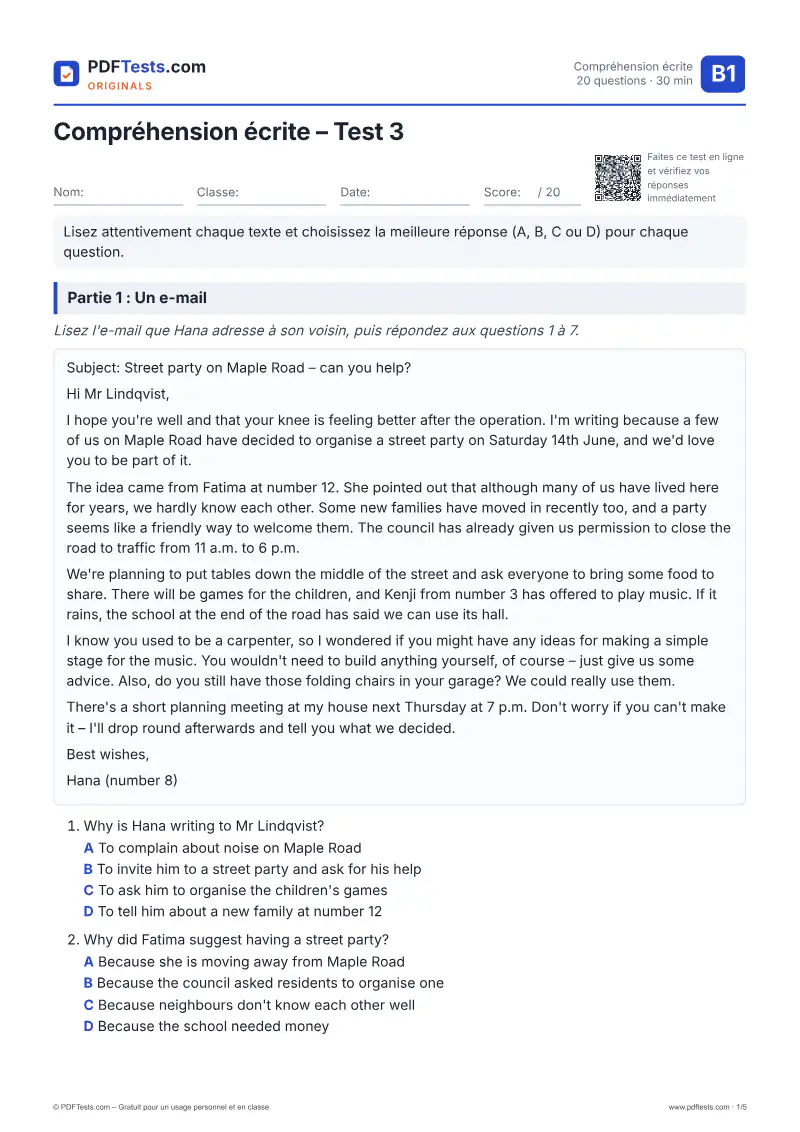
Compréhension écrite – Test 3

B1 Intermédiaire Compréhension écriteAnglais

Ce test de compréhension écrite de niveau B1 propose trois textes originaux : un e-mail entre voisins, un article de presse sur des dimanches sans voiture et une courte nouvelle racontant un dîner qui tourne mal. Les 20 questions évaluent la compréhension des idées principales, des détails, de l'implicite et du vocabulaire en contexte. Il s'adresse aux apprenants de niveau intermédiaire qui préparent un examen B1 et aux enseignants qui cherchent une évaluation de lecture clé en main.
Questions
20
Durée
30 min
PDF
5 pages
Corrigé
Inclus
  • 100 % gratuit
  • Sans inscription
  • PDF A4 prêt à imprimer
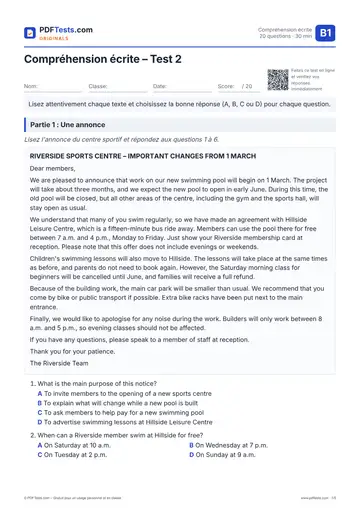
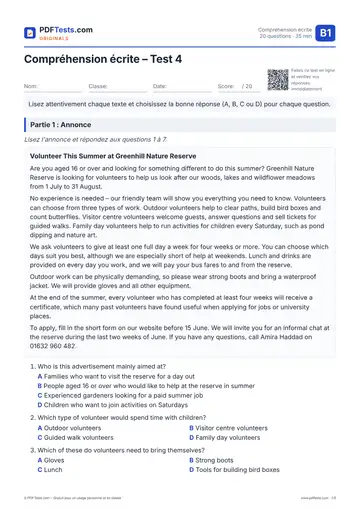
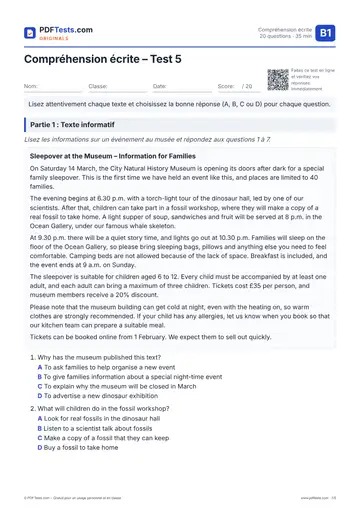
Aperçu de la page 1 : Compréhension écrite – Test 3 Ouvrir le PDF

Faire le test en ligne

Lisez attentivement chaque texte et choisissez la meilleure réponse (A, B, C ou D) pour chaque question. Choisissez vos réponses, puis cliquez sur « Vérifier mes réponses ».

Partie 1 : Un e-mail

Lisez l'e-mail que Hana adresse à son voisin, puis répondez aux questions 1 à 7.

Subject: Street party on Maple Road – can you help?

Hi Mr Lindqvist,

I hope you're well and that your knee is feeling better after the operation. I'm writing because a few of us on Maple Road have decided to organise a street party on Saturday 14th June, and we'd love you to be part of it.

The idea came from Fatima at number 12. She pointed out that although many of us have lived here for years, we hardly know each other. Some new families have moved in recently too, and a party seems like a friendly way to welcome them. The council has already given us permission to close the road to traffic from 11 a.m. to 6 p.m.

We're planning to put tables down the middle of the street and ask everyone to bring some food to share. There will be games for the children, and Kenji from number 3 has offered to play music. If it rains, the school at the end of the road has said we can use its hall.

I know you used to be a carpenter, so I wondered if you might have any ideas for making a simple stage for the music. You wouldn't need to build anything yourself, of course – just give us some advice. Also, do you still have those folding chairs in your garage? We could really use them.

There's a short planning meeting at my house next Thursday at 7 p.m. Don't worry if you can't make it – I'll drop round afterwards and tell you what we decided.

Best wishes,

Hana (number 8)

  1. Why is Hana writing to Mr Lindqvist?

  2. Why did Fatima suggest having a street party?

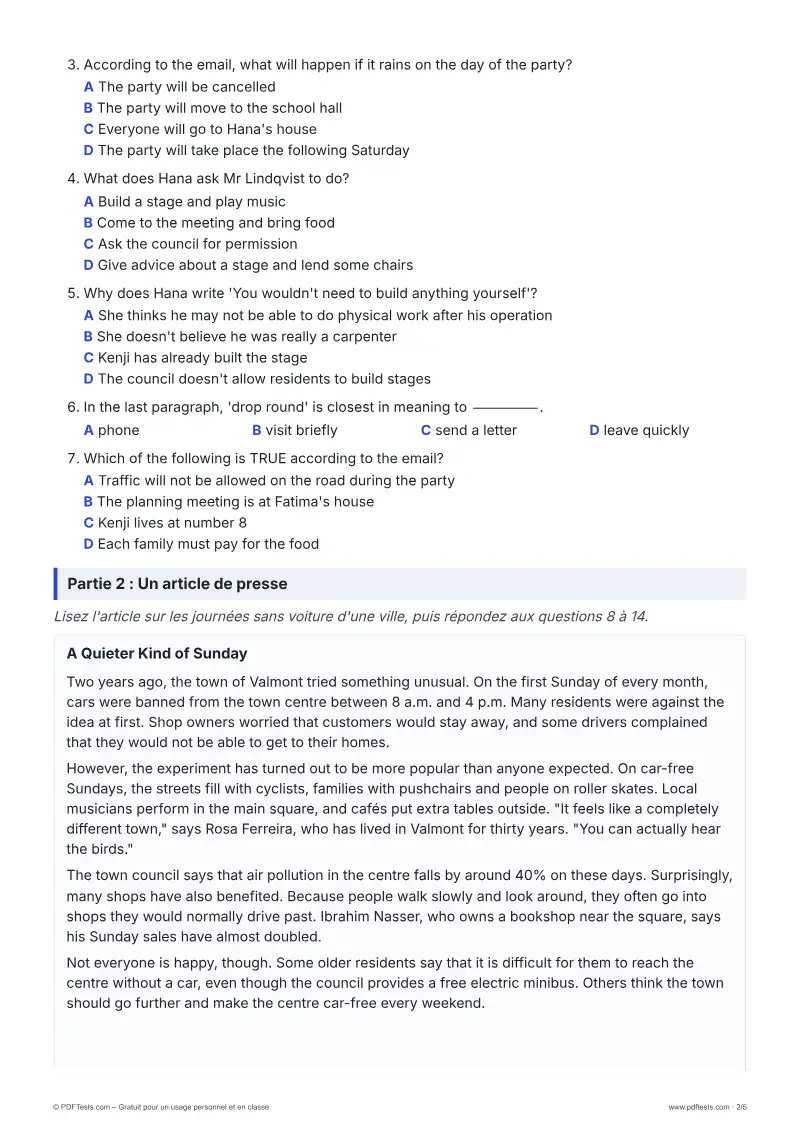
  3. According to the email, what will happen if it rains on the day of the party?

  4. What does Hana ask Mr Lindqvist to do?

  5. Why does Hana write 'You wouldn't need to build anything yourself'?

  6. In the last paragraph, 'drop round' is closest in meaning to _____.

  7. Which of the following is TRUE according to the email?

Partie 2 : Un article de presse

Lisez l'article sur les journées sans voiture d'une ville, puis répondez aux questions 8 à 14.

A Quieter Kind of Sunday

Two years ago, the town of Valmont tried something unusual. On the first Sunday of every month, cars were banned from the town centre between 8 a.m. and 4 p.m. Many residents were against the idea at first. Shop owners worried that customers would stay away, and some drivers complained that they would not be able to get to their homes.

However, the experiment has turned out to be more popular than anyone expected. On car-free Sundays, the streets fill with cyclists, families with pushchairs and people on roller skates. Local musicians perform in the main square, and cafés put extra tables outside. "It feels like a completely different town," says Rosa Ferreira, who has lived in Valmont for thirty years. "You can actually hear the birds."

The town council says that air pollution in the centre falls by around 40% on these days. Surprisingly, many shops have also benefited. Because people walk slowly and look around, they often go into shops they would normally drive past. Ibrahim Nasser, who owns a bookshop near the square, says his Sunday sales have almost doubled.

Not everyone is happy, though. Some older residents say that it is difficult for them to reach the centre without a car, even though the council provides a free electric minibus. Others think the town should go further and make the centre car-free every weekend.

The council is now asking residents for their opinions. A decision about the future of the scheme is expected later this year.

  1. Which would be the best alternative title for the article?

  2. What were shop owners worried about before the first car-free Sunday?

  3. In paragraph 2, 'has turned out to be' is closest in meaning to _____.

  4. Why have some shops sold more on car-free Sundays?

  5. What does Rosa Ferreira's comment 'You can actually hear the birds' suggest?

  6. According to paragraph 4, how do opinions differ about the scheme?

  7. What is happening with the scheme at the moment?

Partie 3 : Une nouvelle

Lisez l'histoire, puis répondez aux questions 15 à 20.

The Dinner

Sami had been planning the dinner for weeks. It was the first time Leila's parents were coming to his flat, and he wanted everything to be perfect. He had chosen a recipe for a fish dish with lemon and herbs, and he had practised it twice the weekend before.

At half past six, an hour before the guests were due, he put the potatoes in the oven and began to prepare the sauce. Then, without warning, the lights went out. The fridge stopped humming, and the oven went silent. Sami looked out of the window. The whole street was dark.

He called the electricity company, but a recorded message said the power would not be back for at least three hours. Sami sat down on the kitchen floor and put his head in his hands. What would Leila's parents think of him now?

When Leila arrived with her parents, she found him lighting candles. "We have a small problem," he said, trying to smile. To his surprise, Leila's father laughed. "This reminds me of our first year of marriage," he said. "We had no electricity for a week!"

In the end, they ate bread, cheese, tomatoes and olives by candlelight, and Leila's mother told stories about her childhood in the countryside. Nobody mentioned the fish. At ten o'clock, just as they were leaving, the lights came back on.

"Next time," said Leila's father, shaking Sami's hand, "you can cook the fish. But I'm not sure it will be as good as tonight."

  1. Why was the dinner so important to Sami?

  2. What went wrong at half past six?

  3. How did Sami feel after he called the electricity company?

  4. Why did Leila's father laugh when he saw the candles?

  5. What did Sami and his guests do during the evening?

  6. What does Leila's father's final comment suggest?

Cette page vous a-t-elle été utile ?

Signaler une erreur

Une mauvaise réponse, une faute de frappe ou une explication peu claire ? Dites-le-nous, nous corrigerons.

Aperçu

À propos de ce test

Ce test de compréhension écrite de niveau B1 propose trois textes originaux : un e-mail entre voisins, un article de presse sur des dimanches sans voiture et une courte nouvelle racontant un dîner qui tourne mal. Les 20 questions évaluent la compréhension des idées principales, des détails, de l'implicite et du vocabulaire en contexte. Il s'adresse aux apprenants de niveau intermédiaire qui préparent un examen B1 et aux enseignants qui cherchent une évaluation de lecture clé en main.

Thèmes abordés

Compréhension écriteE-mailArticle de presseNouvelleInférenceVocabulaire en contexteCompréhension globale et détaillée

Comment utiliser ce test

  1. Téléchargez le PDF et imprimez-le, ou faites le test en ligne ci-dessous.
  2. Répondez à toutes les questions sans dictionnaire et sans vous presser.
  3. Vérifiez vos réponses et notez les points à revoir.

Notes pour l’enseignant

Vous pouvez utiliser ce test comme évaluation chronométrée ou comme travail en classe, puis faire comparer les réponses en binômes. De nombreuses questions ciblent des difficultés typiques du niveau B1 : choisir une option qui reprend des mots du texte mais en change le sens, confondre les noms et les détails, ou prendre au pied de la lettre des verbes à particule (phrasal verbs) et des expressions idiomatiques. En prolongement, demandez aux élèves de répondre à l'e-mail de Hana ou de rédiger un court paragraphe argumenté pour dire si leur ville devrait organiser des journées sans voiture.