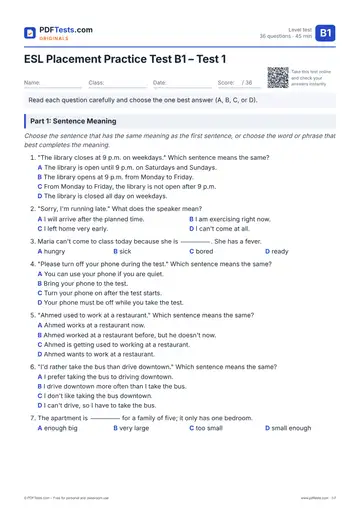
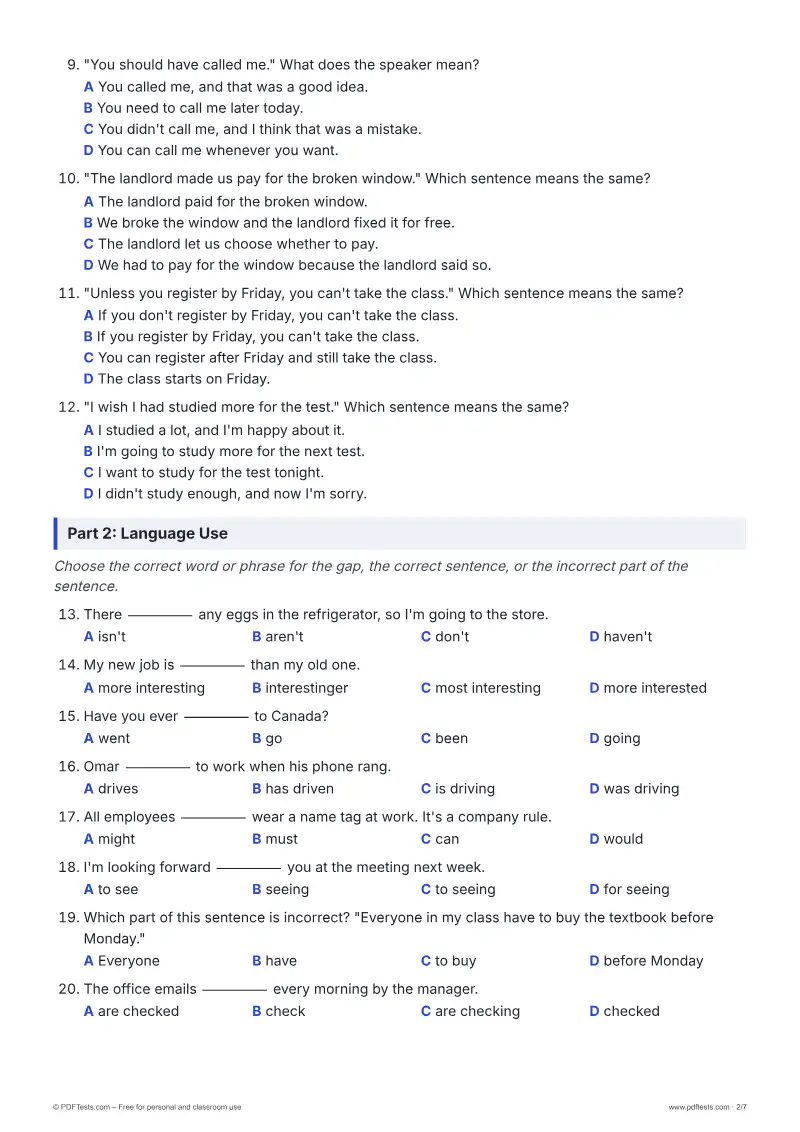
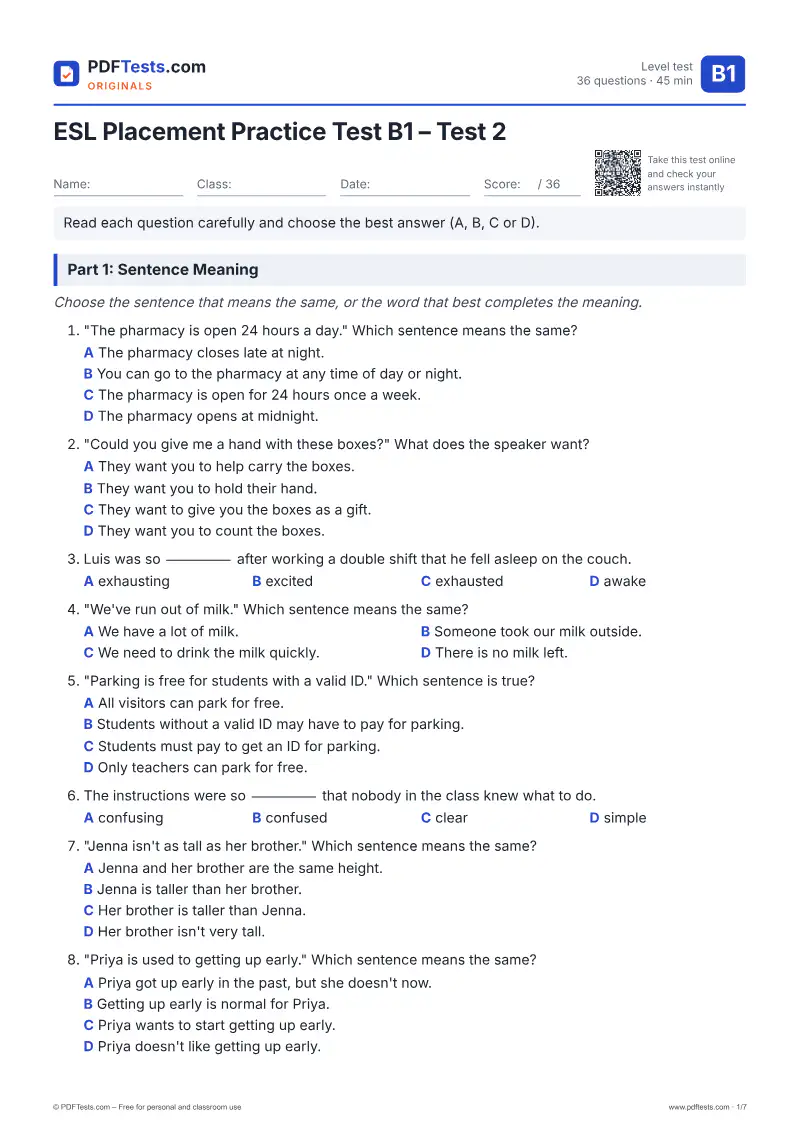
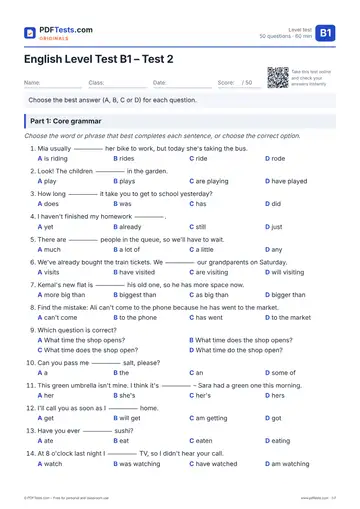
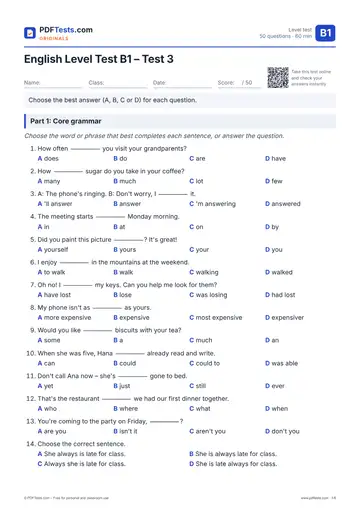
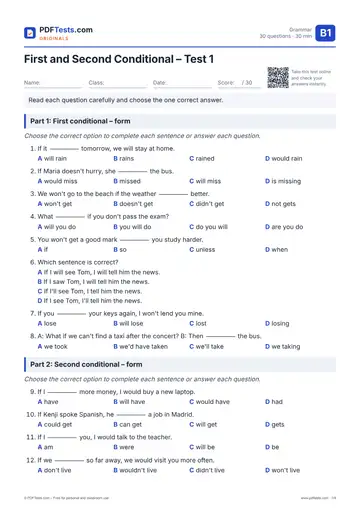
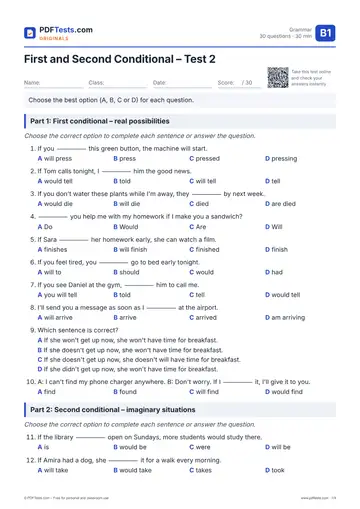
This B1 ESL placement practice test checks whether adult and college learners are secure at the intermediate level. It covers sentence meaning, core B1 grammar and two short reading texts about everyday life in the United States. It suits learners preparing for a college or adult-education ESL placement test and teachers who need a quick level check.
Read each question carefully and choose the best answer (A, B, C or D). Choose your answers, then press “Check my answers”.
0%
Your result
[["Keep practising","This topic needs more practice. Start with the guide, then try a worksheet."],["Good start","You know the basics. Read the guide and practise the parts you missed."],["Very good!","Just a few slips. Review your mistakes, then try the next test."],["Excellent!","You have mastered this topic. Ready for the next challenge?"]]
Please describe the problem in a few words. Sorry, the report could not be sent. Please email us at [email protected].
Preview
About this test
This B1 ESL placement practice test checks whether adult and college learners are secure at the intermediate level. It covers sentence meaning, core B1 grammar and two short reading texts about everyday life in the United States. It suits learners preparing for a college or adult-education ESL placement test and teachers who need a quick level check.
Topics covered
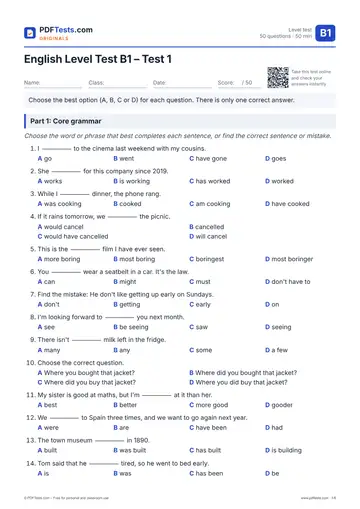
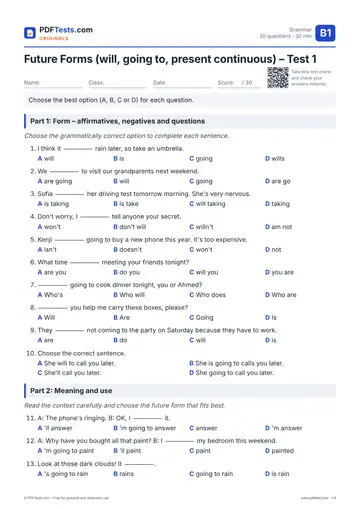
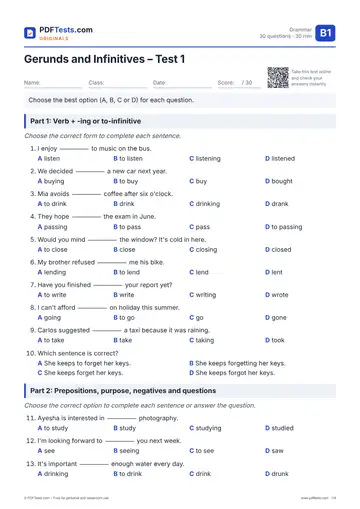
Sentence meaningVocabulary in contextVerb tensesModals and conditionalsPassive voice and reported speechGerunds and infinitivesReading comprehension
How to use this test
Download the PDF and print it, or take the test online below.
Answer every question without a dictionary or time pressure.
Check your answers and note the topics you need to review.
Notes for teachers
Give learners about 45 minutes without dictionaries. A score of 29/36 or higher suggests a learner is secure at B1; 20-28 suggests they are working at B1 but need more practice; below 20 suggests placement at A2. The items target common errors such as confusing 'used to' with 'be used to', subject-verb agreement with 'everyone', 'look forward to + -ing' and the past perfect in reported speech. As a follow-up, have learners correct the wrong options in Part 2 and explain why they are wrong.
 B1
 Open PDF
 B1
 B1
 B1
 B1
 B1
 B1
 B1