PDFTests Originals

Collocations et nuances (C2) – Fiche 1

C2 Maîtrise FicheAnglais

Cette fiche de niveau C2 fait travailler en contexte les collocations et expressions idiomatiques avancées de l'anglais, comme « allay fears », « bear the brunt » ou « a foregone conclusion ». Elle aborde aussi les prépositions régies, la formation des mots et les transformations de phrases à partir d'un mot clé. Elle s'adresse aux apprenants de niveau maîtrise et aux candidats aux examens qui veulent un anglais précis et naturel.

items
39
Durée
40 min
PDF
5 pages
Corrigé
Inclus
  • 100 % gratuit
  • Sans inscription
  • PDF A4 prêt à imprimer
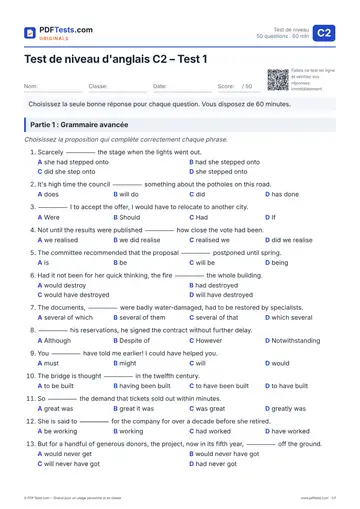
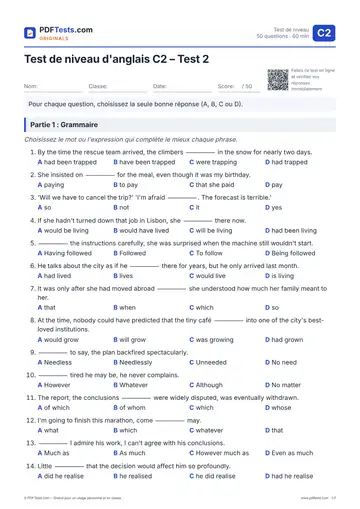
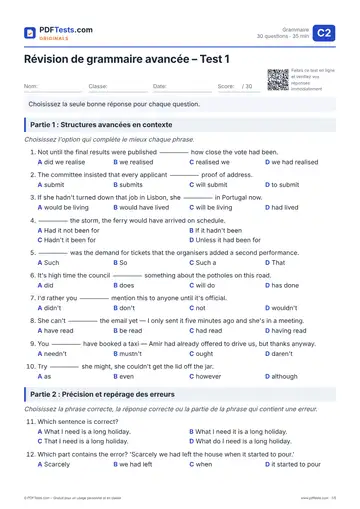
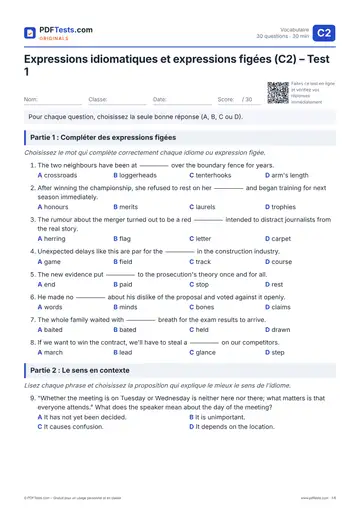
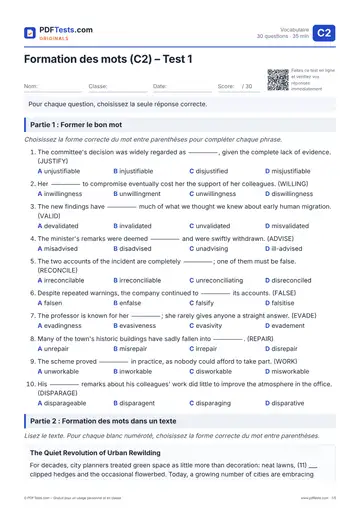
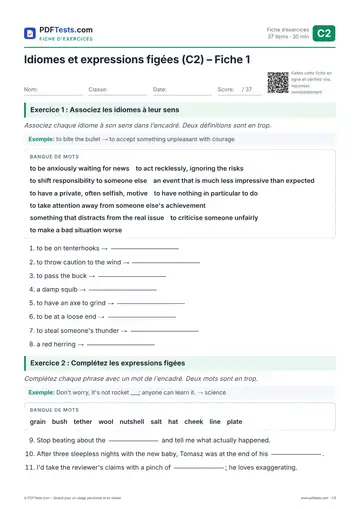
Aperçu de la page 1 : Collocations et nuances (C2) – Fiche 1 Ouvrir le PDF

Faire la fiche en ligne

Tapez vos réponses puis cliquez sur « Vérifier mes réponses ». Les autres réponses correctes sont acceptées.

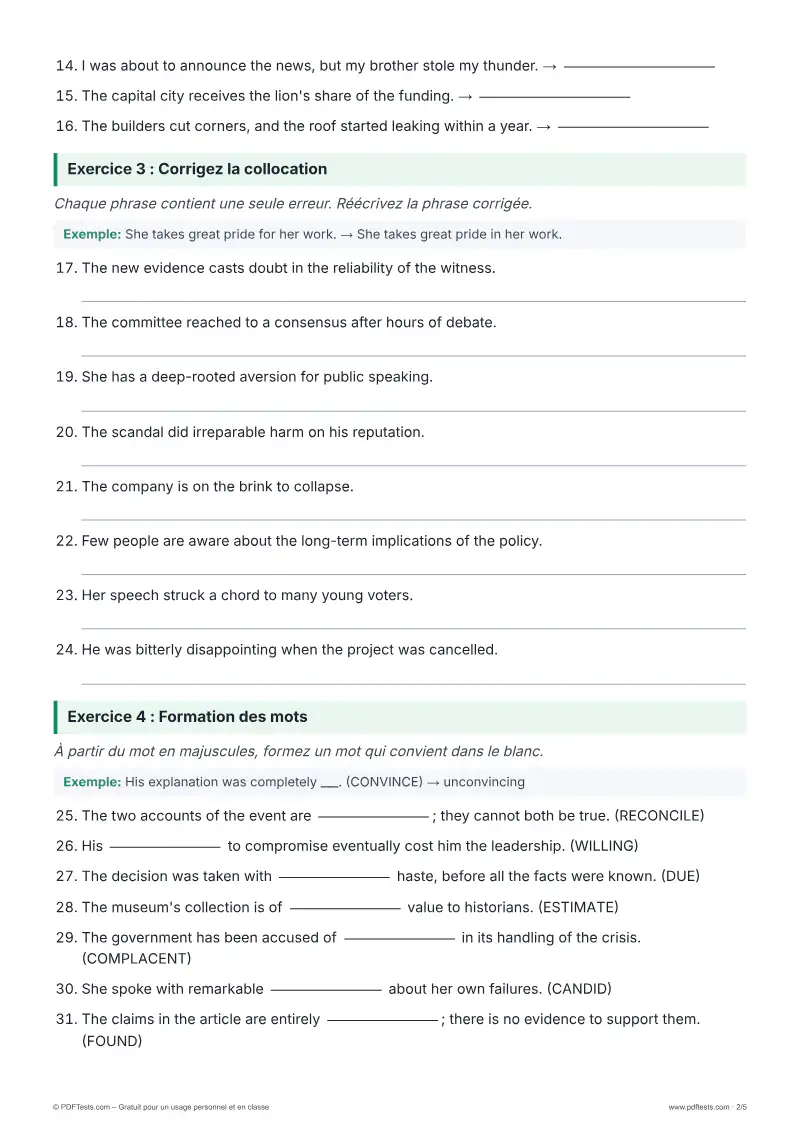
Exercice 1 : Collocations verbe + nom

Complétez chaque phrase avec un verbe de l'encadré. Utilisez chaque verbe une seule fois. Deux verbes sont en trop.

Exemple: The new policy is likely to ___ controversy. → spark

Banque de mots harbourallaystrikewreakbearpaydrawraisecommitfoster

  1. Many residents still serious doubts about the new flood defences.

  2. The minister tried to fears that the factory would close.

  3. It is difficult to a balance between privacy and security.

  4. The storm continued to havoc along the coast for two days.

  5. Low-income families tend to the brunt of rising energy prices.

  6. Critics argue that the company does little more than lip service to sustainability.

  7. We need to a clear distinction between criticism and abuse.

  8. His unconventional methods are bound to a few eyebrows among senior staff.

Exercice 2 : Expressions idiomatiques et leur sens

Associez chaque expression en gras à sa signification dans l'encadré. Une signification est en trop.

Banque de mots to argue about very small, unimportant differencesa result that is certain before it happensin strong disagreementsomething that distracts attention from the real issueto follow the rules or official policyto take attention or praise away from someonethe largest part of somethingto do something cheaply or carelessly to save time or moneyto make a situation calmer after an argument

  1. Let's not split hairs over the exact wording of the contract.

  2. With such a strong team, victory was a foregone conclusion.

  3. The two neighbours have been at loggerheads for years.

  4. The detective soon realised the missing key was a red herring.

  5. Junior staff are expected to toe the line and not question decisions.

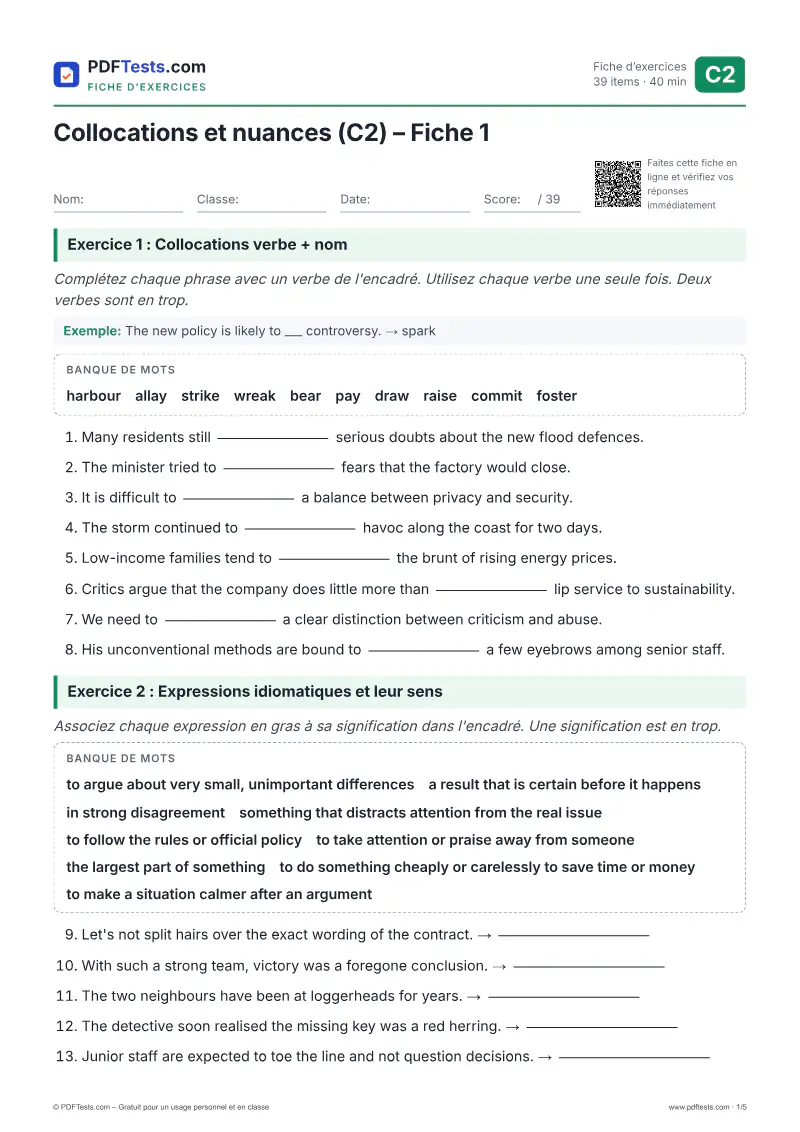
  6. I was about to announce the news, but my brother stole my thunder.

  7. The capital city receives the lion's share of the funding.

  8. The builders cut corners, and the roof started leaking within a year.

Exercice 3 : Corrigez la collocation

Chaque phrase contient une seule erreur. Réécrivez la phrase corrigée.

Exemple: She takes great pride for her work. → She takes great pride in her work.

  1. The new evidence casts doubt in the reliability of the witness.

  2. The committee reached to a consensus after hours of debate.

  3. She has a deep-rooted aversion for public speaking.

  4. The scandal did irreparable harm on his reputation.

  5. The company is on the brink to collapse.

  6. Few people are aware about the long-term implications of the policy.

  7. Her speech struck a chord to many young voters.

  8. He was bitterly disappointing when the project was cancelled.

Exercice 4 : Formation des mots

À partir du mot en majuscules, formez un mot qui convient dans le blanc.

Exemple: His explanation was completely ___. (CONVINCE) → unconvincing

  1. The two accounts of the event are ; they cannot both be true. (RECONCILE)

  2. His to compromise eventually cost him the leadership. (WILLING)

  3. The decision was taken with haste, before all the facts were known. (DUE)

  4. The museum's collection is of value to historians. (ESTIMATE)

  5. The government has been accused of in its handling of the crisis. (COMPLACENT)

  6. She spoke with remarkable about her own failures. (CANDID)

  7. The claims in the article are entirely ; there is no evidence to support them. (FOUND)

  8. Neither side believed a word the other said, so the negotiations took place in an atmosphere of mutual . (TRUST)

Exercice 5 : Transformations avec mot clé

Complétez la deuxième phrase pour qu'elle ait le même sens que la première, en utilisant le mot en majuscules. Écrivez la phrase entière.

Exemple: She was the first to tell everyone the news, so I had nothing left to announce. (THUNDER) → She stole ___. → She stole my thunder.

  1. Everyone knew in advance how the vote would end. (FOREGONE) → The outcome of the vote was ___.

  2. The two departments strongly disagree about the budget. (LOGGERHEADS) → The two departments are ___ the budget.

  3. The poorest regions suffered most from the cuts. (BRUNT) → The poorest regions bore ___.

  4. The manager tried to reduce the staff's fears. (ALLAY) → The manager tried ___.

  5. His remarks surprised many of the delegates. (EYEBROWS) → His remarks ___ among many of the delegates.

  6. The company claims to care about environmental issues, but it does nothing. (LIP) → The company only pays ___ environmental issues.

  7. The author did the research quickly and carelessly to save time. (CORNERS) → The author ___ in the research.

Cette page vous a-t-elle été utile ?

Signaler une erreur

Une mauvaise réponse, une faute de frappe ou une explication peu claire ? Dites-le-nous, nous corrigerons.

Aperçu

À propos de ce test

Fiche d'exercices d'anglais C2 en PDF : collocations verbe-nom, expressions idiomatiques, prépositions, formation des mots et transformations.

Thèmes abordés

Collocations verbe + nomExpressions idiomatiquesPrépositions régiesFormation des motsTransformations avec mot clé

Notes pour l’enseignant

Commencez par les exercices 1 et 2 : les collocations et expressions idiomatiques qu'ils présentent sont réutilisées dans les transformations de l'exercice 5. Erreurs fréquentes : mauvaise préposition régie (« aware about », « harm on »), ajout de « to » après « reach » et choix du mauvais préfixe négatif en formation des mots (par ex. « disfounded » au lieu de « unfounded »). En prolongement, demandez aux apprenants de rédiger un court paragraphe argumentatif sur un sujet local en utilisant au moins six des expressions étudiées.
Tous les tests Anglais C2 →