PDFTests Originals

Idiomes et expressions figées (C2) – Fiche 1

C2 Maîtrise FicheAnglais

Cette fiche permet de travailler en contexte des idiomes et des expressions figées de niveau avancé en anglais, en mettant l'accent sur le sens, les combinaisons de mots figées et la formation des mots. Elle s'adresse aux apprenants de niveau C2 et aux utilisateurs expérimentés qui souhaitent employer la langue idiomatique avec précision et naturel.

items
37
Durée
35 min
PDF
5 pages
Corrigé
Inclus
  • 100 % gratuit
  • Sans inscription
  • PDF A4 prêt à imprimer
Aperçu de la page 1 : Idiomes et expressions figées (C2) – Fiche 1 Ouvrir le PDF

Faire la fiche en ligne

Tapez vos réponses puis cliquez sur « Vérifier mes réponses ». Les autres réponses correctes sont acceptées.

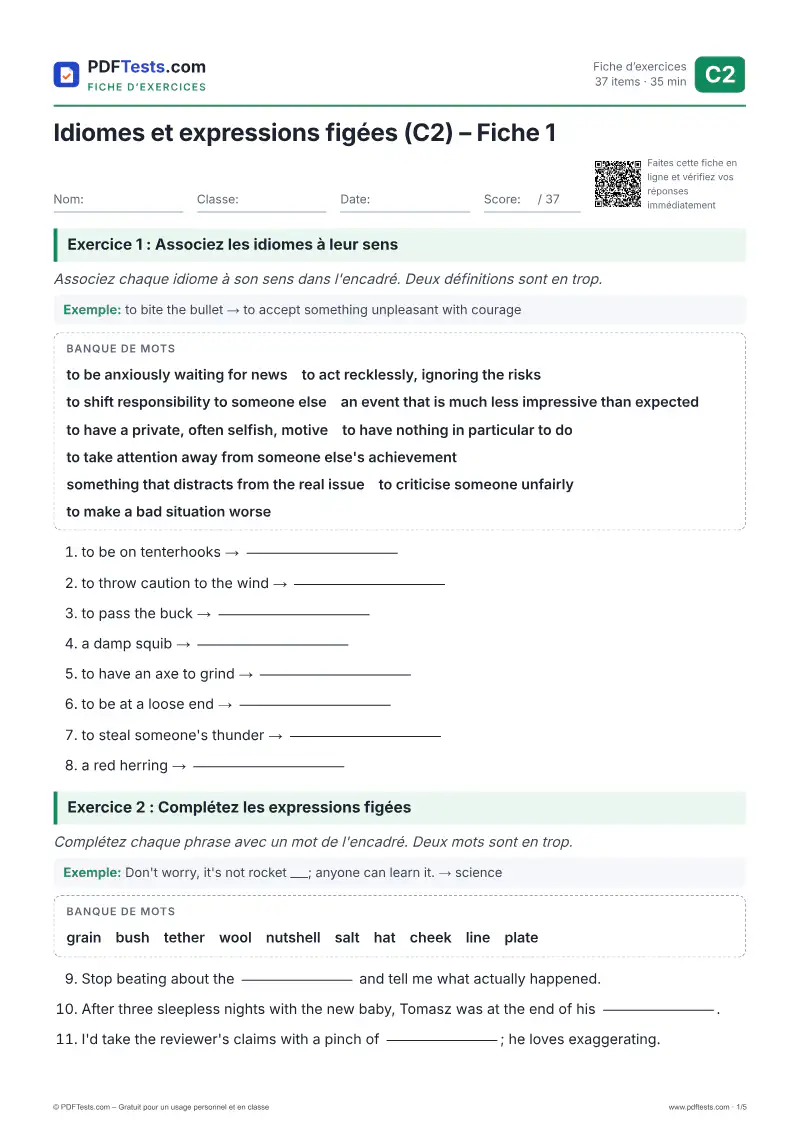
Exercice 1 : Associez les idiomes à leur sens

Associez chaque idiome à son sens dans l'encadré. Deux définitions sont en trop.

Exemple: to bite the bullet → to accept something unpleasant with courage

Banque de mots to be anxiously waiting for newsto act recklessly, ignoring the risksto shift responsibility to someone elsean event that is much less impressive than expectedto have a private, often selfish, motiveto have nothing in particular to doto take attention away from someone else's achievementsomething that distracts from the real issueto criticise someone unfairlyto make a bad situation worse

  1. to be on tenterhooks

  2. to throw caution to the wind

  3. to pass the buck

  4. a damp squib

  5. to have an axe to grind

  6. to be at a loose end

  7. to steal someone's thunder

  8. a red herring

Exercice 2 : Complétez les expressions figées

Complétez chaque phrase avec un mot de l'encadré. Deux mots sont en trop.

Exemple: Don't worry, it's not rocket ___; anyone can learn it. → science

Banque de mots grainbushtetherwoolnutshellsalthatcheeklineplate

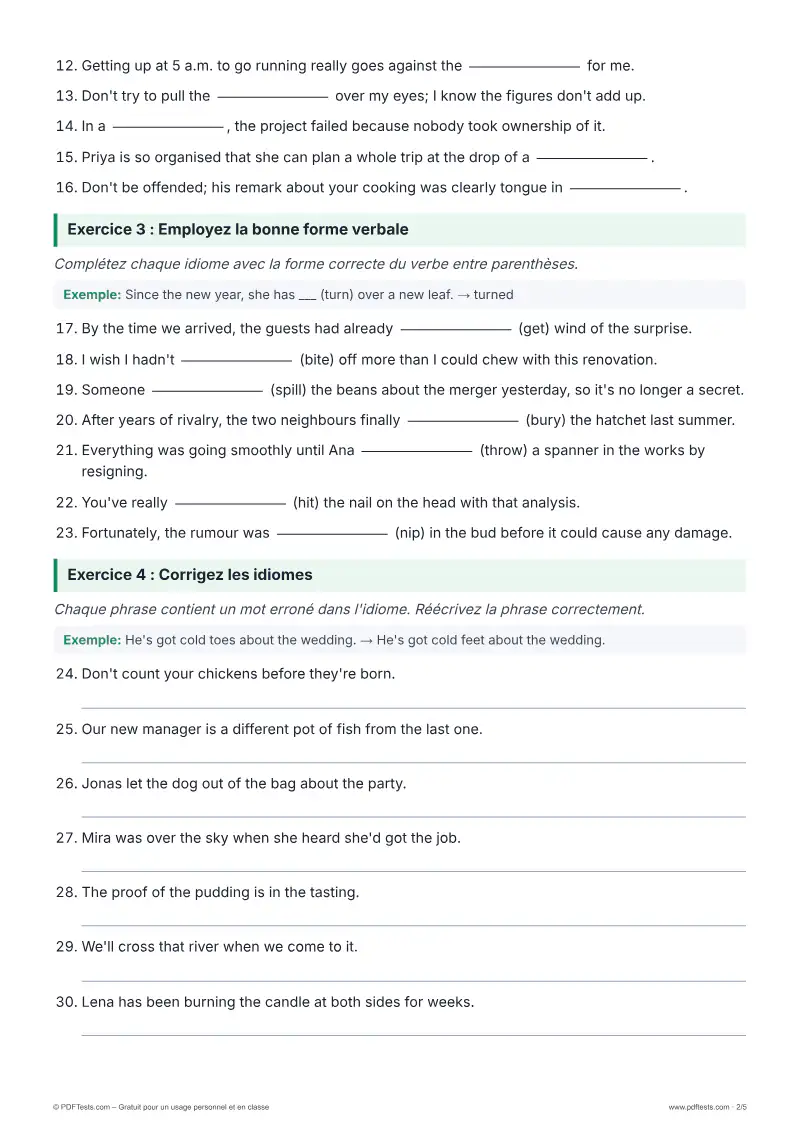
  1. Stop beating about the and tell me what actually happened.

  2. After three sleepless nights with the new baby, Tomasz was at the end of his .

  3. I'd take the reviewer's claims with a pinch of ; he loves exaggerating.

  4. Getting up at 5 a.m. to go running really goes against the for me.

  5. Don't try to pull the over my eyes; I know the figures don't add up.

  6. In a , the project failed because nobody took ownership of it.

  7. Priya is so organised that she can plan a whole trip at the drop of a .

  8. Don't be offended; his remark about your cooking was clearly tongue in .

Exercice 3 : Employez la bonne forme verbale

Complétez chaque idiome avec la forme correcte du verbe entre parenthèses.

Exemple: Since the new year, she has ___ (turn) over a new leaf. → turned

  1. By the time we arrived, the guests had already (get) wind of the surprise.

  2. I wish I hadn't (bite) off more than I could chew with this renovation.

  3. Someone (spill) the beans about the merger yesterday, so it's no longer a secret.

  4. After years of rivalry, the two neighbours finally (bury) the hatchet last summer.

  5. Everything was going smoothly until Ana (throw) a spanner in the works by resigning.

  6. You've really (hit) the nail on the head with that analysis.

  7. Fortunately, the rumour was (nip) in the bud before it could cause any damage.

Exercice 4 : Corrigez les idiomes

Chaque phrase contient un mot erroné dans l'idiome. Réécrivez la phrase correctement.

Exemple: He's got cold toes about the wedding. → He's got cold feet about the wedding.

  1. Don't count your chickens before they're born.

  2. Our new manager is a different pot of fish from the last one.

  3. Jonas let the dog out of the bag about the party.

  4. Mira was over the sky when she heard she'd got the job.

  5. The proof of the pudding is in the tasting.

  6. We'll cross that river when we come to it.

  7. Lena has been burning the candle at both sides for weeks.

Exercice 5 : Formez le mot correct

À partir du mot en majuscules, formez un mot qui complète chaque expression figée.

Exemple: After the argument, he was ___ shown the door. (CEREMONY) → unceremoniously

  1. It goes without that safety must come first. (SAY)

  2. With such a strong team, the result of the final was a foregone . (CONCLUDE)

  3. When it comes to to detail, she is second to none. (ATTEND)

  4. He made a attempt to apologise, but nobody was convinced. (HEART)

  5. The twins are like two peas in a pod; they're practically . (DISTINGUISH)

  6. To add insult to , the train was cancelled after we'd waited an hour. (INJURE)

  7. The deal almost fell through, but they reached an agreement at the hour. (ELEVEN)

Cette page vous a-t-elle été utile ?

Signaler une erreur

Une mauvaise réponse, une faute de frappe ou une explication peu claire ? Dites-le-nous, nous corrigerons.

Aperçu

À propos de ce test

Fiche d'exercices d'anglais C2 en PDF sur les idiomes et expressions figées : sens, mots manquants, formes verbales, correction d'erreurs et formation des mots.

Thèmes abordés

IdiomesExpressions figéesCollocationsFormation des motsCorrection d'erreurs

Notes pour l’enseignant

Commencez par l'exercice d'association pour activer le sens des expressions, puis passez aux exercices à trous et de correction, qui portent sur la forme exacte de chaque expression. Une erreur fréquente consiste à modifier un mot clé, par exemple « end of the line » au lieu de « end of my tether », ou à employer une mauvaise forme verbale, comme « spilled out the beans ». En prolongement, demandez aux apprenants de rédiger une courte anecdote utilisant au moins cinq des expressions, puis faites-les vérifier par un camarade.
Tous les tests Anglais C2 →