PDFTests Originals

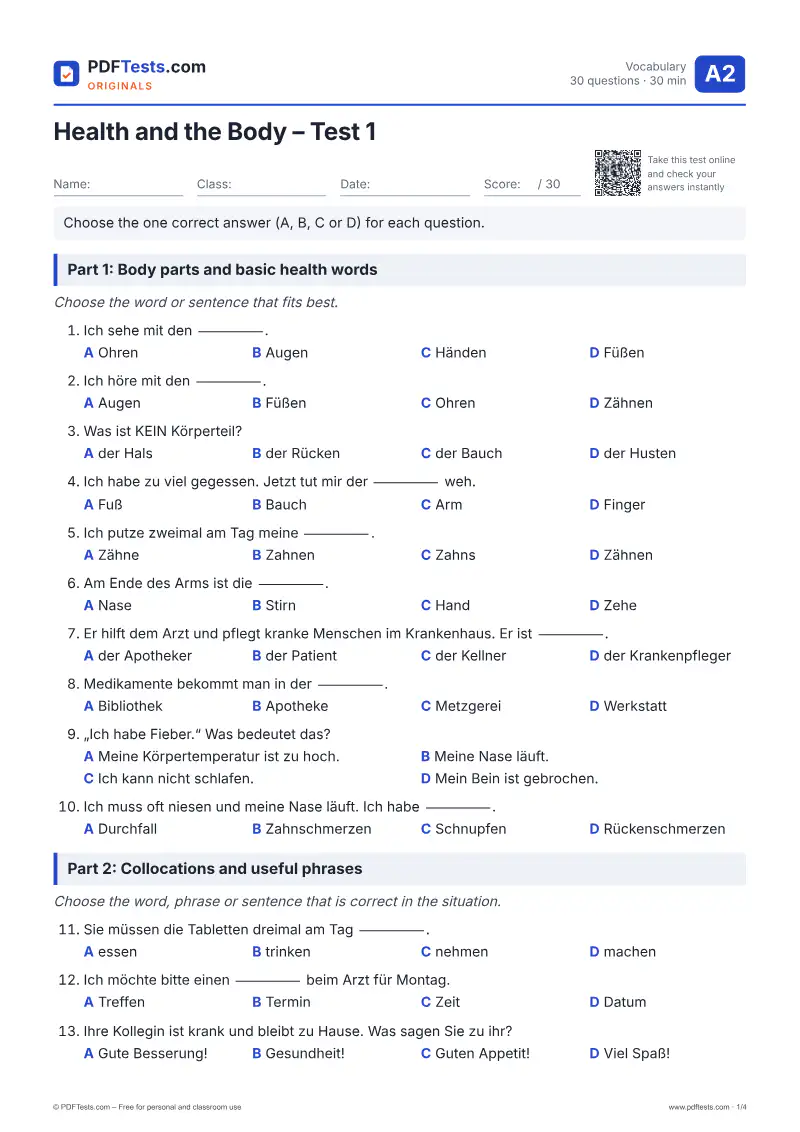
Health and the Body – Test 1

A2 Elementary VocabularyGerman

This A2 German vocabulary test covers health and the body: body parts, common illnesses and symptoms, visits to the doctor and the pharmacy, useful phrases, and word families such as krank, Krankheit and Krankenhaus. It suits learners at A2 level and teachers who want a quick, printable check of everyday health vocabulary.
Questions
30
Time
30 min
PDF
4 pages
Answer key
Included
  • 100% free
  • No sign-up or email
  • Print-ready A4 PDF
Preview of page 1 of Health and the Body – Test 1 Open PDF

Take the test online

Choose the one correct answer (A, B, C or D) for each question. Choose your answers, then press “Check my answers”.

Part 1: Body parts and basic health words

Choose the word or sentence that fits best.

  1. Ich sehe mit den _____.

  2. Ich höre mit den _____.

  3. Was ist KEIN Körperteil?

  4. Ich habe zu viel gegessen. Jetzt tut mir der _____ weh.

  5. Ich putze zweimal am Tag meine _____.

  6. Am Ende des Arms ist die _____.

  7. Er hilft dem Arzt und pflegt kranke Menschen im Krankenhaus. Er ist _____.

  8. Medikamente bekommt man in der _____.

  9. „Ich habe Fieber.“ Was bedeutet das?

  10. Ich muss oft niesen und meine Nase läuft. Ich habe _____.

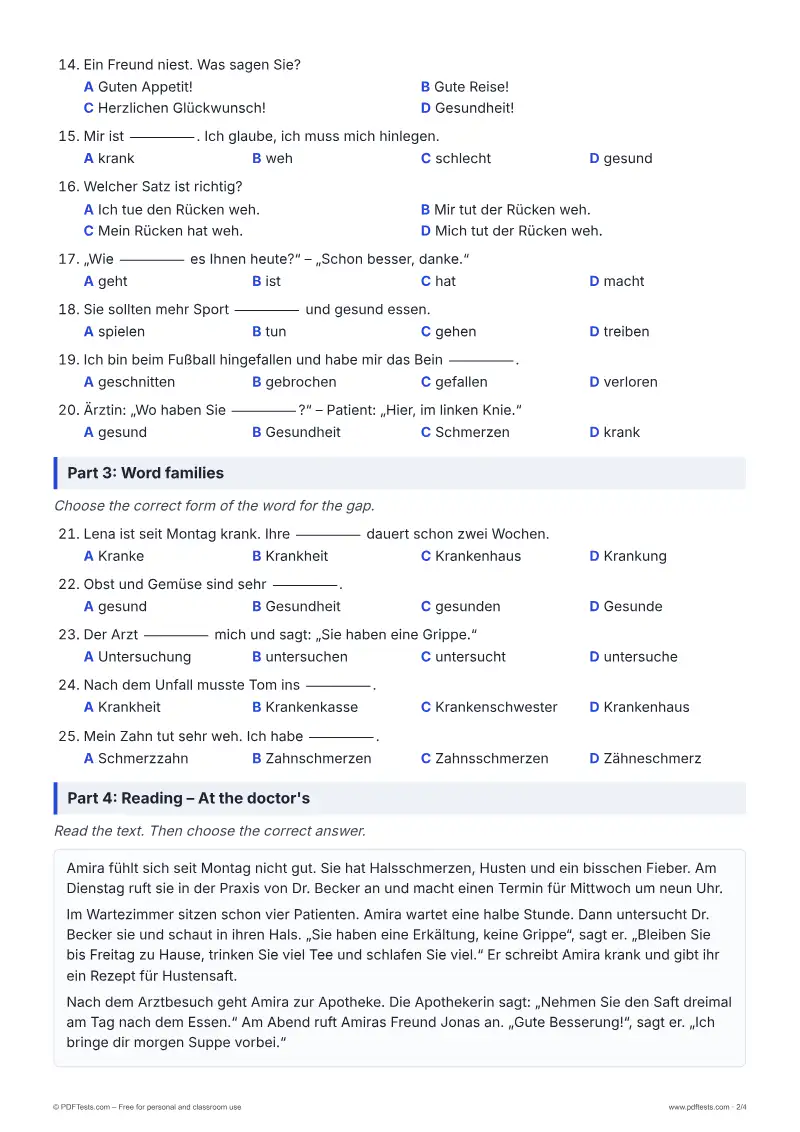
Part 2: Collocations and useful phrases

Choose the word, phrase or sentence that is correct in the situation.

  1. Sie müssen die Tabletten dreimal am Tag _____.

  2. Ich möchte bitte einen _____ beim Arzt für Montag.

  3. Ihre Kollegin ist krank und bleibt zu Hause. Was sagen Sie zu ihr?

  4. Ein Freund niest. Was sagen Sie?

  5. Mir ist _____. Ich glaube, ich muss mich hinlegen.

  6. Welcher Satz ist richtig?

  7. „Wie _____ es Ihnen heute?“ – „Schon besser, danke.“

  8. Sie sollten mehr Sport _____ und gesund essen.

  9. Ich bin beim Fußball hingefallen und habe mir das Bein _____.

  10. Ärztin: „Wo haben Sie _____?“ – Patient: „Hier, im linken Knie.“

Part 3: Word families

Choose the correct form of the word for the gap.

  1. Lena ist seit Montag krank. Ihre _____ dauert schon zwei Wochen.

  2. Obst und Gemüse sind sehr _____.

  3. Der Arzt _____ mich und sagt: „Sie haben eine Grippe.“

  4. Nach dem Unfall musste Tom ins _____.

  5. Mein Zahn tut sehr weh. Ich habe _____.

Part 4: Reading – At the doctor's

Read the text. Then choose the correct answer.

Amira fühlt sich seit Montag nicht gut. Sie hat Halsschmerzen, Husten und ein bisschen Fieber. Am Dienstag ruft sie in der Praxis von Dr. Becker an und macht einen Termin für Mittwoch um neun Uhr.

Im Wartezimmer sitzen schon vier Patienten. Amira wartet eine halbe Stunde. Dann untersucht Dr. Becker sie und schaut in ihren Hals. „Sie haben eine Erkältung, keine Grippe“, sagt er. „Bleiben Sie bis Freitag zu Hause, trinken Sie viel Tee und schlafen Sie viel.“ Er schreibt Amira krank und gibt ihr ein Rezept für Hustensaft.

Nach dem Arztbesuch geht Amira zur Apotheke. Die Apothekerin sagt: „Nehmen Sie den Saft dreimal am Tag nach dem Essen.“ Am Abend ruft Amiras Freund Jonas an. „Gute Besserung!“, sagt er. „Ich bringe dir morgen Suppe vorbei.“

  1. Was hat Amira NICHT?

  2. Wann geht Amira zum Arzt?

  3. Was ist Amiras Krankheit?

  4. „Er schreibt Amira krank.“ Was bedeutet das?

  5. Wie oft soll Amira den Hustensaft nehmen?

Was this page helpful?

Report a mistake

Spotted a wrong answer, a typo or an unclear explanation? Tell us and we will fix it.

Practise with a worksheet: Health and the Body – Worksheet 1

Preview

About this test

This A2 German vocabulary test covers health and the body: body parts, common illnesses and symptoms, visits to the doctor and the pharmacy, useful phrases, and word families such as krank, Krankheit and Krankenhaus. It suits learners at A2 level and teachers who want a quick, printable check of everyday health vocabulary.

Topics covered

Body partsIllnesses and symptomsAt the doctor'sPharmacy and medicineCollocationsWord familiesReading comprehension

How to use this test

  1. Download the PDF and print it, or take the test online below.
  2. Answer every question without a dictionary or time pressure.
  3. Check your answers and note the topics you need to review.

Notes for teachers

Use this test after a unit on health or the doctor's visit, or as a revision check before an A2 exam. It targets typical learner errors, including 'Mir tut ... weh' versus 'Ich tue ... weh', 'Sport treiben' versus 'Sport spielen', and the difference between 'Gesundheit!' and 'Gute Besserung!'. It also checks the plural 'Zähne'. As a follow-up, students can role-play a phone call to book an appointment or a conversation in the doctor's surgery using the vocabulary from the reading text.