PDFTests Originals

Alternatives to the Passive (sich lassen, -bar, sein + zu) – Test 1

C1 Advanced GrammarGerman

This C1 grammar test covers the main alternatives to the German passive: sich lassen + infinitive, adjectives ending in -bar and the modal construction sein + zu + infinitive. It also includes related structures such as the attributive gerundive, bleiben + zu and middle constructions like 'sich gut lesen'. It is for advanced learners and teachers who want to check form, meaning and typical errors.
Questions
30
Time
30 min
PDF
4 pages
Answer key
Included
  • 100% free
  • No sign-up or email
  • Print-ready A4 PDF
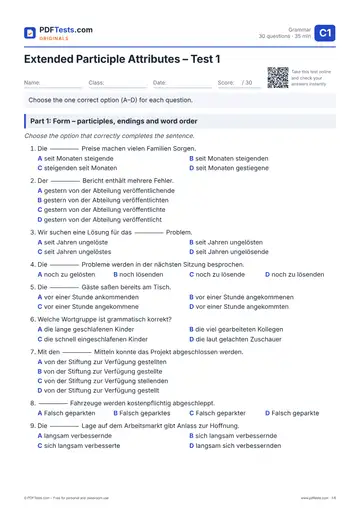
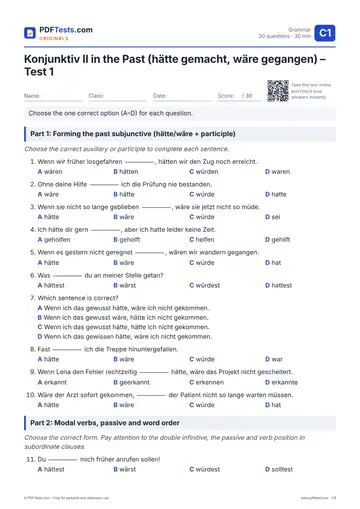
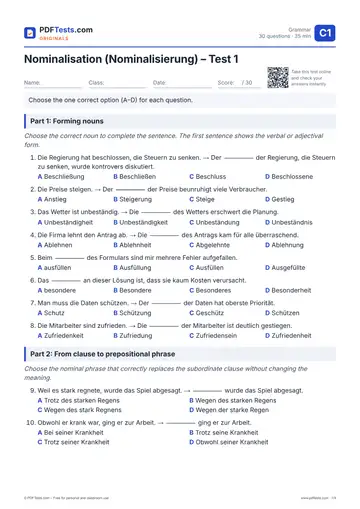
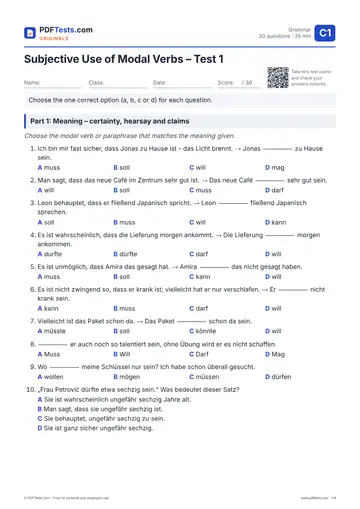
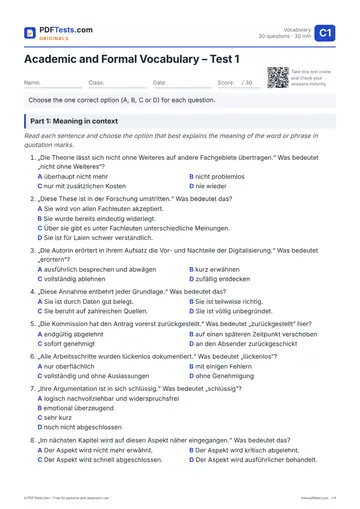
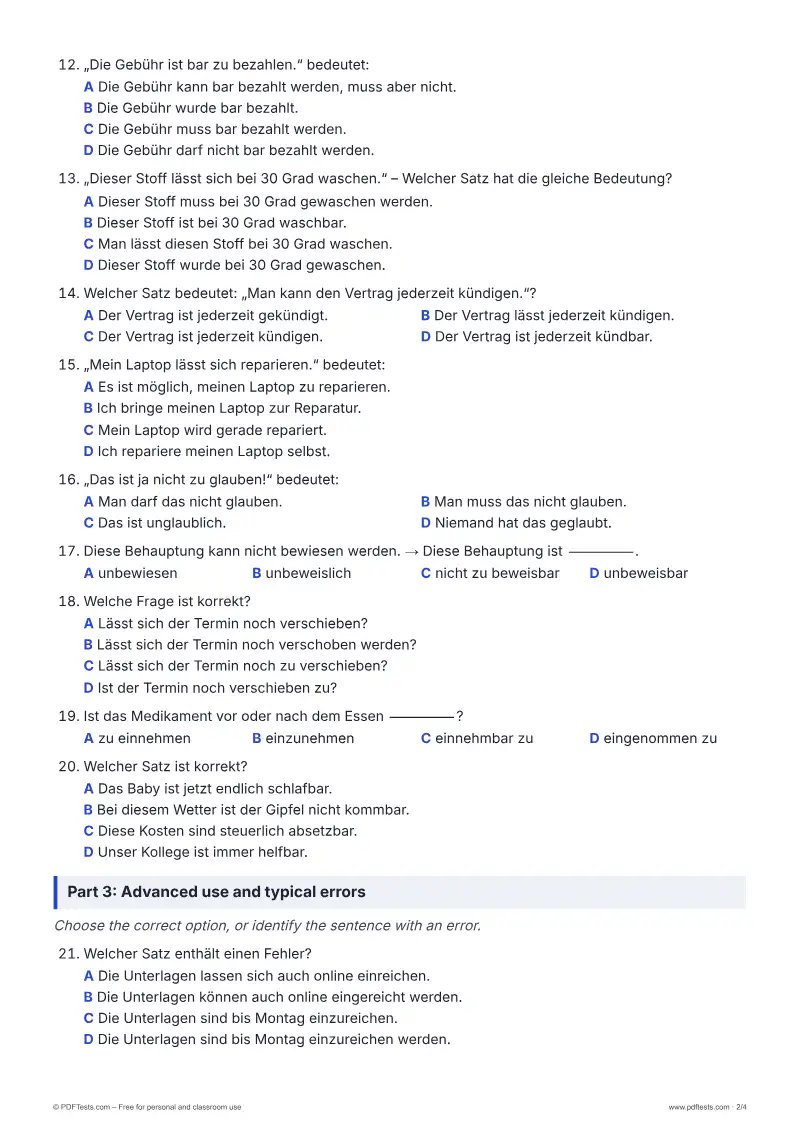
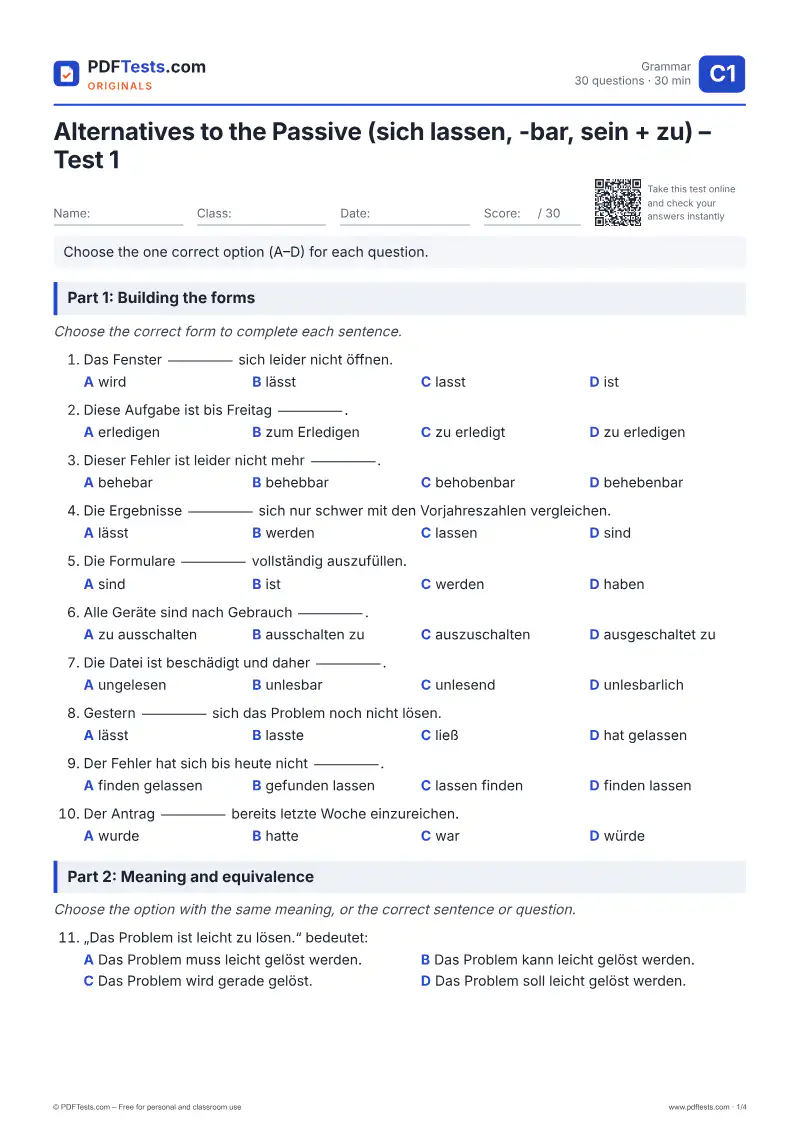
Preview of page 1 of Alternatives to the Passive (sich lassen, -bar, sein + zu) – Test 1 Open PDF

Take the test online

Choose the one correct option (A–D) for each question. Choose your answers, then press “Check my answers”.

Part 1: Building the forms

Choose the correct form to complete each sentence.

  1. Das Fenster _____ sich leider nicht öffnen.

  2. Diese Aufgabe ist bis Freitag _____.

  3. Dieser Fehler ist leider nicht mehr _____.

  4. Die Ergebnisse _____ sich nur schwer mit den Vorjahreszahlen vergleichen.

  5. Die Formulare _____ vollständig auszufüllen.

  6. Alle Geräte sind nach Gebrauch _____.

  7. Die Datei ist beschädigt und daher _____.

  8. Gestern _____ sich das Problem noch nicht lösen.

  9. Der Fehler hat sich bis heute nicht _____.

  10. Der Antrag _____ bereits letzte Woche einzureichen.

Part 2: Meaning and equivalence

Choose the option with the same meaning, or the correct sentence or question.

  1. „Das Problem ist leicht zu lösen.“ bedeutet:

  2. „Die Gebühr ist bar zu bezahlen.“ bedeutet:

  3. „Dieser Stoff lässt sich bei 30 Grad waschen.“ – Welcher Satz hat die gleiche Bedeutung?

  4. Welcher Satz bedeutet: „Man kann den Vertrag jederzeit kündigen.“?

  5. „Mein Laptop lässt sich reparieren.“ bedeutet:

  6. „Das ist ja nicht zu glauben!“ bedeutet:

  7. Diese Behauptung kann nicht bewiesen werden. → Diese Behauptung ist _____.

  8. Welche Frage ist korrekt?

  9. Ist das Medikament vor oder nach dem Essen _____?

  10. Welcher Satz ist korrekt?

Part 3: Advanced use and typical errors

Choose the correct option, or identify the sentence with an error.

  1. Welcher Satz enthält einen Fehler?

  2. Die noch _____ Probleme besprechen wir morgen.

  3. Das ist eine kaum _____ Aufgabe.

  4. „Die Kosten, die man nicht vorhersehen konnte, belasten das Budget.“ → Die nicht _____ Kosten belasten das Budget.

  5. Das wird sich wohl nicht vermeiden _____.

  6. Welcher Satz ist korrekt?

  7. Ich weiß noch nicht, ob sich das Problem _____.

  8. Wir bedauern, dass sich der Fehler nicht _____.

  9. „Es bleibt abzuwarten, ob die neue Regelung wirkt.“ bedeutet:

  10. „Der Roman liest sich leicht.“ – Welcher Satz hat die gleiche Bedeutung?

Preview

About this test

This C1 grammar test covers the main alternatives to the German passive: sich lassen + infinitive, adjectives ending in -bar and the modal construction sein + zu + infinitive. It also includes related structures such as the attributive gerundive, bleiben + zu and middle constructions like 'sich gut lesen'. It is for advanced learners and teachers who want to check form, meaning and typical errors.

Topics covered

sich lassen + infinitive-bar adjectivessein + zu + infinitiveAttributive gerundive (zu + participle I)Ersatzinfinitiv in the perfectModal meaning: possibility vs. necessityWord order in subordinate clauses

How to use this test

  1. Download the PDF and print it, or take the test online below.
  2. Answer every question without a dictionary or time pressure.
  3. Check your answers and note the topics you need to review.

Notes for teachers

Use Part 1 to check forms, Part 2 to check meaning and equivalence, and Part 3 for advanced structures and error spotting. The test targets common C1 errors: 'gelassen' instead of the Ersatzinfinitiv, wrong position of zu with separable verbs, -bar formed from intransitive verbs, and confusing 'sich lassen' (possibility) with 'etwas machen lassen' (causative). As a follow-up, ask learners to rewrite a set of official instructions or product descriptions using all three alternatives.