PDFTests Originals

Subjunctive vs Indicative – Test 1

B2 Upper-intermediate GrammarSpanish

This B2 test checks when Spanish uses the subjunctive and when it uses the indicative. It covers wishes, emotions, doubt and opinion, time and purpose clauses, relative clauses, conditional sentences and sequence of tenses. It suits upper-intermediate learners who want to check their accuracy, and teachers who need a ready-made assessment.
Questions
30
Time
30 min
PDF
4 pages
Answer key
Included
  • 100% free
  • No sign-up or email
  • Print-ready A4 PDF
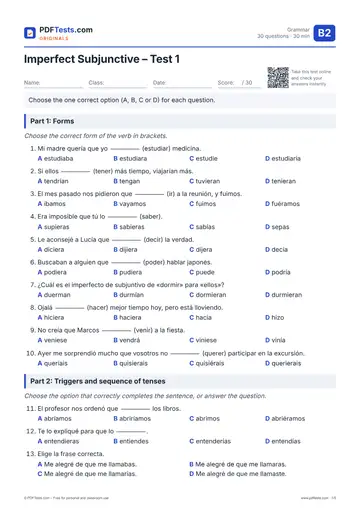
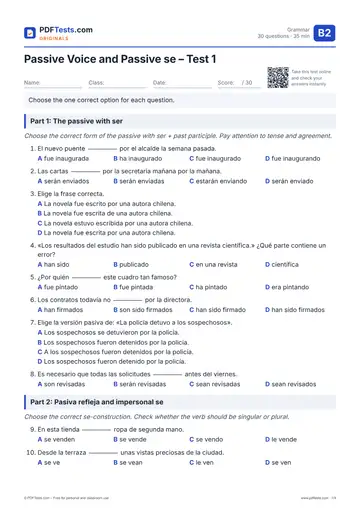
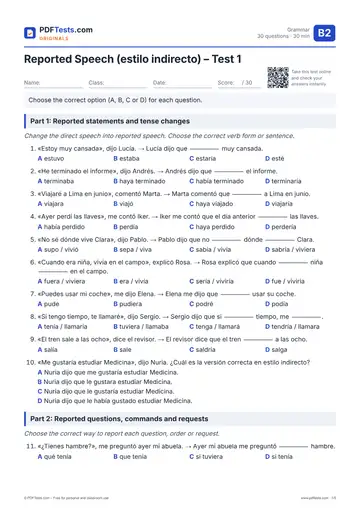
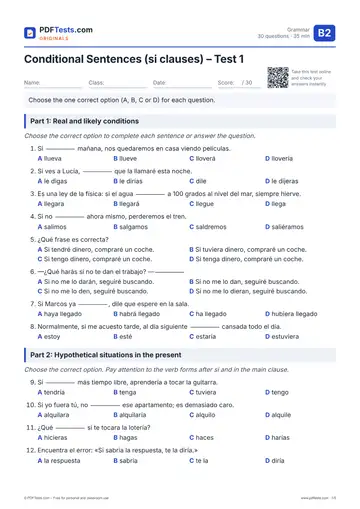
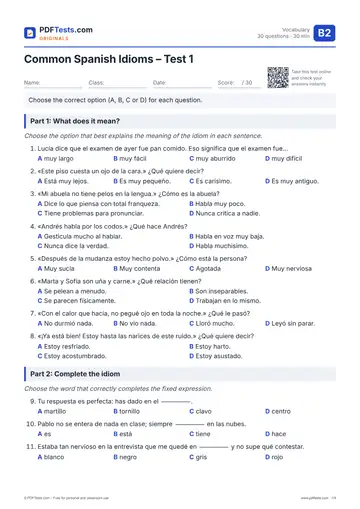
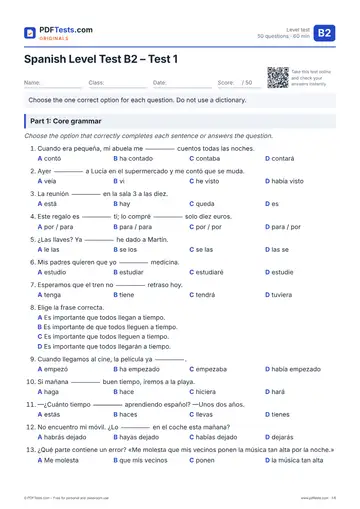
Preview of page 1 of Subjunctive vs Indicative – Test 1 Open PDF

Take the test online

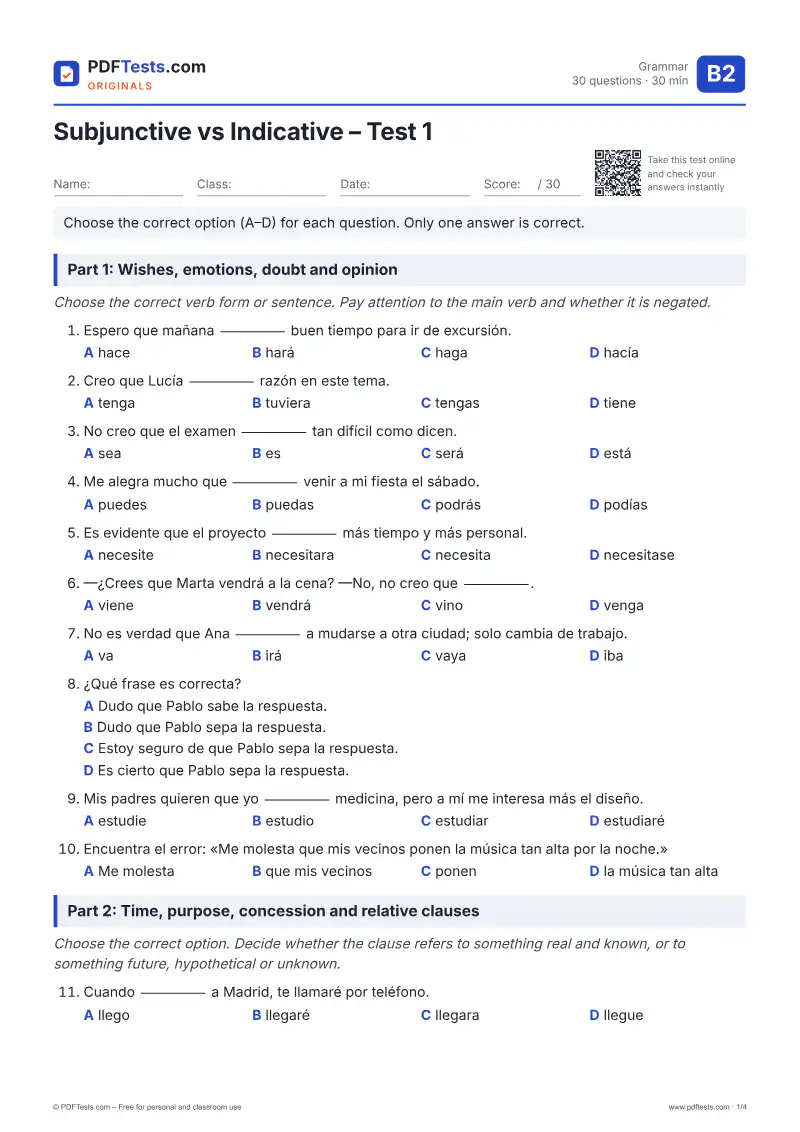
Choose the correct option (A–D) for each question. Only one answer is correct. Choose your answers, then press “Check my answers”.

Part 1: Wishes, emotions, doubt and opinion

Choose the correct verb form or sentence. Pay attention to the main verb and whether it is negated.

  1. Espero que mañana _____ buen tiempo para ir de excursión.

  2. Creo que Lucía _____ razón en este tema.

  3. No creo que el examen _____ tan difícil como dicen.

  4. Me alegra mucho que _____ venir a mi fiesta el sábado.

  5. Es evidente que el proyecto _____ más tiempo y más personal.

  6. —¿Crees que Marta vendrá a la cena? —No, no creo que _____.

  7. No es verdad que Ana _____ a mudarse a otra ciudad; solo cambia de trabajo.

  8. ¿Qué frase es correcta?

  9. Mis padres quieren que yo _____ medicina, pero a mí me interesa más el diseño.

  10. Encuentra el error: «Me molesta que mis vecinos ponen la música tan alta por la noche.»

Part 2: Time, purpose, concession and relative clauses

Choose the correct option. Decide whether the clause refers to something real and known, or to something future, hypothetical or unknown.

  1. Cuando _____ a Madrid, te llamaré por teléfono.

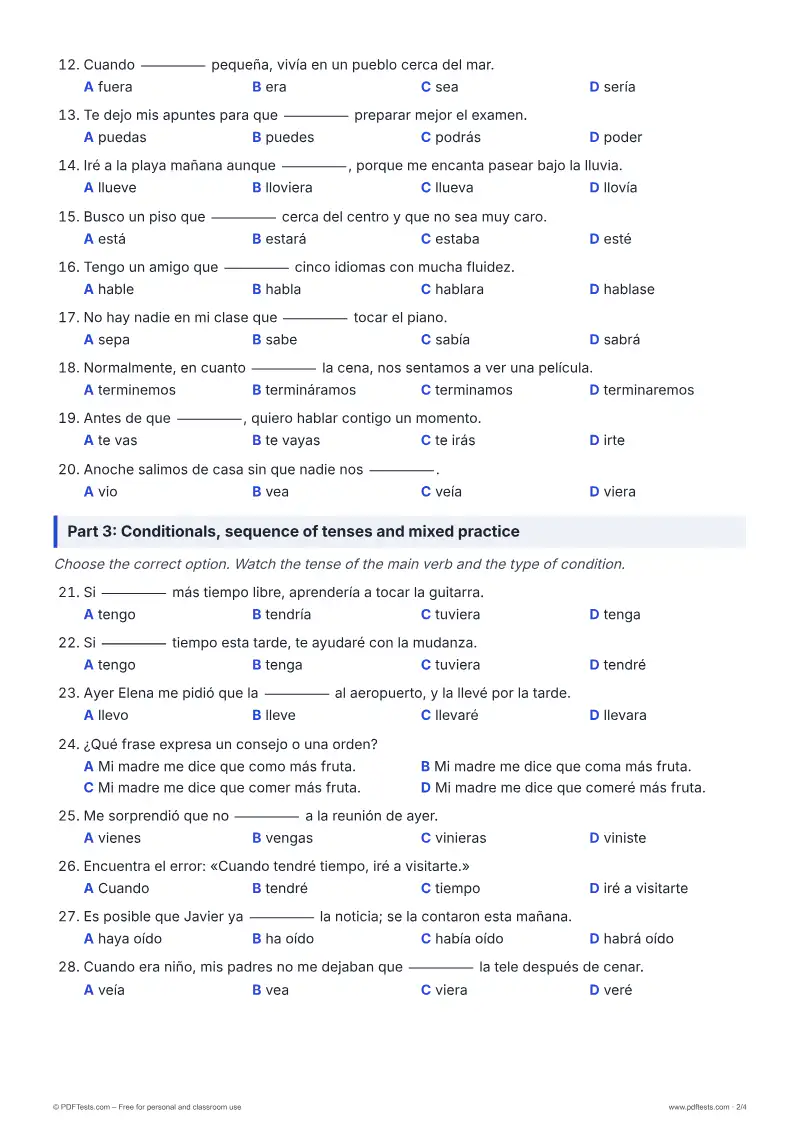
  2. Cuando _____ pequeña, vivía en un pueblo cerca del mar.

  3. Te dejo mis apuntes para que _____ preparar mejor el examen.

  4. Iré a la playa mañana aunque _____, porque me encanta pasear bajo la lluvia.

  5. Busco un piso que _____ cerca del centro y que no sea muy caro.

  6. Tengo un amigo que _____ cinco idiomas con mucha fluidez.

  7. No hay nadie en mi clase que _____ tocar el piano.

  8. Normalmente, en cuanto _____ la cena, nos sentamos a ver una película.

  9. Antes de que _____, quiero hablar contigo un momento.

  10. Anoche salimos de casa sin que nadie nos _____.

Part 3: Conditionals, sequence of tenses and mixed practice

Choose the correct option. Watch the tense of the main verb and the type of condition.

  1. Si _____ más tiempo libre, aprendería a tocar la guitarra.

  2. Si _____ tiempo esta tarde, te ayudaré con la mudanza.

  3. Ayer Elena me pidió que la _____ al aeropuerto, y la llevé por la tarde.

  4. ¿Qué frase expresa un consejo o una orden?

  5. Me sorprendió que no _____ a la reunión de ayer.

  6. Encuentra el error: «Cuando tendré tiempo, iré a visitarte.»

  7. Es posible que Javier ya _____ la noticia; se la contaron esta mañana.

  8. Cuando era niño, mis padres no me dejaban que _____ la tele después de cenar.

  9. ¿Qué frase es correcta?

  10. Pase lo que _____, siempre seré tu amiga.

Preview

About this test

This B2 test checks when Spanish uses the subjunctive and when it uses the indicative. It covers wishes, emotions, doubt and opinion, time and purpose clauses, relative clauses, conditional sentences and sequence of tenses. It suits upper-intermediate learners who want to check their accuracy, and teachers who need a ready-made assessment.

Topics covered

Subjunctive vs indicativeWishes, emotions and doubtNegated opinion verbsTime and purpose clausesRelative clausesSi-clausesSequence of tensesError correction

How to use this test

  1. Download the PDF and print it, or take the test online below.
  2. Answer every question without a dictionary or time pressure.
  3. Check your answers and note the topics you need to review.

Notes for teachers

Part 1 tests noun clauses, Part 2 adverbial and relative clauses, and Part 3 tense sequence, conditionals and error spotting. The test targets common errors such as using the indicative after negated opinion verbs, putting the future after 'cuando', and using the present subjunctive after a past main verb. Ask students to explain the trigger in each sentence. As a follow-up, they can write their own contrasting pairs, such as 'Creo que…' and 'No creo que…', or 'Busco a una persona que…' and 'Conozco a una persona que…'.