PDFTests Originals

Use of English C1 – Ficha 1

C1 Avanzado FichaInglés

Esta ficha de Use of English de nivel C1 trabaja cuatro tareas con formato de examen: un open cloze, word formation, key word transformations y un ejercicio de huecos con colocaciones. Está pensada para alumnos de nivel avanzado que preparan exámenes de nivel C1 y para docentes que buscan material imprimible con solucionario.
ejercicios
34
Tiempo
40 min
PDF
5 páginas
Soluciones
Incluidas
  • 100 % gratis
  • Sin registro
  • PDF A4 listo para imprimir
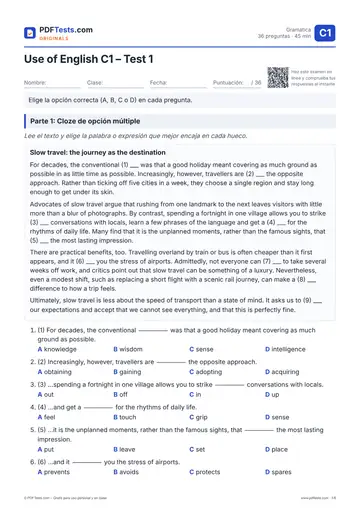
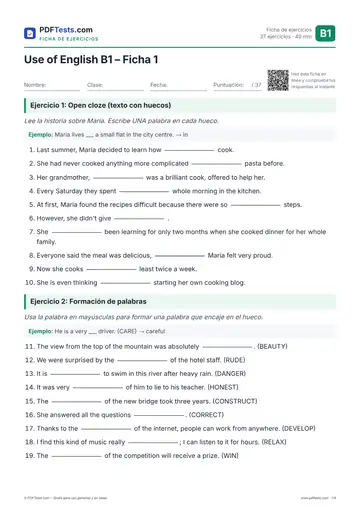
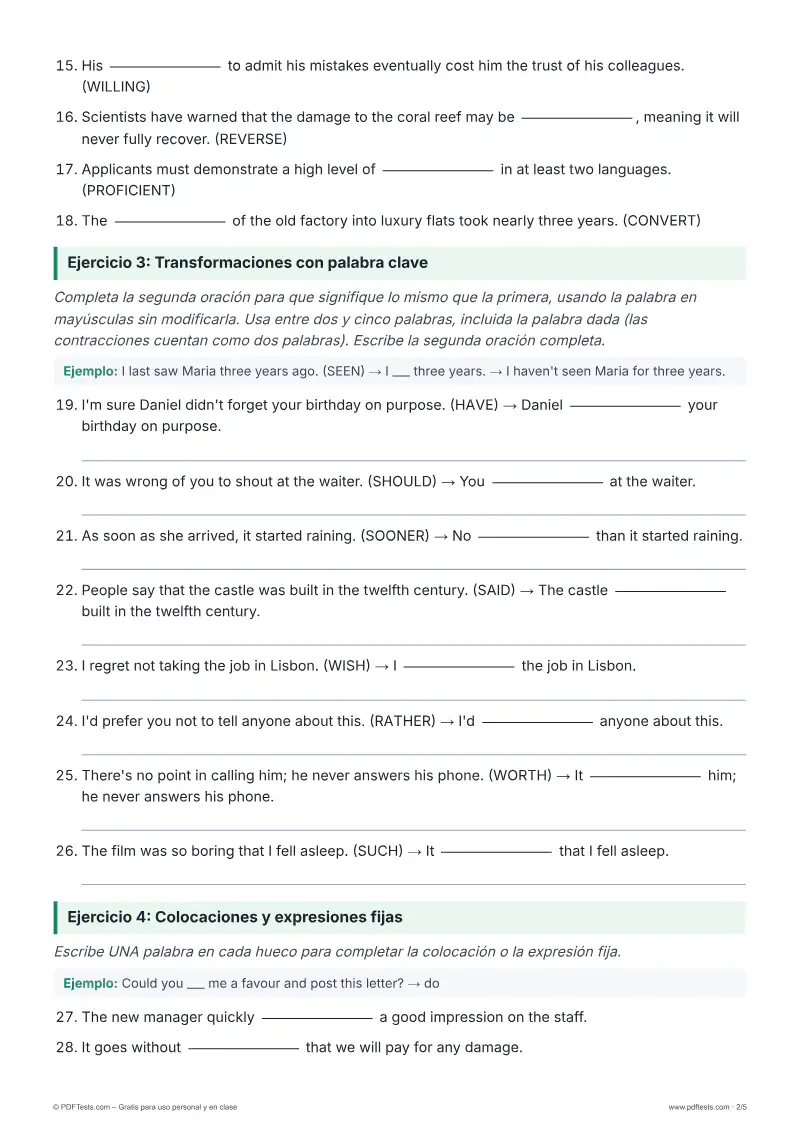
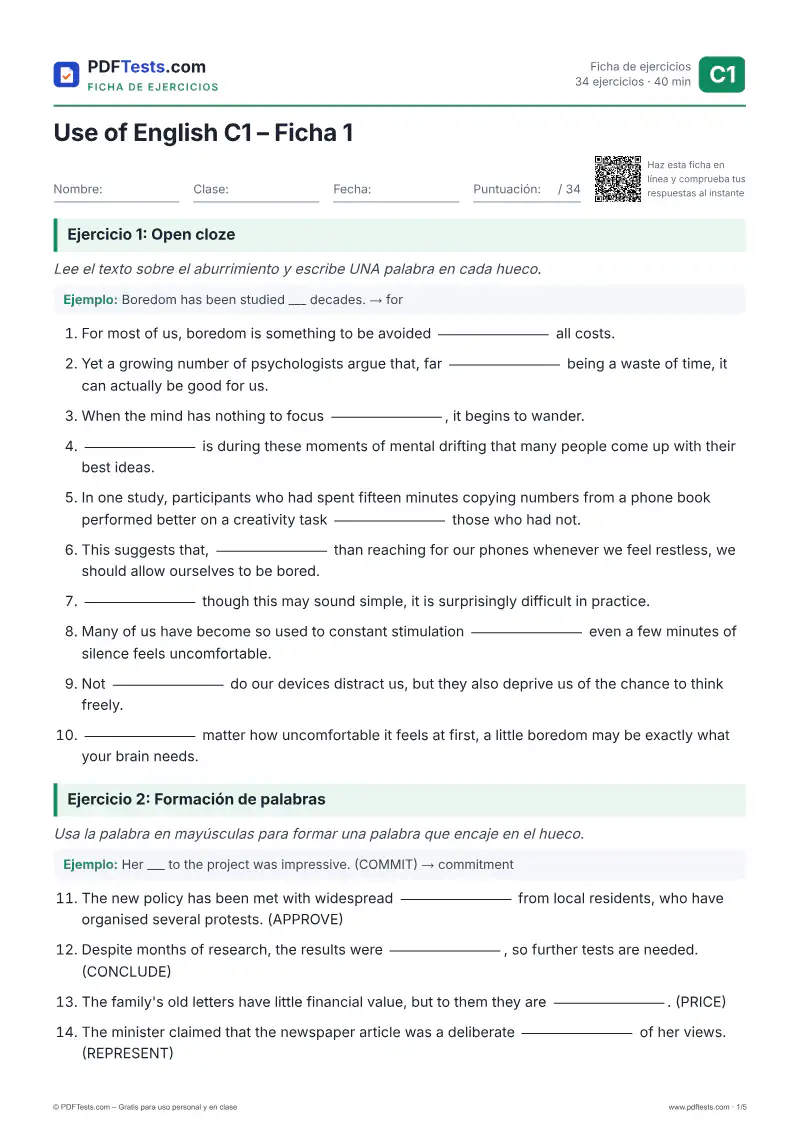
Vista previa de la página 1: Use of English C1 – Ficha 1 Abrir PDF
Use of English B1–C2 · todos los exámenes con formato de examen, tipos de tarea y consejos

Haz la ficha en línea

Escribe tus respuestas y pulsa «Comprobar respuestas». Se aceptan otras respuestas correctas.

Ejercicio 1: Open cloze

Lee el texto sobre el aburrimiento y escribe UNA palabra en cada hueco.

Ejemplo: Boredom has been studied ___ decades. → for

  1. For most of us, boredom is something to be avoided all costs.

  2. Yet a growing number of psychologists argue that, far being a waste of time, it can actually be good for us.

  3. When the mind has nothing to focus , it begins to wander.

  4. is during these moments of mental drifting that many people come up with their best ideas.

  5. In one study, participants who had spent fifteen minutes copying numbers from a phone book performed better on a creativity task those who had not.

  6. This suggests that, than reaching for our phones whenever we feel restless, we should allow ourselves to be bored.

  7. though this may sound simple, it is surprisingly difficult in practice.

  8. Many of us have become so used to constant stimulation even a few minutes of silence feels uncomfortable.

  9. Not do our devices distract us, but they also deprive us of the chance to think freely.

  10. matter how uncomfortable it feels at first, a little boredom may be exactly what your brain needs.

Ejercicio 2: Formación de palabras

Usa la palabra en mayúsculas para formar una palabra que encaje en el hueco.

Ejemplo: Her ___ to the project was impressive. (COMMIT) → commitment

  1. The new policy has been met with widespread from local residents, who have organised several protests. (APPROVE)

  2. Despite months of research, the results were , so further tests are needed. (CONCLUDE)

  3. The family's old letters have little financial value, but to them they are . (PRICE)

  4. The minister claimed that the newspaper article was a deliberate of her views. (REPRESENT)

  5. His to admit his mistakes eventually cost him the trust of his colleagues. (WILLING)

  6. Scientists have warned that the damage to the coral reef may be , meaning it will never fully recover. (REVERSE)

  7. Applicants must demonstrate a high level of in at least two languages. (PROFICIENT)

  8. The of the old factory into luxury flats took nearly three years. (CONVERT)

Ejercicio 3: Transformaciones con palabra clave

Completa la segunda oración para que signifique lo mismo que la primera, usando la palabra en mayúsculas sin modificarla. Usa entre dos y cinco palabras, incluida la palabra dada (las contracciones cuentan como dos palabras). Escribe la segunda oración completa.

Ejemplo: I last saw Maria three years ago. (SEEN) → I ___ three years. → I haven't seen Maria for three years.

  1. I'm sure Daniel didn't forget your birthday on purpose. (HAVE) → Daniel ___ your birthday on purpose.

  2. It was wrong of you to shout at the waiter. (SHOULD) → You ___ at the waiter.

  3. As soon as she arrived, it started raining. (SOONER) → No ___ than it started raining.

  4. People say that the castle was built in the twelfth century. (SAID) → The castle ___ built in the twelfth century.

  5. I regret not taking the job in Lisbon. (WISH) → I ___ the job in Lisbon.

  6. I'd prefer you not to tell anyone about this. (RATHER) → I'd ___ anyone about this.

  7. There's no point in calling him; he never answers his phone. (WORTH) → It ___ him; he never answers his phone.

  8. The film was so boring that I fell asleep. (SUCH) → It ___ that I fell asleep.

Ejercicio 4: Colocaciones y expresiones fijas

Escribe UNA palabra en cada hueco para completar la colocación o la expresión fija.

Ejemplo: Could you ___ me a favour and post this letter? → do

  1. The new manager quickly a good impression on the staff.

  2. It goes without that we will pay for any damage.

  3. There were a few small problems, but and large the event was a success.

  4. She was in two about whether to accept the offer.

  5. When planning the park, we need to into account the needs of older residents.

  6. The new regulations will come into next January.

  7. The project is still in its early , so it's hard to predict the outcome.

  8. The proposal was rejected the grounds that it was too expensive.

¿Te ha resultado útil esta página?

Informar de un error

¿Has visto una respuesta incorrecta, una errata o una explicación poco clara? Avísanos y lo corregiremos.

Vista previa

Sobre este examen

Ficha de inglés C1 en PDF con soluciones: Use of English con open cloze, word formation, key word transformations y collocations, en formato de examen.

Temas

Open cloze (texto con huecos)Formación de palabrasTransformaciones con palabra claveColocaciones y expresiones fijasVerbos modales perfectos e inversión

Notas para el profesor

Plantee el ejercicio 1 como una tarea de lectura cronometrada. Pida a los alumnos que lean el texto completo antes de rellenar los huecos y que después comparen sus respuestas por parejas y justifiquen cada elección. En las transformaciones con palabra clave, los alumnos suelen superar el límite de palabras, modificar la palabra clave u olvidar que las contracciones cuentan como dos palabras. Insista en que revisen estos tres aspectos. Como actividad de ampliación, pida a los alumnos que redacten sus propias transformaciones con las estructuras del ejercicio 3 y que las intercambien con un compañero.

Todos los exámenes de Inglés C1 →