PDFTests Originals

Use of English C1 – Test 2

C1 Fortgeschritten GrammatikEnglisch

Dieser Use-of-English-Test auf Niveau C1 trainiert die vier klassischen Aufgabentypen der Prüfung: Multiple-Choice-Lückentext, offener Lückentext, Wortbildung und Satzumformungen mit Schlüsselwort (Key Word Transformations). Abgefragt werden Kollokationen, Phrasal Verbs, Funktionswörter, Präfixe und Suffixe sowie anspruchsvolle Strukturen wie Inversion und Bedingungssätze. Der Test eignet sich für fortgeschrittene Lernende, die sich auf eine C1-Prüfung vorbereiten, und für Lehrkräfte, die einen fertigen Übungstest suchen.
Fragen
36
Zeit
45 Min.
PDF
6 Seiten
Lösungen
Enthalten
  • 100 % kostenlos
  • Ohne Anmeldung
  • Druckfertiges A4-PDF
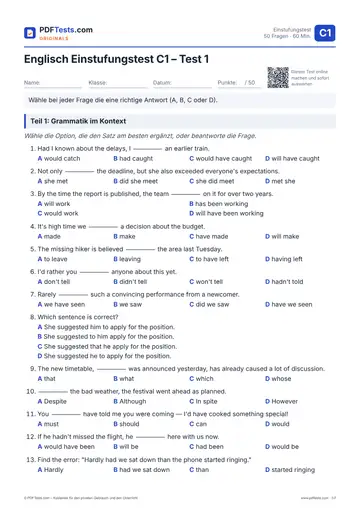
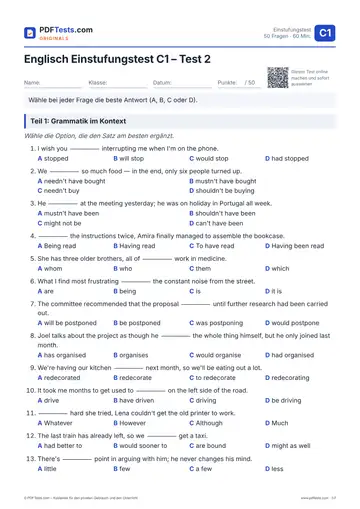
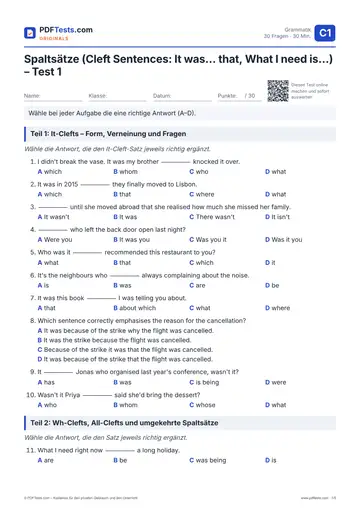
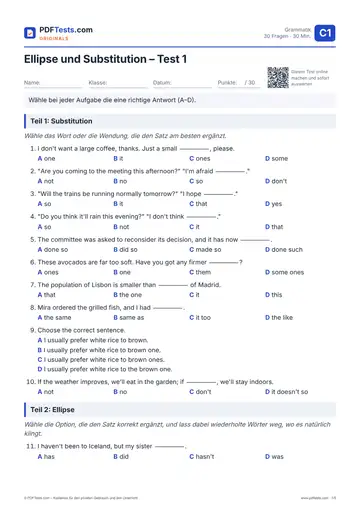
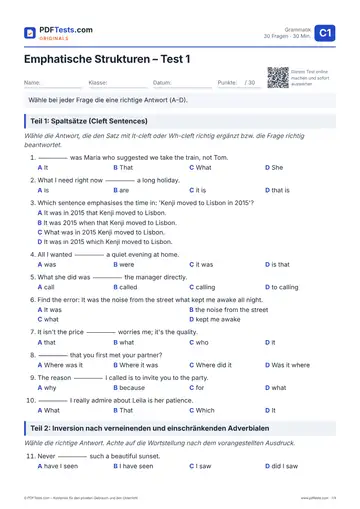
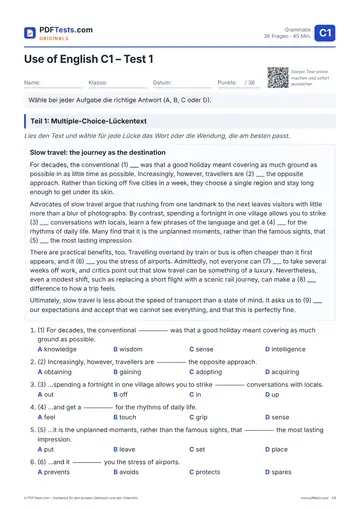
Vorschau von Seite 1: Use of English C1 – Test 2 PDF öffnen
Use of English B1–C2 · alle Tests im Prüfungsformat, Aufgabentypen und Tipps

Test online machen

Lies jede Aufgabe genau und wähle die eine richtige Antwort (A, B, C oder D). Wählen Sie Ihre Antworten und klicken Sie auf „Antworten prüfen“.

Teil 1: Multiple-Choice-Lückentext

Lies den Text und wähle für jede Lücke das Wort oder die Wendung, die am besten passt.

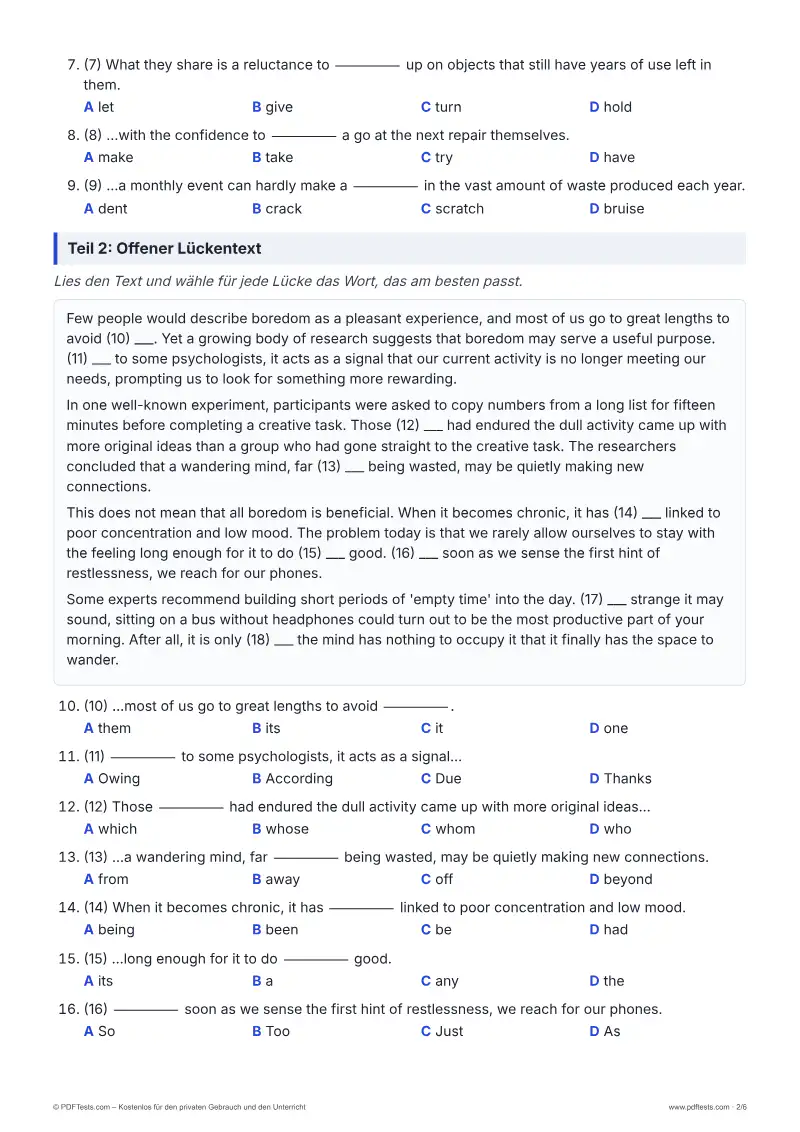
In many towns, a quiet revolution is (1) ___ place in community halls and libraries. Once a month, volunteers set up tables, plug in their tools and offer to fix whatever local people bring along, from wobbly chairs to broken toasters. These so-called repair cafés were originally (2) ___ up as a response to the growing mountain of household waste, but they have come to mean much more than that.

For one thing, they challenge the assumption that it is always cheaper to replace than to repair. Many visitors are surprised to learn that a fault which seemed fatal can be (3) ___ down to a single loose wire. For another, they (4) ___ a need that has little to do with electronics. Regulars often say that the chance to chat over a cup of tea is what keeps them coming back, and organisers are well (5) ___ that the social side matters as much as the technical one.

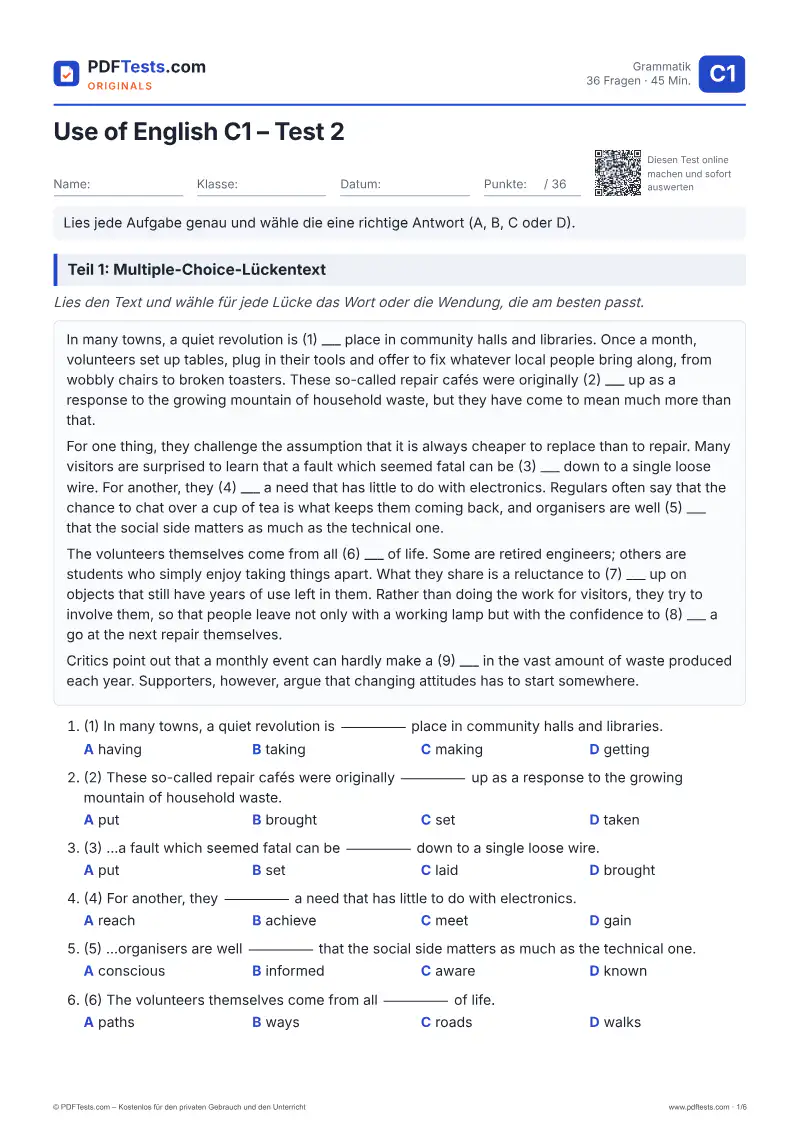
The volunteers themselves come from all (6) ___ of life. Some are retired engineers; others are students who simply enjoy taking things apart. What they share is a reluctance to (7) ___ up on objects that still have years of use left in them. Rather than doing the work for visitors, they try to involve them, so that people leave not only with a working lamp but with the confidence to (8) ___ a go at the next repair themselves.

Critics point out that a monthly event can hardly make a (9) ___ in the vast amount of waste produced each year. Supporters, however, argue that changing attitudes has to start somewhere.

  1. (1) In many towns, a quiet revolution is _____ place in community halls and libraries.

  2. (2) These so-called repair cafés were originally _____ up as a response to the growing mountain of household waste.

  3. (3) ...a fault which seemed fatal can be _____ down to a single loose wire.

  4. (4) For another, they _____ a need that has little to do with electronics.

  5. (5) ...organisers are well _____ that the social side matters as much as the technical one.

  6. (6) The volunteers themselves come from all _____ of life.

  7. (7) What they share is a reluctance to _____ up on objects that still have years of use left in them.

  8. (8) ...with the confidence to _____ a go at the next repair themselves.

  9. (9) ...a monthly event can hardly make a _____ in the vast amount of waste produced each year.

Teil 2: Offener Lückentext

Lies den Text und wähle für jede Lücke das Wort, das am besten passt.

Few people would describe boredom as a pleasant experience, and most of us go to great lengths to avoid (10) ___. Yet a growing body of research suggests that boredom may serve a useful purpose. (11) ___ to some psychologists, it acts as a signal that our current activity is no longer meeting our needs, prompting us to look for something more rewarding.

In one well-known experiment, participants were asked to copy numbers from a long list for fifteen minutes before completing a creative task. Those (12) ___ had endured the dull activity came up with more original ideas than a group who had gone straight to the creative task. The researchers concluded that a wandering mind, far (13) ___ being wasted, may be quietly making new connections.

This does not mean that all boredom is beneficial. When it becomes chronic, it has (14) ___ linked to poor concentration and low mood. The problem today is that we rarely allow ourselves to stay with the feeling long enough for it to do (15) ___ good. (16) ___ soon as we sense the first hint of restlessness, we reach for our phones.

Some experts recommend building short periods of 'empty time' into the day. (17) ___ strange it may sound, sitting on a bus without headphones could turn out to be the most productive part of your morning. After all, it is only (18) ___ the mind has nothing to occupy it that it finally has the space to wander.

  1. (10) ...most of us go to great lengths to avoid _____.

  2. (11) _____ to some psychologists, it acts as a signal...

  3. (12) Those _____ had endured the dull activity came up with more original ideas...

  4. (13) ...a wandering mind, far _____ being wasted, may be quietly making new connections.

  5. (14) When it becomes chronic, it has _____ linked to poor concentration and low mood.

  6. (15) ...long enough for it to do _____ good.

  7. (16) _____ soon as we sense the first hint of restlessness, we reach for our phones.

  8. (17) _____ strange it may sound, sitting on a bus without headphones could turn out to be...

  9. (18) ...it is only _____ the mind has nothing to occupy it that it finally has the space to wander.

Teil 3: Wortbildung

Wähle die Form des großgeschriebenen Wortes, die den Satz jeweils korrekt ergänzt.

  1. The assembly instructions were so badly translated that they were completely _____. (COMPREHEND)

  2. The rise in prices was _____ the main reason for the fall in sales. (DOUBT)

  3. Her _____ to compromise eventually led to the collapse of the negotiations. (WILL)

  4. The _____ of so many key players from the team left the coach with few options. (WITHDRAW)

  5. Compared with last year's figures, this year's drop in profits is relatively _____. (SIGNIFY)

  6. Many of the town's former factories have been converted into _____ flats. (RESIDE)

  7. Wearing a helmet is _____ for all cyclists taking part in the race. (OBLIGE)

  8. He's not really a close friend – more of a casual _____. (ACQUAINT)

  9. When asked whether she would do it all again, she answered without the slightest _____. (HESITATE)

Teil 4: Satzumformungen mit Schlüsselwort

Wähle den Satz, der das großgeschriebene Wort enthält, grammatisch korrekt ist und dieselbe Bedeutung wie der erste Satz hat.

  1. As soon as she arrived, the meeting began. (SOONER)

  2. I'd prefer you not to mention this to anyone. (RATHER)

  3. Paula is very likely to win the award. (CHANCE)

  4. They didn't finish the project because they didn't have enough money. (LACK)

  5. I didn't know she was ill, so I didn't visit her. (HAD)

  6. It took me a long time to get used to working at night. (ACCUSTOMED)

  7. Everyone was surprised when he resigned. (CAME)

  8. Tom is unlikely to accept the offer. (DOUBT)

  9. The new rules have had no effect on the number of complaints. (DIFFERENCE)

War diese Seite hilfreich?

Fehler melden

Falsche Lösung, Tippfehler oder unklare Erklärung? Schreiben Sie uns, wir korrigieren es.

Mit einem Arbeitsblatt üben: Use of English C1 – Arbeitsblatt 1

Vorschau

Über diesen Test

Dieser Use-of-English-Test auf Niveau C1 trainiert die vier klassischen Aufgabentypen der Prüfung: Multiple-Choice-Lückentext, offener Lückentext, Wortbildung und Satzumformungen mit Schlüsselwort (Key Word Transformations). Abgefragt werden Kollokationen, Phrasal Verbs, Funktionswörter, Präfixe und Suffixe sowie anspruchsvolle Strukturen wie Inversion und Bedingungssätze. Der Test eignet sich für fortgeschrittene Lernende, die sich auf eine C1-Prüfung vorbereiten, und für Lehrkräfte, die einen fertigen Übungstest suchen.

Themen

Kollokationen und feste WendungenPhrasal VerbsArtikel, Pronomen und PräpositionenKonnektoren und RelativsätzeWortbildung mit Präfixen und SuffixenInversion und Bedingungssätze (Conditionals)Satzumformungen mit Schlüsselwort (Key Word Transformations)

So nutzen Sie diesen Test

  1. Laden Sie das PDF herunter und drucken Sie es aus – oder machen Sie den Test unten online.
  2. Beantworten Sie alle Fragen ohne Wörterbuch und ohne Zeitdruck.
  3. Prüfen Sie Ihre Antworten und notieren Sie, was Sie wiederholen sollten.

Hinweise für Lehrkräfte

Setzen Sie den Test als Übungsprüfung mit Zeitvorgabe ein oder bearbeiten Sie ihn im Unterricht Teil für Teil. Teil 1 behandelt Kollokationen und Phrasal Verbs, die Lernende häufig verwechseln, Teil 2 konzentriert sich auf kleine Funktionswörter, die leicht übersehen werden, Teil 3 prüft verneinende Präfixe und Wortarten, und Teil 4 testet Strukturen wie Inversion, „I'd rather“ und den Third Conditional. Zur Vertiefung können die Lernenden begründen, warum die einzelnen Distraktoren falsch sind, oder mit denselben Schlüsselwörtern eigene Umformungen schreiben.