PDFTests Originals

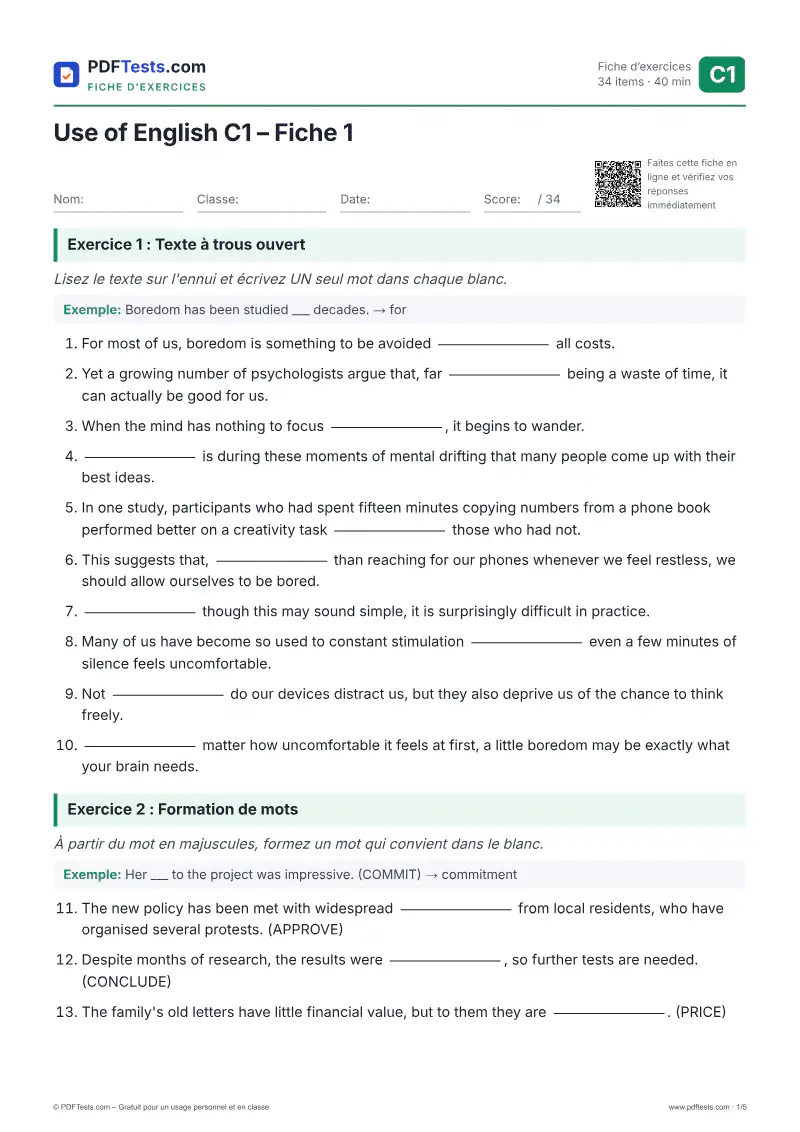
Use of English C1 – Fiche 1

C1 Avancé FicheAnglais

Cette fiche Use of English de niveau C1 propose quatre exercices au format examen : un texte à trous ouvert, de la formation de mots, des transformations de phrases à mot clé et un texte à trous sur les collocations. Elle s'adresse aux apprenants avancés qui préparent un examen de niveau C1 et aux enseignants qui souhaitent un entraînement imprimable avec corrigé.
items
34
Durée
40 min
PDF
5 pages
Corrigé
Inclus
  • 100 % gratuit
  • Sans inscription
  • PDF A4 prêt à imprimer
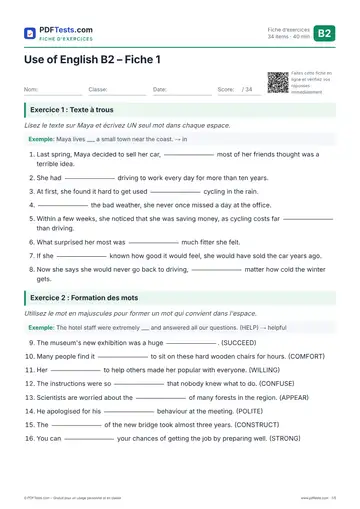
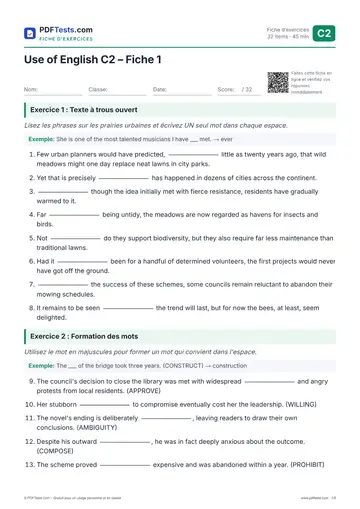
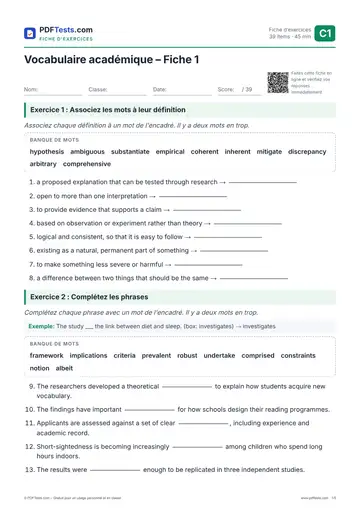
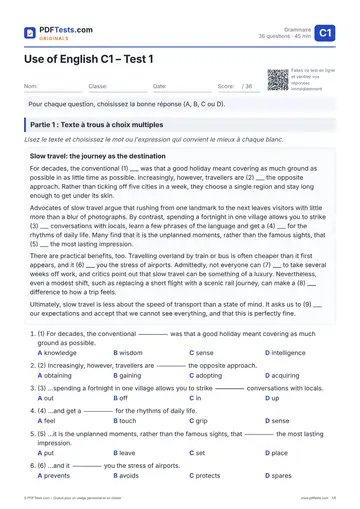
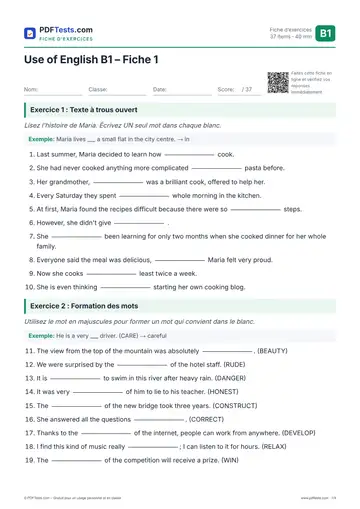
Aperçu de la page 1 : Use of English C1 – Fiche 1 Ouvrir le PDF
Use of English B1–C2 · tous les tests au format examen, types de tâches et conseils

Faire la fiche en ligne

Tapez vos réponses puis cliquez sur « Vérifier mes réponses ». Les autres réponses correctes sont acceptées.

Exercice 1 : Texte à trous ouvert

Lisez le texte sur l'ennui et écrivez UN seul mot dans chaque blanc.

Exemple: Boredom has been studied ___ decades. → for

  1. For most of us, boredom is something to be avoided all costs.

  2. Yet a growing number of psychologists argue that, far being a waste of time, it can actually be good for us.

  3. When the mind has nothing to focus , it begins to wander.

  4. is during these moments of mental drifting that many people come up with their best ideas.

  5. In one study, participants who had spent fifteen minutes copying numbers from a phone book performed better on a creativity task those who had not.

  6. This suggests that, than reaching for our phones whenever we feel restless, we should allow ourselves to be bored.

  7. though this may sound simple, it is surprisingly difficult in practice.

  8. Many of us have become so used to constant stimulation even a few minutes of silence feels uncomfortable.

  9. Not do our devices distract us, but they also deprive us of the chance to think freely.

  10. matter how uncomfortable it feels at first, a little boredom may be exactly what your brain needs.

Exercice 2 : Formation de mots

À partir du mot en majuscules, formez un mot qui convient dans le blanc.

Exemple: Her ___ to the project was impressive. (COMMIT) → commitment

  1. The new policy has been met with widespread from local residents, who have organised several protests. (APPROVE)

  2. Despite months of research, the results were , so further tests are needed. (CONCLUDE)

  3. The family's old letters have little financial value, but to them they are . (PRICE)

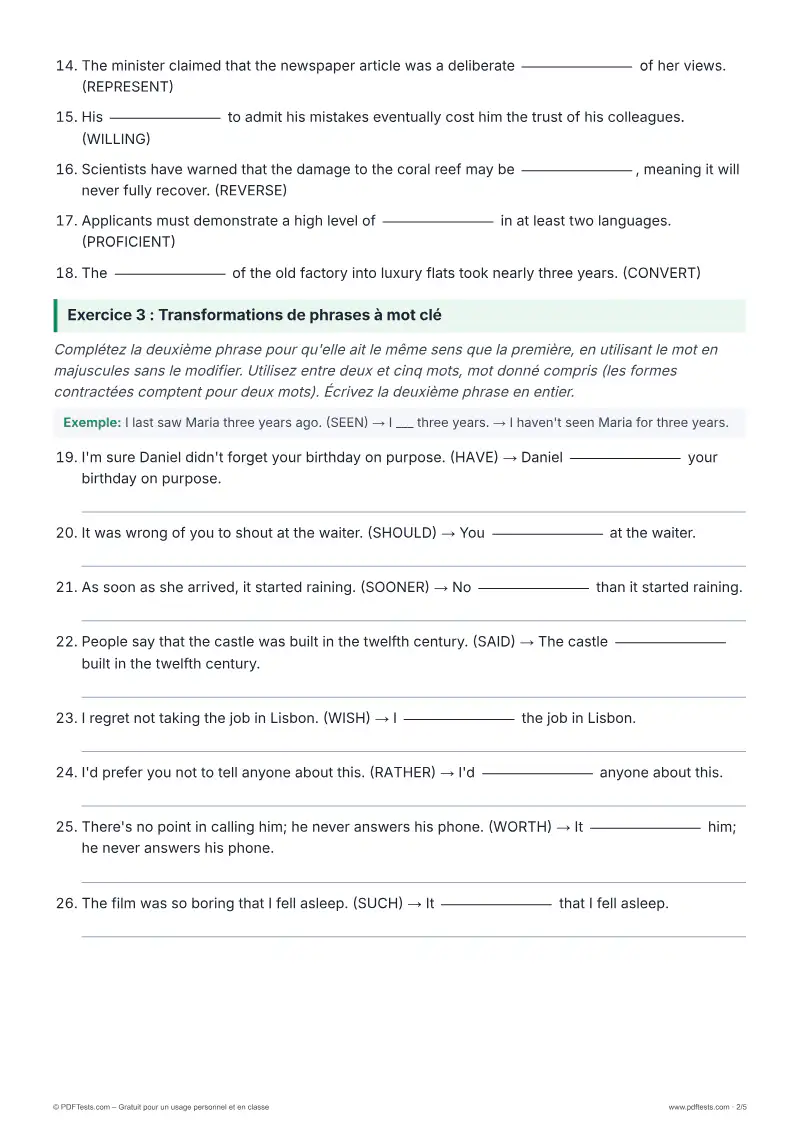
  4. The minister claimed that the newspaper article was a deliberate of her views. (REPRESENT)

  5. His to admit his mistakes eventually cost him the trust of his colleagues. (WILLING)

  6. Scientists have warned that the damage to the coral reef may be , meaning it will never fully recover. (REVERSE)

  7. Applicants must demonstrate a high level of in at least two languages. (PROFICIENT)

  8. The of the old factory into luxury flats took nearly three years. (CONVERT)

Exercice 3 : Transformations de phrases à mot clé

Complétez la deuxième phrase pour qu'elle ait le même sens que la première, en utilisant le mot en majuscules sans le modifier. Utilisez entre deux et cinq mots, mot donné compris (les formes contractées comptent pour deux mots). Écrivez la deuxième phrase en entier.

Exemple: I last saw Maria three years ago. (SEEN) → I ___ three years. → I haven't seen Maria for three years.

  1. I'm sure Daniel didn't forget your birthday on purpose. (HAVE) → Daniel ___ your birthday on purpose.

  2. It was wrong of you to shout at the waiter. (SHOULD) → You ___ at the waiter.

  3. As soon as she arrived, it started raining. (SOONER) → No ___ than it started raining.

  4. People say that the castle was built in the twelfth century. (SAID) → The castle ___ built in the twelfth century.

  5. I regret not taking the job in Lisbon. (WISH) → I ___ the job in Lisbon.

  6. I'd prefer you not to tell anyone about this. (RATHER) → I'd ___ anyone about this.

  7. There's no point in calling him; he never answers his phone. (WORTH) → It ___ him; he never answers his phone.

  8. The film was so boring that I fell asleep. (SUCH) → It ___ that I fell asleep.

Exercice 4 : Collocations et expressions figées

Écrivez UN seul mot dans chaque blanc pour compléter la collocation ou l'expression figée.

Exemple: Could you ___ me a favour and post this letter? → do

  1. The new manager quickly a good impression on the staff.

  2. It goes without that we will pay for any damage.

  3. There were a few small problems, but and large the event was a success.

  4. She was in two about whether to accept the offer.

  5. When planning the park, we need to into account the needs of older residents.

  6. The new regulations will come into next January.

  7. The project is still in its early , so it's hard to predict the outcome.

  8. The proposal was rejected the grounds that it was too expensive.

Cette page vous a-t-elle été utile ?

Signaler une erreur

Une mauvaise réponse, une faute de frappe ou une explication peu claire ? Dites-le-nous, nous corrigerons.

Aperçu

À propos de ce test

Fiche d'anglais C1 en PDF : texte à trous, formation de mots, transformations de phrases et collocations, au format examen, avec corrigé.

Thèmes abordés

Texte à trous ouvertFormation de motsTransformations de phrases à mot cléCollocations et expressions figéesModaux au passé et inversion

Notes pour l’enseignant

Proposez l'exercice 1 comme une lecture chronométrée. Demandez aux élèves de lire l'ensemble du texte avant de compléter les blancs, puis de comparer leurs réponses en binômes en justifiant chaque choix. Dans les transformations de phrases, les élèves dépassent souvent le nombre de mots autorisé, modifient le mot clé ou oublient que les formes contractées comptent pour deux mots. Insistez pour qu'ils vérifient ces trois points. En prolongement, demandez-leur de rédiger leurs propres phrases à transformer à partir des structures de l'exercice 3, puis de les échanger avec un camarade.

Tous les tests Anglais C1 →