PDFTests Originals

Formelles und informelles Register – Test 1

C1 Fortgeschritten WortschatzEnglisch

Dieser Wortschatztest auf Niveau C1 prüft, wie sicher Sie zwischen formellem und informellem Englisch wechseln können. Er behandelt formelle Entsprechungen alltäglicher Wörter, informelle Ausdrücke und Phrasal Verbs, Stilbrüche sowie feste Kollokationen und Wortfamilien aus der formellen Korrespondenz. Der Test eignet sich für fortgeschrittene Lernende, die sich auf Prüfungen oder berufliches Schreiben vorbereiten, und für Lehrkräfte, die eine fertige Übung zum Register suchen.
Fragen
30
Zeit
30 Min.
PDF
5 Seiten
Lösungen
Enthalten
  • 100 % kostenlos
  • Ohne Anmeldung
  • Druckfertiges A4-PDF
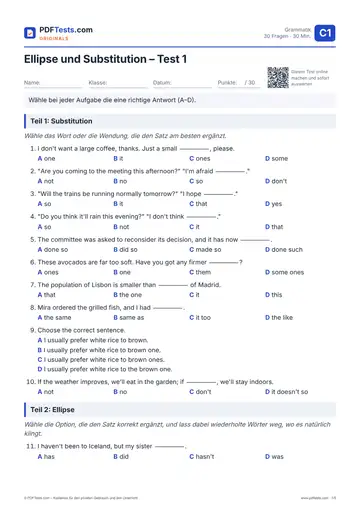
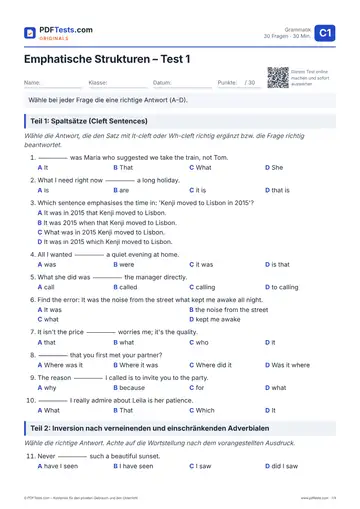
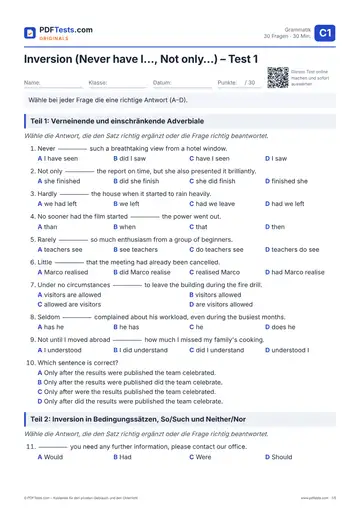
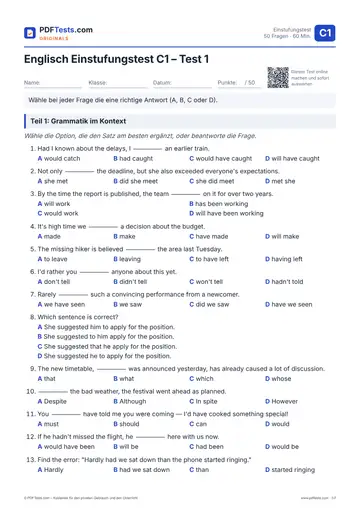
Vorschau von Seite 1: Formelles und informelles Register – Test 1 PDF öffnen

Test online machen

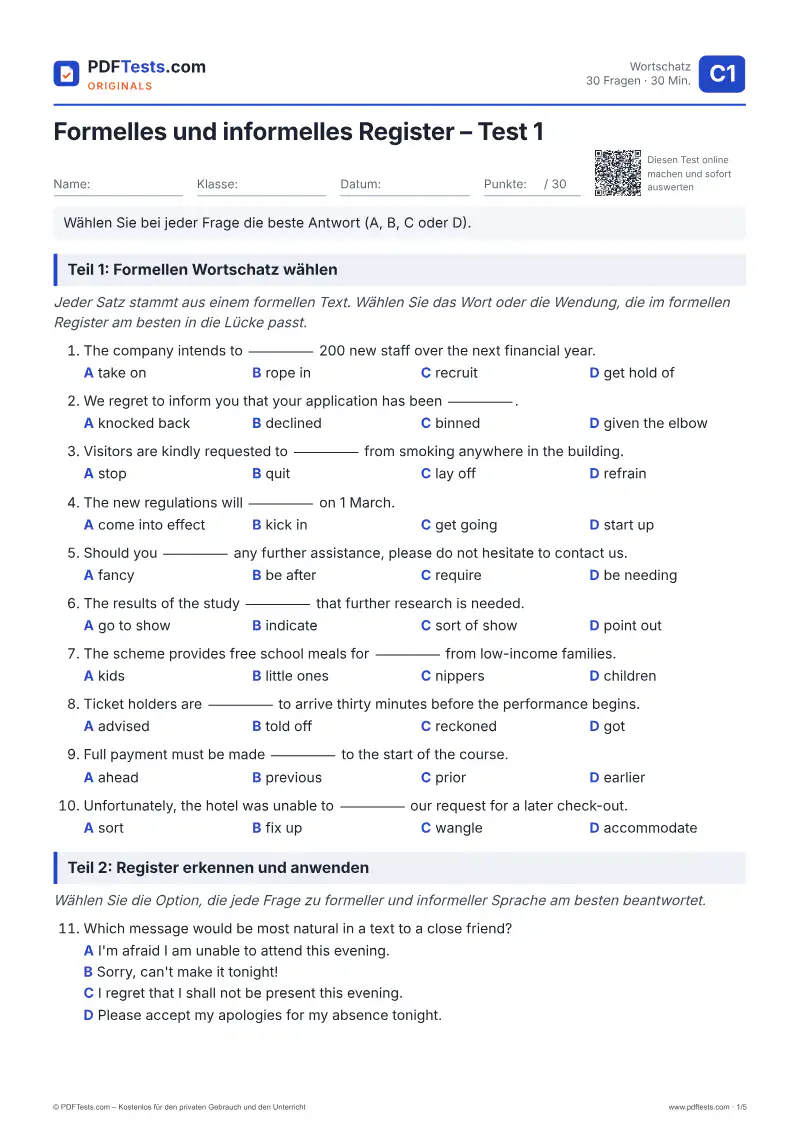
Wählen Sie bei jeder Frage die beste Antwort (A, B, C oder D). Wählen Sie Ihre Antworten und klicken Sie auf „Antworten prüfen“.

Teil 1: Formellen Wortschatz wählen

Jeder Satz stammt aus einem formellen Text. Wählen Sie das Wort oder die Wendung, die im formellen Register am besten in die Lücke passt.

  1. The company intends to _____ 200 new staff over the next financial year.

  2. We regret to inform you that your application has been _____.

  3. Visitors are kindly requested to _____ from smoking anywhere in the building.

  4. The new regulations will _____ on 1 March.

  5. Should you _____ any further assistance, please do not hesitate to contact us.

  6. The results of the study _____ that further research is needed.

  7. The scheme provides free school meals for _____ from low-income families.

  8. Ticket holders are _____ to arrive thirty minutes before the performance begins.

  9. Full payment must be made _____ to the start of the course.

  10. Unfortunately, the hotel was unable to _____ our request for a later check-out.

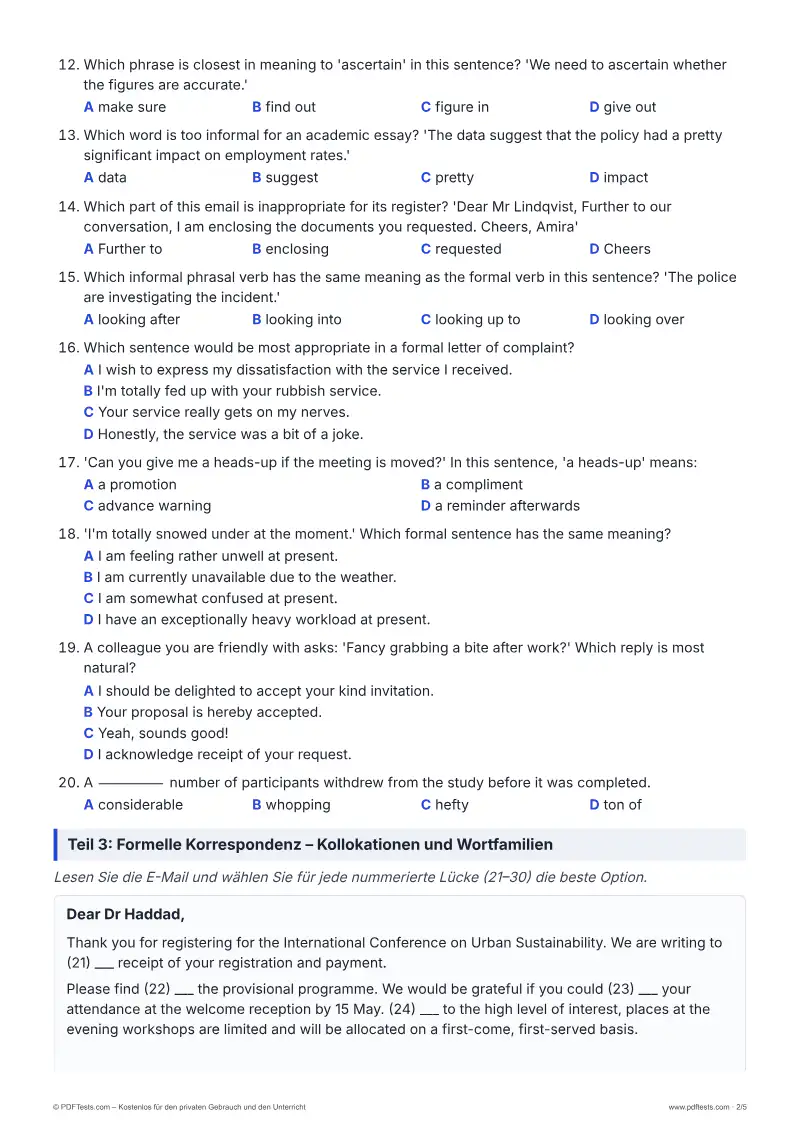
Teil 2: Register erkennen und anwenden

Wählen Sie die Option, die jede Frage zu formeller und informeller Sprache am besten beantwortet.

  1. Which message would be most natural in a text to a close friend?

  2. Which phrase is closest in meaning to 'ascertain' in this sentence? 'We need to ascertain whether the figures are accurate.'

  3. Which word is too informal for an academic essay? 'The data suggest that the policy had a pretty significant impact on employment rates.'

  4. Which part of this email is inappropriate for its register? 'Dear Mr Lindqvist, Further to our conversation, I am enclosing the documents you requested. Cheers, Amira'

  5. Which informal phrasal verb has the same meaning as the formal verb in this sentence? 'The police are investigating the incident.'

  6. Which sentence would be most appropriate in a formal letter of complaint?

  7. 'Can you give me a heads-up if the meeting is moved?' In this sentence, 'a heads-up' means:

  8. 'I'm totally snowed under at the moment.' Which formal sentence has the same meaning?

  9. A colleague you are friendly with asks: 'Fancy grabbing a bite after work?' Which reply is most natural?

  10. A _____ number of participants withdrew from the study before it was completed.

Teil 3: Formelle Korrespondenz – Kollokationen und Wortfamilien

Lesen Sie die E-Mail und wählen Sie für jede nummerierte Lücke (21–30) die beste Option.

Dear Dr Haddad,

Thank you for registering for the International Conference on Urban Sustainability. We are writing to (21) ___ receipt of your registration and payment.

Please find (22) ___ the provisional programme. We would be grateful if you could (23) ___ your attendance at the welcome reception by 15 May. (24) ___ to the high level of interest, places at the evening workshops are limited and will be allocated on a first-come, first-served basis.

Delegates who require (25) ___ are advised to book directly with one of our partner hotels, details of which are available on the conference website. Please note that the organisers cannot accept (26) ___ for the loss of personal belongings during the event.

Should you have any dietary requirements or accessibility needs, kindly (27) ___ the registration team at your earliest (28) ___. We will make every effort to (29) ___ your needs.

We look forward to welcoming you in June.

Yours (30) ___,

Elena Moreau

Conference Coordinator

  1. (21) We are writing to _____ receipt of your registration and payment.

  2. (22) Please find _____ the provisional programme.

  3. (23) We would be grateful if you could _____ your attendance at the welcome reception by 15 May.

  4. (24) _____ to the high level of interest, places at the evening workshops are limited.

  5. (25) Delegates who require _____ are advised to book directly with one of our partner hotels.

  6. (26) Please note that the organisers cannot accept _____ for the loss of personal belongings.

  7. (27) Kindly _____ the registration team at your earliest convenience.

  8. (28) Kindly contact the registration team at your earliest _____.

  9. (29) We will make every effort to _____ your needs.

  10. (30) Yours _____, (letter to Dr Haddad)

War diese Seite hilfreich?

Fehler melden

Falsche Lösung, Tippfehler oder unklare Erklärung? Schreiben Sie uns, wir korrigieren es.

Mit einem Arbeitsblatt üben: Formelles und informelles Register – Arbeitsblatt 1

Vorschau

Über diesen Test

Dieser Wortschatztest auf Niveau C1 prüft, wie sicher Sie zwischen formellem und informellem Englisch wechseln können. Er behandelt formelle Entsprechungen alltäglicher Wörter, informelle Ausdrücke und Phrasal Verbs, Stilbrüche sowie feste Kollokationen und Wortfamilien aus der formellen Korrespondenz. Der Test eignet sich für fortgeschrittene Lernende, die sich auf Prüfungen oder berufliches Schreiben vorbereiten, und für Lehrkräfte, die eine fertige Übung zum Register suchen.

Themen

Formeller vs. informeller WortschatzFormelle Entsprechungen von Phrasal VerbsStilbruch (register mismatch)Informelle RedewendungenKollokationen in formellen BriefenWortfamilien

So nutzen Sie diesen Test

  1. Laden Sie das PDF herunter und drucken Sie es aus – oder machen Sie den Test unten online.
  2. Beantworten Sie alle Fragen ohne Wörterbuch und ohne Zeitdruck.
  3. Prüfen Sie Ihre Antworten und notieren Sie, was Sie wiederholen sollten.

Hinweise für Lehrkräfte

Setzen Sie diesen Test nach einer Unterrichtseinheit zum Schreiben von E-Mails und Berichten ein oder als Diagnosetest vor einer formellen Schreibaufgabe. Er zielt auf typische Fehler auf C1-Niveau: Phrasal Verbs und Slang in formellen Texten, zu steife Sprache in lockeren Kontexten, falsche feste Präpositionen (refrain from, prior to) und Verwechslungen innerhalb von Wortfamilien (responsible/responsibility, convenient/convenience). Als Anschlussaufgabe können die Lernenden die E-Mail aus Teil 3 als informelle Nachricht an einen Freund umschreiben und anschließend ihre Wortwahl vergleichen.