PDFTests Originals

Use of English C1 – Test 2

C1 Avancé GrammaireAnglais

Ce test Use of English de niveau C1 vous entraîne aux quatre types d'exercices classiques des examens : texte à trous à choix multiples, texte à trous ouvert, formation des mots et transformations de phrases à partir d'un mot clé. Il aborde les collocations, les verbes à particule (phrasal verbs), les mots grammaticaux, les préfixes et suffixes ainsi que des structures avancées comme l'inversion et les phrases conditionnelles. Il s'adresse aux apprenants de niveau avancé qui préparent un examen de niveau C1 et aux enseignants à la recherche d'une épreuve d'entraînement clé en main.
Questions
36
Durée
45 min
PDF
6 pages
Corrigé
Inclus
  • 100 % gratuit
  • Sans inscription
  • PDF A4 prêt à imprimer
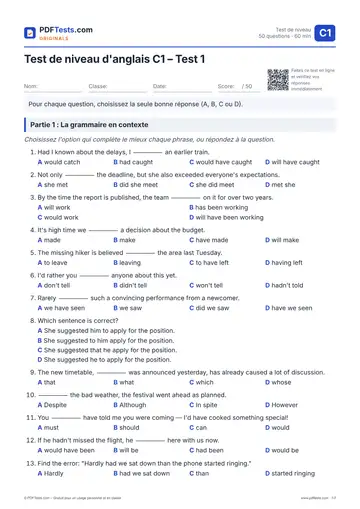
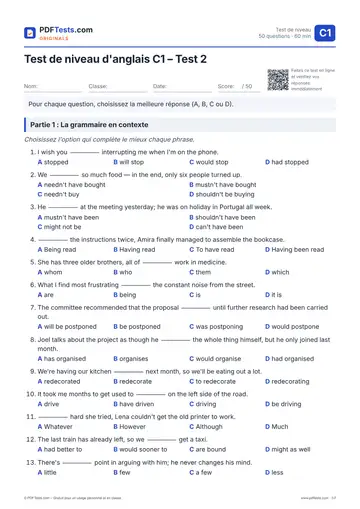
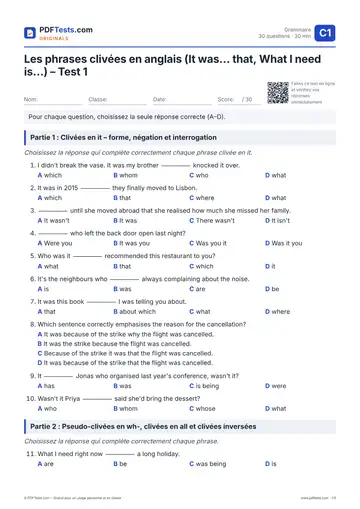
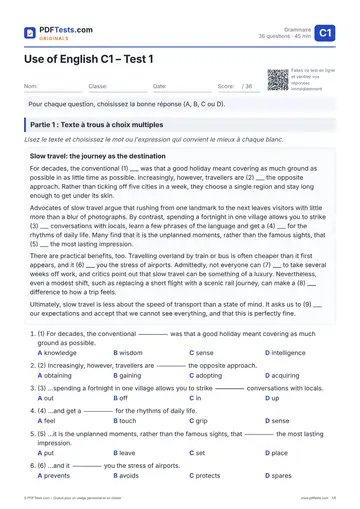
Aperçu de la page 1 : Use of English C1 – Test 2 Ouvrir le PDF
Use of English B1–C2 · tous les tests au format examen, types de tâches et conseils

Faire le test en ligne

Lisez attentivement chaque question et choisissez la seule bonne réponse (A, B, C ou D). Choisissez vos réponses, puis cliquez sur « Vérifier mes réponses ».

Partie 1 : Texte à trous à choix multiples

Lisez le texte et choisissez le mot ou l'expression qui convient le mieux à chaque trou.

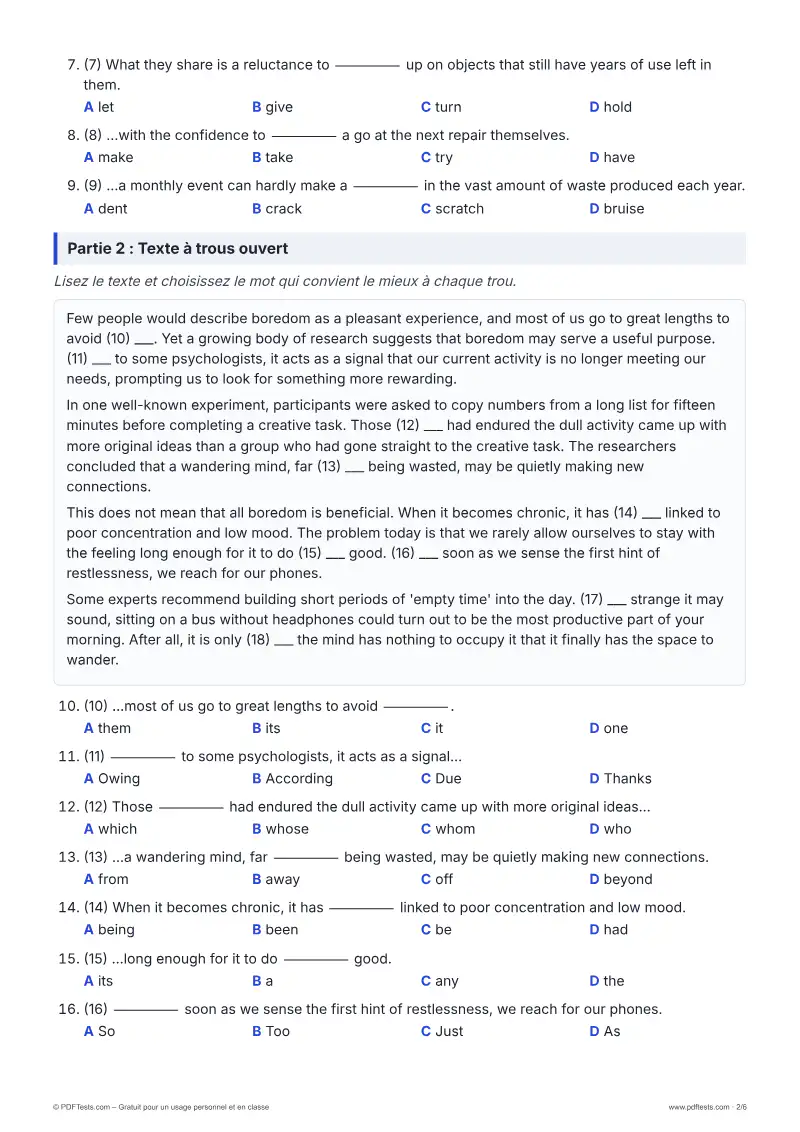
In many towns, a quiet revolution is (1) ___ place in community halls and libraries. Once a month, volunteers set up tables, plug in their tools and offer to fix whatever local people bring along, from wobbly chairs to broken toasters. These so-called repair cafés were originally (2) ___ up as a response to the growing mountain of household waste, but they have come to mean much more than that.

For one thing, they challenge the assumption that it is always cheaper to replace than to repair. Many visitors are surprised to learn that a fault which seemed fatal can be (3) ___ down to a single loose wire. For another, they (4) ___ a need that has little to do with electronics. Regulars often say that the chance to chat over a cup of tea is what keeps them coming back, and organisers are well (5) ___ that the social side matters as much as the technical one.

The volunteers themselves come from all (6) ___ of life. Some are retired engineers; others are students who simply enjoy taking things apart. What they share is a reluctance to (7) ___ up on objects that still have years of use left in them. Rather than doing the work for visitors, they try to involve them, so that people leave not only with a working lamp but with the confidence to (8) ___ a go at the next repair themselves.

Critics point out that a monthly event can hardly make a (9) ___ in the vast amount of waste produced each year. Supporters, however, argue that changing attitudes has to start somewhere.

  1. (1) In many towns, a quiet revolution is _____ place in community halls and libraries.

  2. (2) These so-called repair cafés were originally _____ up as a response to the growing mountain of household waste.

  3. (3) ...a fault which seemed fatal can be _____ down to a single loose wire.

  4. (4) For another, they _____ a need that has little to do with electronics.

  5. (5) ...organisers are well _____ that the social side matters as much as the technical one.

  6. (6) The volunteers themselves come from all _____ of life.

  7. (7) What they share is a reluctance to _____ up on objects that still have years of use left in them.

  8. (8) ...with the confidence to _____ a go at the next repair themselves.

  9. (9) ...a monthly event can hardly make a _____ in the vast amount of waste produced each year.

Partie 2 : Texte à trous ouvert

Lisez le texte et choisissez le mot qui convient le mieux à chaque trou.

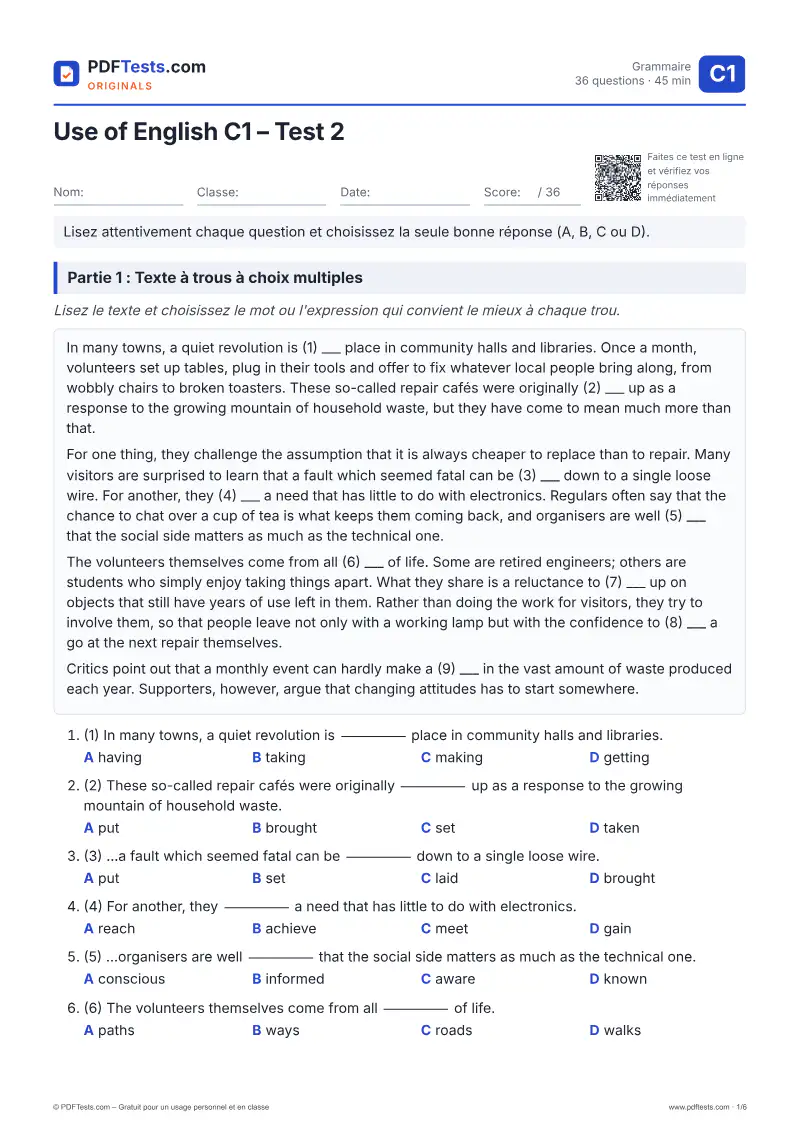
Few people would describe boredom as a pleasant experience, and most of us go to great lengths to avoid (10) ___. Yet a growing body of research suggests that boredom may serve a useful purpose. (11) ___ to some psychologists, it acts as a signal that our current activity is no longer meeting our needs, prompting us to look for something more rewarding.

In one well-known experiment, participants were asked to copy numbers from a long list for fifteen minutes before completing a creative task. Those (12) ___ had endured the dull activity came up with more original ideas than a group who had gone straight to the creative task. The researchers concluded that a wandering mind, far (13) ___ being wasted, may be quietly making new connections.

This does not mean that all boredom is beneficial. When it becomes chronic, it has (14) ___ linked to poor concentration and low mood. The problem today is that we rarely allow ourselves to stay with the feeling long enough for it to do (15) ___ good. (16) ___ soon as we sense the first hint of restlessness, we reach for our phones.

Some experts recommend building short periods of 'empty time' into the day. (17) ___ strange it may sound, sitting on a bus without headphones could turn out to be the most productive part of your morning. After all, it is only (18) ___ the mind has nothing to occupy it that it finally has the space to wander.

  1. (10) ...most of us go to great lengths to avoid _____.

  2. (11) _____ to some psychologists, it acts as a signal...

  3. (12) Those _____ had endured the dull activity came up with more original ideas...

  4. (13) ...a wandering mind, far _____ being wasted, may be quietly making new connections.

  5. (14) When it becomes chronic, it has _____ linked to poor concentration and low mood.

  6. (15) ...long enough for it to do _____ good.

  7. (16) _____ soon as we sense the first hint of restlessness, we reach for our phones.

  8. (17) _____ strange it may sound, sitting on a bus without headphones could turn out to be...

  9. (18) ...it is only _____ the mind has nothing to occupy it that it finally has the space to wander.

Partie 3 : Formation des mots

Choisissez la forme du mot en majuscules qui complète correctement chaque phrase.

  1. The assembly instructions were so badly translated that they were completely _____. (COMPREHEND)

  2. The rise in prices was _____ the main reason for the fall in sales. (DOUBT)

  3. Her _____ to compromise eventually led to the collapse of the negotiations. (WILL)

  4. The _____ of so many key players from the team left the coach with few options. (WITHDRAW)

  5. Compared with last year's figures, this year's drop in profits is relatively _____. (SIGNIFY)

  6. Many of the town's former factories have been converted into _____ flats. (RESIDE)

  7. Wearing a helmet is _____ for all cyclists taking part in the race. (OBLIGE)

  8. He's not really a close friend – more of a casual _____. (ACQUAINT)

  9. When asked whether she would do it all again, she answered without the slightest _____. (HESITATE)

Partie 4 : Transformations de phrases

Choisissez la phrase qui contient le mot en majuscules, qui est grammaticalement correcte et qui a le même sens que la première phrase.

  1. As soon as she arrived, the meeting began. (SOONER)

  2. I'd prefer you not to mention this to anyone. (RATHER)

  3. Paula is very likely to win the award. (CHANCE)

  4. They didn't finish the project because they didn't have enough money. (LACK)

  5. I didn't know she was ill, so I didn't visit her. (HAD)

  6. It took me a long time to get used to working at night. (ACCUSTOMED)

  7. Everyone was surprised when he resigned. (CAME)

  8. Tom is unlikely to accept the offer. (DOUBT)

  9. The new rules have had no effect on the number of complaints. (DIFFERENCE)

Cette page vous a-t-elle été utile ?

Signaler une erreur

Une mauvaise réponse, une faute de frappe ou une explication peu claire ? Dites-le-nous, nous corrigerons.

S’entraîner avec une fiche: Use of English C1 – Fiche 1

Aperçu

À propos de ce test

Ce test Use of English de niveau C1 vous entraîne aux quatre types d'exercices classiques des examens : texte à trous à choix multiples, texte à trous ouvert, formation des mots et transformations de phrases à partir d'un mot clé. Il aborde les collocations, les verbes à particule (phrasal verbs), les mots grammaticaux, les préfixes et suffixes ainsi que des structures avancées comme l'inversion et les phrases conditionnelles. Il s'adresse aux apprenants de niveau avancé qui préparent un examen de niveau C1 et aux enseignants à la recherche d'une épreuve d'entraînement clé en main.

Thèmes abordés

Collocations et expressions figéesVerbes à particule (phrasal verbs)Articles, pronoms et prépositionsConnecteurs et propositions relativesFormation des mots avec préfixes et suffixesInversion et phrases conditionnellesTransformations de phrases (key word transformations)

Comment utiliser ce test

  1. Téléchargez le PDF et imprimez-le, ou faites le test en ligne ci-dessous.
  2. Répondez à toutes les questions sans dictionnaire et sans vous presser.
  3. Vérifiez vos réponses et notez les points à revoir.

Notes pour l’enseignant

Vous pouvez utiliser ce test comme épreuve blanche chronométrée ou le traiter partie par partie en classe. La partie 1 cible des collocations et des phrasal verbs que les apprenants confondent souvent, la partie 2 porte sur les petits mots grammaticaux faciles à négliger, la partie 3 vérifie les préfixes négatifs et la nature des mots, et la partie 4 teste des structures comme l'inversion, « I'd rather » et le conditionnel du troisième type (third conditional). En prolongement, demandez aux élèves d'expliquer pourquoi chaque distracteur est incorrect, ou faites-leur rédiger leurs propres transformations avec les mêmes mots clés.