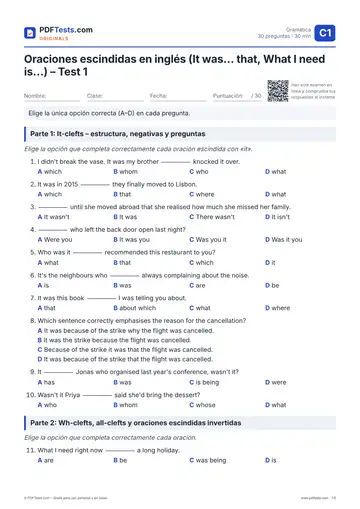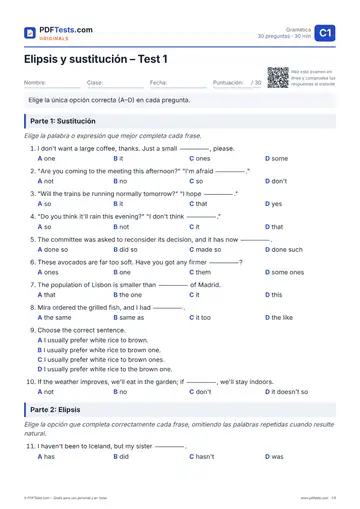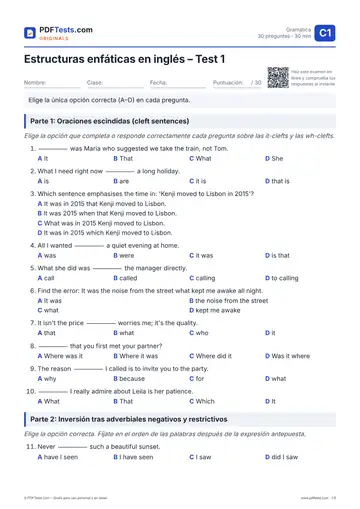
PDFTests Originals

Use of English C1 – Test 2

C1 Avanzado GramáticaInglés

Este test de Use of English de nivel C1 practica los cuatro tipos de tarea clásicos de los exámenes: multiple-choice cloze, open cloze, formación de palabras (word formation) y transformaciones con palabra clave (key word transformations). Trabaja colocaciones, phrasal verbs, palabras gramaticales, afijos y estructuras avanzadas como la inversión y las oraciones condicionales. Es ideal para alumnos de nivel avanzado que preparan exámenes de nivel C1 y para profesores que buscan una prueba de práctica lista para usar.
Preguntas
36
Tiempo
45 min
PDF
6 páginas
Soluciones
Incluidas
  • 100 % gratis
  • Sin registro
  • PDF A4 listo para imprimir
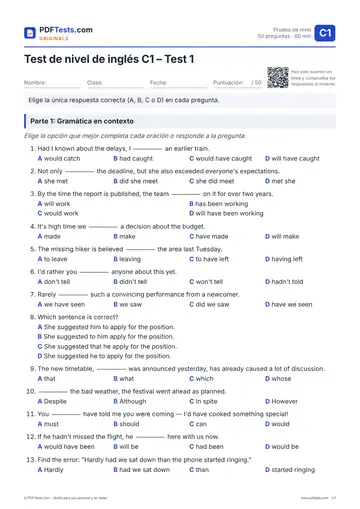
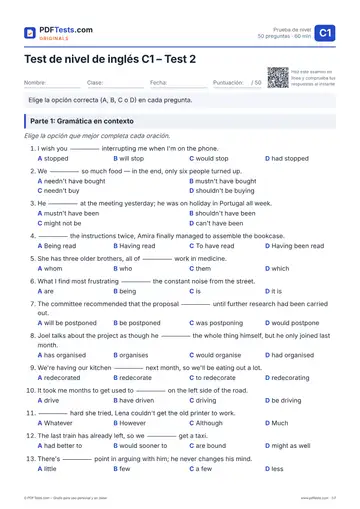
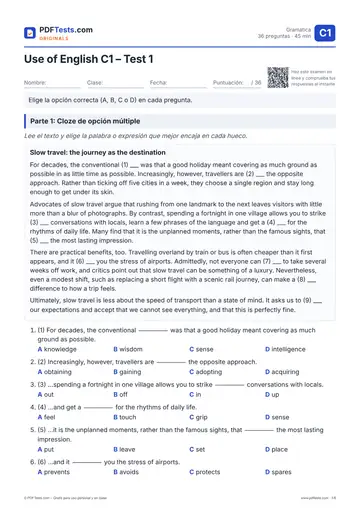
Vista previa de la página 1: Use of English C1 – Test 2 Abrir PDF
Use of English B1–C2 · todos los exámenes con formato de examen, tipos de tarea y consejos

Haz el examen en línea

Lee cada pregunta con atención y elige la única opción correcta (A, B, C o D). Elige tus respuestas y pulsa «Comprobar respuestas».

Parte 1: Multiple-choice cloze

Lee el texto y elige la palabra o expresión que mejor encaja en cada hueco.

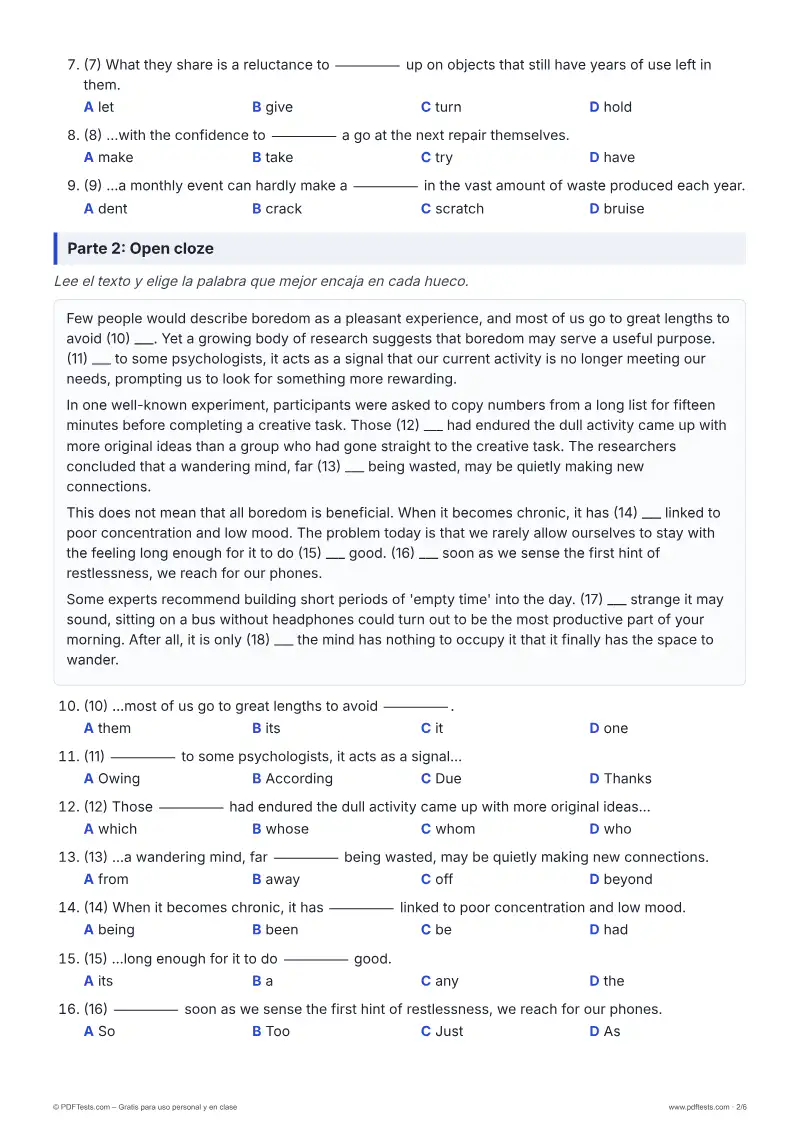
In many towns, a quiet revolution is (1) ___ place in community halls and libraries. Once a month, volunteers set up tables, plug in their tools and offer to fix whatever local people bring along, from wobbly chairs to broken toasters. These so-called repair cafés were originally (2) ___ up as a response to the growing mountain of household waste, but they have come to mean much more than that.

For one thing, they challenge the assumption that it is always cheaper to replace than to repair. Many visitors are surprised to learn that a fault which seemed fatal can be (3) ___ down to a single loose wire. For another, they (4) ___ a need that has little to do with electronics. Regulars often say that the chance to chat over a cup of tea is what keeps them coming back, and organisers are well (5) ___ that the social side matters as much as the technical one.

The volunteers themselves come from all (6) ___ of life. Some are retired engineers; others are students who simply enjoy taking things apart. What they share is a reluctance to (7) ___ up on objects that still have years of use left in them. Rather than doing the work for visitors, they try to involve them, so that people leave not only with a working lamp but with the confidence to (8) ___ a go at the next repair themselves.

Critics point out that a monthly event can hardly make a (9) ___ in the vast amount of waste produced each year. Supporters, however, argue that changing attitudes has to start somewhere.

  1. (1) In many towns, a quiet revolution is _____ place in community halls and libraries.

  2. (2) These so-called repair cafés were originally _____ up as a response to the growing mountain of household waste.

  3. (3) ...a fault which seemed fatal can be _____ down to a single loose wire.

  4. (4) For another, they _____ a need that has little to do with electronics.

  5. (5) ...organisers are well _____ that the social side matters as much as the technical one.

  6. (6) The volunteers themselves come from all _____ of life.

  7. (7) What they share is a reluctance to _____ up on objects that still have years of use left in them.

  8. (8) ...with the confidence to _____ a go at the next repair themselves.

  9. (9) ...a monthly event can hardly make a _____ in the vast amount of waste produced each year.

Parte 2: Open cloze

Lee el texto y elige la palabra que mejor encaja en cada hueco.

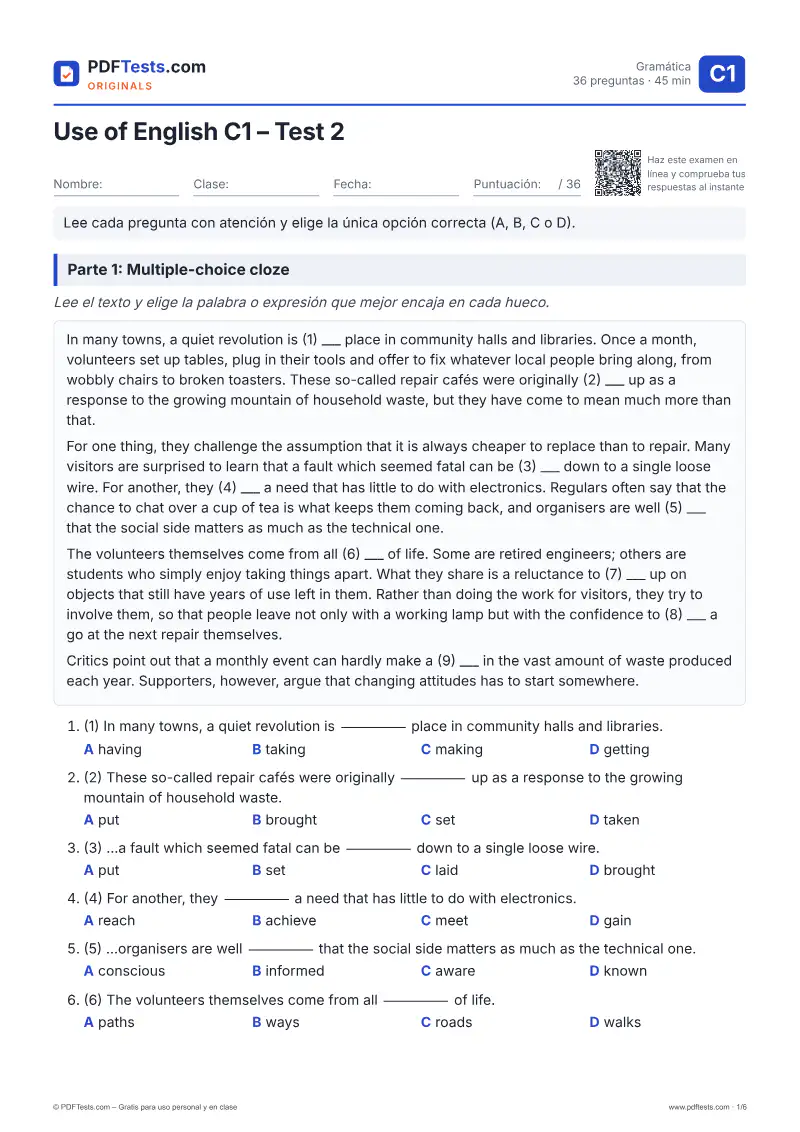
Few people would describe boredom as a pleasant experience, and most of us go to great lengths to avoid (10) ___. Yet a growing body of research suggests that boredom may serve a useful purpose. (11) ___ to some psychologists, it acts as a signal that our current activity is no longer meeting our needs, prompting us to look for something more rewarding.

In one well-known experiment, participants were asked to copy numbers from a long list for fifteen minutes before completing a creative task. Those (12) ___ had endured the dull activity came up with more original ideas than a group who had gone straight to the creative task. The researchers concluded that a wandering mind, far (13) ___ being wasted, may be quietly making new connections.

This does not mean that all boredom is beneficial. When it becomes chronic, it has (14) ___ linked to poor concentration and low mood. The problem today is that we rarely allow ourselves to stay with the feeling long enough for it to do (15) ___ good. (16) ___ soon as we sense the first hint of restlessness, we reach for our phones.

Some experts recommend building short periods of 'empty time' into the day. (17) ___ strange it may sound, sitting on a bus without headphones could turn out to be the most productive part of your morning. After all, it is only (18) ___ the mind has nothing to occupy it that it finally has the space to wander.

  1. (10) ...most of us go to great lengths to avoid _____.

  2. (11) _____ to some psychologists, it acts as a signal...

  3. (12) Those _____ had endured the dull activity came up with more original ideas...

  4. (13) ...a wandering mind, far _____ being wasted, may be quietly making new connections.

  5. (14) When it becomes chronic, it has _____ linked to poor concentration and low mood.

  6. (15) ...long enough for it to do _____ good.

  7. (16) _____ soon as we sense the first hint of restlessness, we reach for our phones.

  8. (17) _____ strange it may sound, sitting on a bus without headphones could turn out to be...

  9. (18) ...it is only _____ the mind has nothing to occupy it that it finally has the space to wander.

Parte 3: Formación de palabras (word formation)

Elige la forma de la palabra en mayúsculas que completa correctamente cada oración.

  1. The assembly instructions were so badly translated that they were completely _____. (COMPREHEND)

  2. The rise in prices was _____ the main reason for the fall in sales. (DOUBT)

  3. Her _____ to compromise eventually led to the collapse of the negotiations. (WILL)

  4. The _____ of so many key players from the team left the coach with few options. (WITHDRAW)

  5. Compared with last year's figures, this year's drop in profits is relatively _____. (SIGNIFY)

  6. Many of the town's former factories have been converted into _____ flats. (RESIDE)

  7. Wearing a helmet is _____ for all cyclists taking part in the race. (OBLIGE)

  8. He's not really a close friend – more of a casual _____. (ACQUAINT)

  9. When asked whether she would do it all again, she answered without the slightest _____. (HESITATE)

Parte 4: Transformaciones con palabra clave (key word transformations)

Elige la oración que utiliza la palabra en mayúsculas, es gramaticalmente correcta y tiene el mismo significado que la primera oración.

  1. As soon as she arrived, the meeting began. (SOONER)

  2. I'd prefer you not to mention this to anyone. (RATHER)

  3. Paula is very likely to win the award. (CHANCE)

  4. They didn't finish the project because they didn't have enough money. (LACK)

  5. I didn't know she was ill, so I didn't visit her. (HAD)

  6. It took me a long time to get used to working at night. (ACCUSTOMED)

  7. Everyone was surprised when he resigned. (CAME)

  8. Tom is unlikely to accept the offer. (DOUBT)

  9. The new rules have had no effect on the number of complaints. (DIFFERENCE)

¿Te ha resultado útil esta página?

Informar de un error

¿Has visto una respuesta incorrecta, una errata o una explicación poco clara? Avísanos y lo corregiremos.

Practica con una ficha: Use of English C1 – Ficha 1

Vista previa

Sobre este examen

Este test de Use of English de nivel C1 practica los cuatro tipos de tarea clásicos de los exámenes: multiple-choice cloze, open cloze, formación de palabras (word formation) y transformaciones con palabra clave (key word transformations). Trabaja colocaciones, phrasal verbs, palabras gramaticales, afijos y estructuras avanzadas como la inversión y las oraciones condicionales. Es ideal para alumnos de nivel avanzado que preparan exámenes de nivel C1 y para profesores que buscan una prueba de práctica lista para usar.

Temas

Colocaciones y expresiones fijasPhrasal verbsArtículos, pronombres y preposicionesConectores y oraciones de relativoFormación de palabras con prefijos y sufijosInversión y oraciones condicionalesTransformaciones con palabra clave (key word transformations)

Cómo usar este examen

  1. Descarga el PDF e imprímelo, o haz el examen en línea más abajo.
  2. Responde todas las preguntas sin diccionario y sin prisas.
  3. Comprueba tus respuestas y apunta los temas que debes repasar.

Notas para el profesor

Puedes usar este test como simulacro cronometrado o trabajarlo parte por parte en clase. La parte 1 se centra en colocaciones y phrasal verbs que los alumnos suelen confundir; la parte 2, en pequeñas palabras gramaticales que pasan fácilmente desapercibidas; la parte 3 comprueba los prefijos negativos y la categoría gramatical, y la parte 4 evalúa estructuras como la inversión, 'I'd rather' y el tercer condicional. Como actividad de seguimiento, pide a los alumnos que expliquen por qué cada distractor es incorrecto o que redacten sus propias transformaciones con las mismas palabras clave.