PDFTests Originals

Some and Any, Countable and Uncountable Nouns – Worksheet 1

A1 Beginner WorksheetEnglish

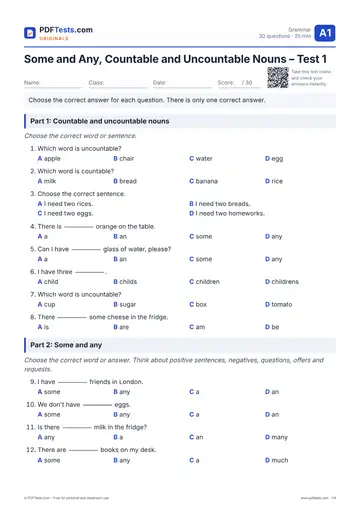
This worksheet helps A1 learners understand countable and uncountable nouns and use some, any, a and an correctly. Learners practise positive sentences, negatives and questions in everyday contexts like food, home and school.
items
39
Time
30 min
PDF
5 pages
Answer key
Included
  • 100% free
  • No sign-up or email
  • Print-ready A4 PDF
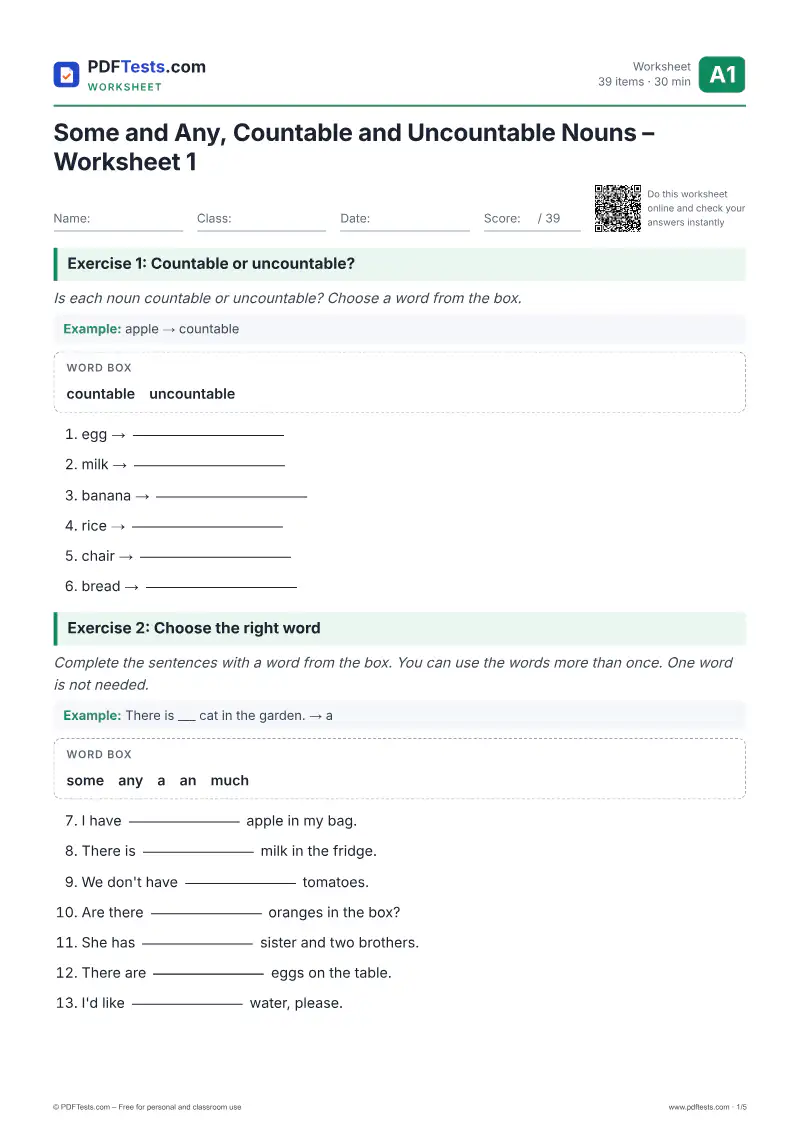
Preview of page 1 of Some and Any, Countable and Uncountable Nouns – Worksheet 1 Open PDF
New to this topic? Read the guide first: Some and Any: Countable and Uncountable Nouns

Do the worksheet online

Type your answers, then press “Check my answers”. Alternative correct answers are accepted.

Exercise 1: Countable or uncountable?

Is each noun countable or uncountable? Choose a word from the box.

Example: apple → countable

Word box countableuncountable

  1. egg

  2. milk

  3. banana

  4. rice

  5. chair

  6. bread

Exercise 2: Choose the right word

Complete the sentences with a word from the box. You can use the words more than once. One word is not needed.

Example: There is ___ cat in the garden. → a

Word box someanyaanmuch

  1. I have apple in my bag.

  2. There is milk in the fridge.

  3. We don't have tomatoes.

  4. Are there oranges in the box?

  5. She has sister and two brothers.

  6. There are eggs on the table.

  7. I'd like water, please.

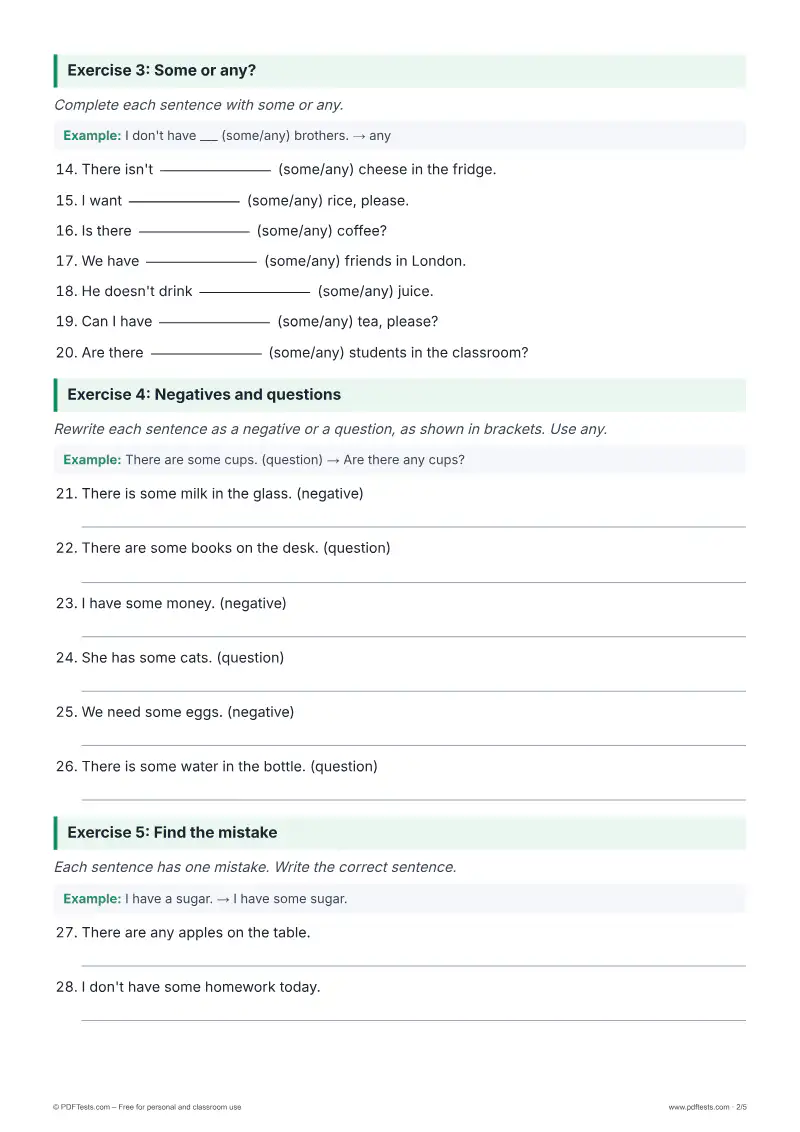
Exercise 3: Some or any?

Complete each sentence with some or any.

Example: I don't have ___ (some/any) brothers. → any

  1. There isn't (some/any) cheese in the fridge.

  2. I want (some/any) rice, please.

  3. Is there (some/any) coffee?

  4. We have (some/any) friends in London.

  5. He doesn't drink (some/any) juice.

  6. Can I have (some/any) tea, please?

  7. Are there (some/any) students in the classroom?

Exercise 4: Negatives and questions

Rewrite each sentence as a negative or a question, as shown in brackets. Use any.

Example: There are some cups. (question) → Are there any cups?

  1. There is some milk in the glass. (negative)

  2. There are some books on the desk. (question)

  3. I have some money. (negative)

  4. She has some cats. (question)

  5. We need some eggs. (negative)

  6. There is some water in the bottle. (question)

Exercise 5: Find the mistake

Each sentence has one mistake. Write the correct sentence.

Example: I have a sugar. → I have some sugar.

  1. There are any apples on the table.

  2. I don't have some homework today.

  3. I'd like a bread, please.

  4. There is some breads in the kitchen.

  5. Are there any milk in the fridge?

  6. She has two orange.

  7. I have an banana.

Exercise 6: Make sentences

Put the words in the correct order to make sentences and questions.

Example: some / have / I / pens → I have some pens.

  1. any / there / juice / is / ?

  2. some / I / bananas / have

  3. any / we / have / don't / sugar

  4. are / any / there / chairs / ?

  5. some / there / cheese / is / the / on / plate

  6. you / any / have / do / brothers / ?

Was this page helpful?

Report a mistake

Spotted a wrong answer, a typo or an unclear explanation? Tell us and we will fix it.

Preview

About this test

Printable A1 worksheet on some and any with countable and uncountable nouns: positives, negatives and questions, with answers.

Topics covered

Countable nounsUncountable nounsSome and anyA and anNegatives and questions

Notes for teachers

Start by sorting real classroom or food objects into countable and uncountable groups before doing Exercise 1. Typical mistakes are adding -s to uncountable nouns (breads), using a with uncountable nouns (a bread) and using some in negatives. Point out that we use some in requests and offers (Can I have some tea?). As a follow-up, ask pairs to describe what is and isn't in their fridge at home using some and any.

All English A1 tests →