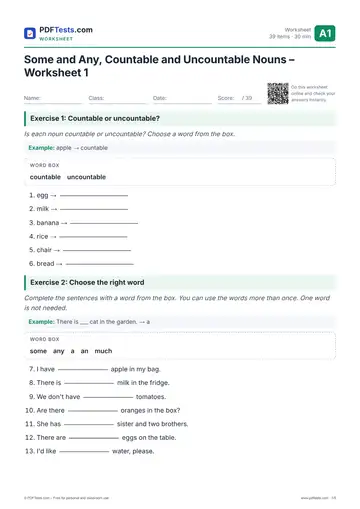
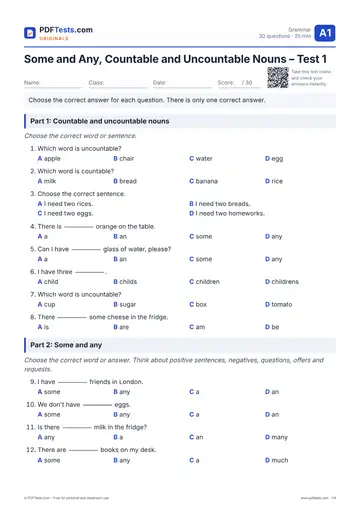
We use some and any to talk about an amount of something when the exact number is not important: There are some apples. There isn’t any milk. Use some in positive sentences, and any in negative sentences and questions. Both words go with plural countable nouns (apples, eggs) and uncountable nouns (milk, bread). They do not go with singular countable nouns. For those, use a or an.
To use some and any correctly, first you need to know if a noun is countable or uncountable. Let’s start there.
Countable and uncountable nouns
Countable nouns
Countable nouns are things you can count: one apple, two apples, three apples. They have a singular and a plural form.
| Singular | Plural |
|---|---|
| an apple | apples |
| a banana | bananas |
| an egg | eggs |
| a chair | chairs |
| a child | children |
A singular countable noun always needs a word before it, such as a, an, the, my or this.
- I’ve got a sandwich.
- She eats an orange every day.
For help with plural forms like tomatoes, babies and children, see our guide to plural nouns.
Uncountable nouns
Uncountable nouns are things you cannot count one by one. They have no plural form and you cannot use a/an with them. The verb is singular: The water is cold.
Common uncountable nouns at A1:
| Food and drink | Other common nouns |
|---|---|
| water, milk, juice, tea, coffee | money |
| bread, rice, pasta | music |
| cheese, butter, sugar, salt | information |
| meat, fruit | homework |
| soup, chocolate | furniture, luggage |
Examples:
- I need water. (not
a water, notwaters) - My homework is easy. (not
homeworks) - Music makes me happy.
How to count uncountable nouns
When you want a number, use a container or a unit + of:
| Container or unit | Example |
|---|---|
| a bottle of | a bottle of water |
| a cup of | two cups of tea |
| a glass of | a glass of milk |
| a slice of | three slices of bread |
| a piece of | a piece of cheese |
| a kilo of | a kilo of rice |
Note: In cafés, people often say a coffee or two teas to mean a cup of coffee or two cups of tea. This is normal in spoken English.
When to use some
1. Positive sentences
Use some in affirmative sentences with plural countable nouns and uncountable nouns.
- There are some eggs in the fridge.
- I bought some bread this morning.
- We’ve got some new students in our class.
- She wants some information about the course.
2. Offers and requests
Use some in questions when you offer something or ask for something. In these questions you expect the answer yes.
- Would you like some tea? (offer)
- Can I have some water, please? (request)
- Do you want some biscuits?
When to use any
1. Negative sentences
Use any after not (isn’t, aren’t, don’t, haven’t).
- There isn’t any milk.
- I don’t have any money with me.
- We haven’t got any tomatoes.
2. Questions
Use any in normal questions when you don’t know the answer.
- Are there any shops near here?
- Is there any coffee?
- Do you have any brothers or sisters?
Form: some and any in sentences
With plural countable nouns
| Type | Example |
|---|---|
| Affirmative | There are some apples on the table. |
| Negative | There aren’t any apples on the table. |
| Question | Are there any apples on the table? |
| Offer / request | Would you like some apples? |
With uncountable nouns
| Type | Example |
|---|---|
| Affirmative | There is some juice in the bottle. |
| Negative | There isn’t any juice in the bottle. |
| Question | Is there any juice in the bottle? |
| Offer / request | Can I have some juice, please? |
Notice the verb: there are + plural countable noun, there is + uncountable noun. You can read more in our guide to there is and there are.
A/an, some or any
Learners often mix up a/an and some. Use this table:
| Noun | Affirmative | Negative | Question |
|---|---|---|---|
| Singular countable | a/an: I’ve got a pen. | a/an: I haven’t got a pen. | a/an: Have you got a pen? |
| Plural countable | some: I’ve got some pens. | any: I haven’t got any pens. | any: Have you got any pens? |
| Uncountable | some: I’ve got some paper. | any: I haven’t got any paper. | any: Have you got any paper? |
So:
- There’s a banana. (one banana)
- There are some bananas. (more than one, but we don’t say how many)
- There’s some fruit. (uncountable)
If a and an still feel difficult, review our guide to articles a, an and the.
Some and any without a noun
You can use some and any alone when the noun is clear from the conversation.
- Is there any cheese? – Yes, there’s some in the fridge.
- Do you need any stamps? – No, I don’t need any, thanks.
- I’m making coffee. Do you want some?
Useful patterns to remember
These questions are very common in everyday English:
- Is there any … ? – Is there any sugar?
- Are there any … ? – Are there any good restaurants here?
- Have you got any … ? – Have you got any pets?
- Do you have any … ? – Do you have any questions?
- Would you like some … ? – Would you like some cake?
- Can I have some … ? – Can I have some more rice, please?
Common mistakes
✗ There are some milk in the fridge. → ✓ There is some milk in the fridge. Milk is uncountable, so the verb is singular.
✗ I have some apple. → ✓ I have an apple. / I have some apples. Some goes with plural countable nouns, not singular ones.
✗ I don’t have some money. → ✓ I don’t have any money. Use any in negative sentences.
✗ Are there some cafés near here? → ✓ Are there any cafés near here? Use any in normal questions when you don’t know the answer.
✗ Would you like any tea? → ✓ Would you like some tea? Use some in offers.
✗ Can you give me an information? → ✓ Can you give me some information? Information is uncountable: no a/an and no plural.
✗ I’ve got a lot of homeworks. → ✓ I’ve got a lot of homework. Homework is uncountable, so it has no -s.
✗ I’d like a bread, please. → ✓ I’d like some bread / a loaf of bread, please. Bread is uncountable; use some or a unit like a loaf or a slice.
Quick check
Choose the correct word: a/an, some or any.
- There isn’t ___ coffee in the cupboard.
- I’d like ___ glass of water, please.
- Would you like ___ chocolate?
- Are there ___ students in the classroom?
- We need ___ eggs for the cake.
Answers
- any – negative sentence.
- a – glass is a singular countable noun.
- some – an offer.
- any – a normal question.
- some – positive sentence with a plural countable noun.
Next step
Now practise what you have learned: test yourself with our A1 Some and Any test, which mixes countable and uncountable nouns in positive sentences, negatives and questions. Many of the nouns in this guide are food words, so the A1 Food and Drink vocabulary test is a good partner. When you feel confident, move on to talking about quantity with our guide to much, many, a lot of, a few and a little, which builds directly on the countable and uncountable rules you have just learned.
Was this page helpful?
What was the problem?
Thank you for your feedback!