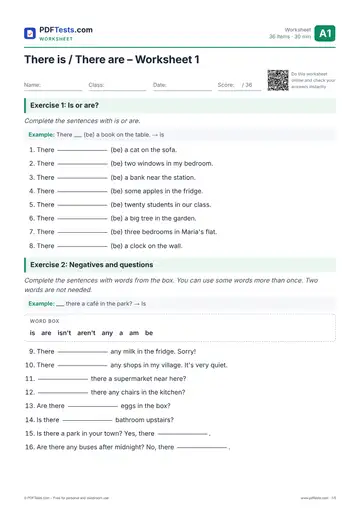
We use there is and there are to say that something exists or is in a place. Use there is with one thing (There is a café near my house) and there are with two or more things (There are three cafés in my street). It is one of the most useful structures at A1, because you need it to describe your home, your town and the world around you.
What does “there is / there are” mean?
There is and there are introduce new information. They tell the listener that something is in a place, often for the first time.
- There is a bank on Main Street.
- There are two bedrooms in my flat.
- There is a problem with my phone.
In these sentences, there does not mean “in that place”. It is just the start of the structure. The real information comes after the verb: a bank, two bedrooms, a problem.
The verb is a form of be, so if you know the verb to be (am, is, are), you already know most of the grammar here.
When to use there is / there are
1. To say that something exists or is in a place
- There is a supermarket next to the station.
- There are some good restaurants in this area.
- There is a cat in the garden.
We often add a place at the end, using words like in, on, under and next to. See our guide to prepositions of place for more on these.
2. To describe a room, a building, a town or a picture
- In my bedroom, there is a bed, a desk and a big window.
- There are lots of trees in the park.
- In the picture, there are two children and a dog.
3. To talk about quantity
- There are 25 students in my class.
- There is one bathroom in the house.
- How many people are there in your family?
Form
Affirmative
| Singular / uncountable | Plural |
|---|---|
| There is a table. | There are two tables. |
| There**’s** a table. (contraction) | There are two tables. (no common written contraction) |
| There is some milk. | There are some eggs. |
The contraction there’s is very common in speaking and informal writing. For there are, we normally write the full form.
Negative
| Singular / uncountable | Plural |
|---|---|
| There isn’t a lift. | There aren’t any shops. |
| There is not a lift. | There are not any shops. |
| There**’s no** lift. | There are no shops. |
| There isn’t any water. |
Isn’t / aren’t and no mean the same thing here, but be careful: use one negative only. There isn’t a lift or There is no lift – not There isn’t no lift.
Questions and short answers
To make a question, put is or are before there.
| Question | Yes | No |
|---|---|---|
| Is there a bank near here? | Yes, there is. | No, there isn’t. |
| Are there any good cafés? | Yes, there are. | No, there aren’t. |
| Is there any sugar? | Yes, there is. | No, there isn’t. |
In short answers, do not use the contraction in the positive form: say Yes, there is, not Yes, there’s.
Questions with “How many”
Use How many + plural noun + are there…? to ask about number.
- How many rooms are there in the hotel? – There are 40.
- How many students are there in your class? – There are 18.
The verb is always are after How many, because the noun is plural.
There is or there are? Choosing the right verb
The verb depends on the noun that comes after it.
| Noun after the verb | Verb | Example |
|---|---|---|
| one countable thing (a / an / one) | is | There is an apple on the table. |
| uncountable noun | is | There is some rice in the cupboard. |
| two or more things | are | There are three apples. |
Uncountable nouns such as water, milk, money, bread, information and traffic always take is:
- There is a lot of traffic today.
- There isn’t much time.
Lists of things
When you list several things, the verb usually agrees with the first noun in the list:
- There is a sofa, two chairs and a TV in the living room.
- There are two chairs, a sofa and a TV in the living room.
If this feels strange, start the list with the plural noun and use there are.
Some, any, a/an and no
These small words often go with there is / there are.
| Sentence type | Singular countable | Plural | Uncountable |
|---|---|---|---|
| Affirmative | There’s a park. | There are some parks. | There’s some juice. |
| Negative | There isn’t a park. | There aren’t any parks. | There isn’t any juice. |
| Question | Is there a park? | Are there any parks? | Is there any juice? |
The basic rule: some in affirmative sentences, any in negatives and questions. For more practice with this, read our guide to some and any, countable and uncountable nouns.
Pronunciation notes
- there’s is pronounced /ðeəz/ – it sounds like theirs.
- In fast speech, there are often sounds like /ðeərə/, with the two words joined.
- there is pronounced the same as their and they’re, but they are different words with different meanings.
In very informal speech, you may hear there’s with a plural noun (There’s two buses an hour). In writing and in tests, use there are with plural nouns.
There is vs It is
Learners often mix these up. There is introduces something new. It is gives more information about something we already know.
- There’s a new restaurant in town. It’s Italian.
- There’s a message for you. It’s from your boss.
We also use it is for time, weather and distance, not there is:
- It’s cold today. (not There is cold)
- It’s ten o’clock.
There are vs They are
The same idea works with plurals:
- There are two dogs in the garden. They are very friendly.
There are = new information (they exist). They are = more about the same dogs.
There is vs have got / has got
Sometimes you can say the same thing in two ways:
- There is a swimming pool in my hotel.
- My hotel has got a swimming pool.
With there is, the place usually comes at the end. With have got, the place or owner is the subject. You can read more in our guide to have got / has got.
Common mistakes
✗ It is a supermarket near my house. → ✓ There is a supermarket near my house. Use there is to say that something exists in a place.
✗ There is three chairs in the kitchen. → ✓ There are three chairs in the kitchen. Use are with plural nouns.
✗ There are some milk in the fridge. → ✓ There is some milk in the fridge. Uncountable nouns take is.
✗ Have a bank near here? → ✓ Is there a bank near here? In questions, put is / are before there.
✗ There isn’t no bread. → ✓ There isn’t any bread. / There is no bread. Use only one negative word.
✗ Yes, there’s. → ✓ Yes, there is. Do not use the contraction in positive short answers.
✗ How many students there are in your class? → ✓ How many students are there in your class? Change the word order in questions.
✗ Their is a problem. → ✓ There is a problem. Their means “belonging to them”; the structure uses there.
✗ There are any eggs. → ✓ There are some eggs. Use some in affirmative sentences, any in negatives and questions.
Quick check
Choose or complete the correct form.
- ___ a big window in my bedroom. (There is / There are)
- There ___ any shops in my village. (isn’t / aren’t)
- ___ a cinema near here? – Yes, ___ .
- How many people ___ in your family?
- There’s a new café in town. ___ very small. (There’s / It’s)
Answers
- There is – a window is singular.
- aren’t – shops is plural.
- Is there a cinema near here? – Yes, there is.
- How many people are there in your family?
- It’s – we already know about the café, so we use it.
Next step
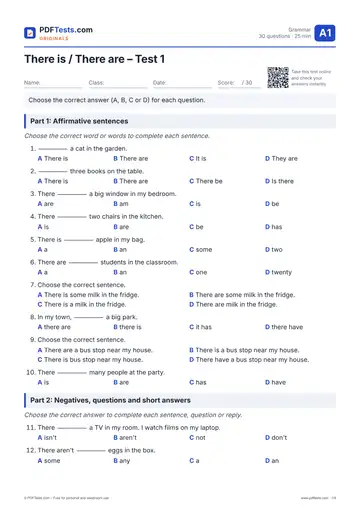
Now test yourself with our A1 There is / There are test to check you can choose between is and are, form negatives and questions, and use some and any correctly. If you find plurals difficult, the A1 Plural Nouns test is a good next practice, and you can find more practice at your level on our English A1 tests page.
Practise this topic: There is / There are
Was this page helpful?
What was the problem?
Thank you for your feedback!