PDFTests Originals

ESL Placement Practice Test B1 – Test 1

B1 Intermediate Level testEnglish

This B1 ESL placement practice test has 36 multiple-choice questions on sentence meaning, language use, and reading skills. The two reading texts are set in everyday US work and school life. It is for adult-education and college ESL learners, and for teachers who want to check whether a student is secure at the intermediate (B1) level.

Questions
36
Time
45 min
PDF
7 pages
Answer key
Included
  • 100% free
  • No sign-up or email
  • Print-ready A4 PDF
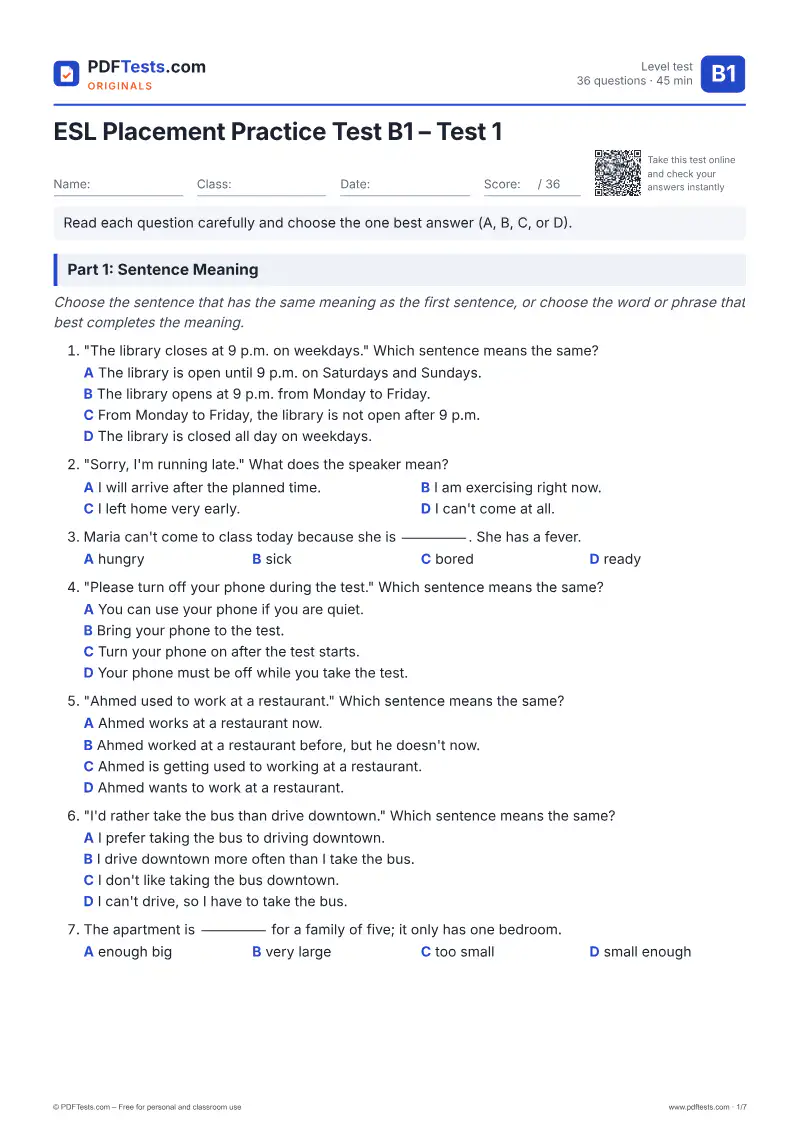
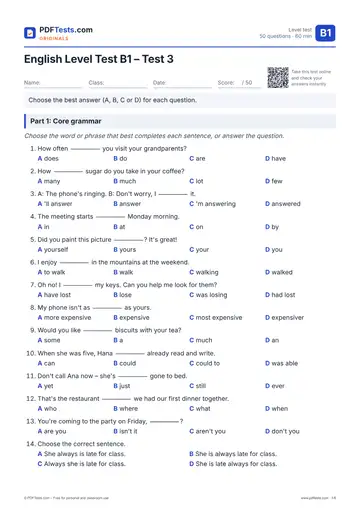
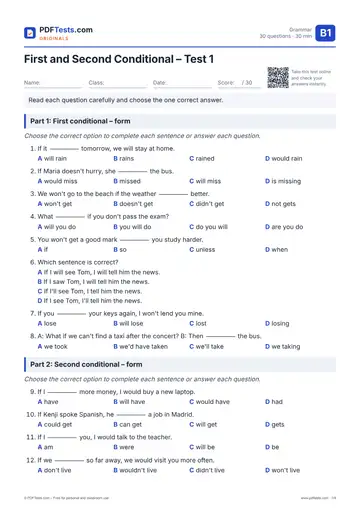
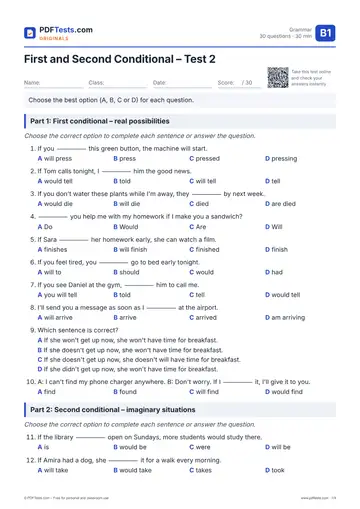
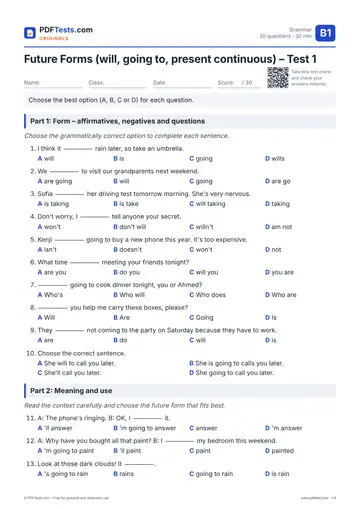
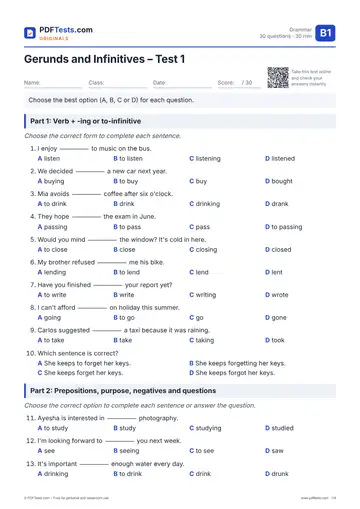
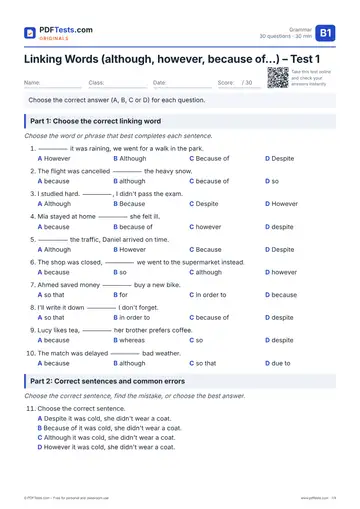
Preview of page 1 of ESL Placement Practice Test B1 – Test 1 Open PDF
ESL placement test · all practice tests, levels and tips

Take the test online

Read each question carefully and choose the one best answer (A, B, C, or D). Choose your answers, then press “Check my answers”.

Part 1: Sentence Meaning

Choose the sentence that has the same meaning as the first sentence, or choose the word or phrase that best completes the meaning.

  1. "The library closes at 9 p.m. on weekdays." Which sentence means the same?

  2. "Sorry, I'm running late." What does the speaker mean?

  3. Maria can't come to class today because she is _____. She has a fever.

  4. "Please turn off your phone during the test." Which sentence means the same?

  5. "Ahmed used to work at a restaurant." Which sentence means the same?

  6. "I'd rather take the bus than drive downtown." Which sentence means the same?

  7. The apartment is _____ for a family of five; it only has one bedroom.

  8. "You don't have to bring lunch on Friday." Which sentence means the same?

  9. "Kim hasn't finished the report yet." Which sentence means the same?

  10. "The meeting was put off until next week." Which sentence means the same?

  11. "If I had more time, I would take an evening class." Which sentence is true?

  12. "Despite the heavy rain, the game continued." Which sentence means the same?

Part 2: Language Use

Choose the correct word or phrase to fill the gap, choose the grammatically correct sentence, or find the part of the sentence that is incorrect.

  1. My sister _____ in Chicago since 2019.

  2. Choose the correct sentence.

  3. When I got home, my roommate _____ dinner.

  4. Today is the _____ day of the year so far.

  5. We're _____ a picnic this Saturday if the weather is nice.

  6. If it _____ tomorrow, we will stay inside.

  7. Choose the correct sentence.

  8. The new community center _____ last year.

  9. Excuse me, can you tell me where _____?

  10. Which part of this sentence is incorrect? "The teacher, who she is from Texas, gave us a lot of homework last night."

  11. He asked me _____ I could help him move on Sunday.

  12. By the time we arrived at the theater, the movie _____.

Part 3: Reading Skills – A Workplace Email

Read the email. Then choose the best answer to each question.

Subject: Schedule changes for next week

Hi everyone,

As you know, the store will be closed on Monday for the Labor Day holiday. Because of this, our weekly team meeting will move from Monday morning to Tuesday at 8:30 a.m. in the break room. Please arrive a few minutes early so we can start on time.

Also, we still need two people to work extra hours on Saturday, September 9. We are expecting a large delivery that morning, and we need help putting products on the shelves. If you are interested, please write your name on the list next to the time clock by Thursday. Extra hours will be paid at the usual rate plus $3 per hour.

Finally, a reminder: if you are sick and cannot come to work, call the store directly. Please do not send a text message to a coworker and ask them to tell me.

Thanks,

Denise Morales

Store Manager

  1. Why is the team meeting moving to a different day?

  2. When is the team meeting now?

  3. Why does the store need extra workers on Saturday?

  4. How can an employee ask to work the extra hours?

  5. In the sentence "Extra hours will be paid at the usual rate plus $3 per hour," the word "rate" is closest in meaning to:

  6. What should an employee do if they are sick and cannot work?

Part 4: Reading Skills – A Short Article

Read the article. Then choose the best answer to each question.

Learning English at Night

When Thanh Nguyen moved to Houston three years ago, she could read English fairly well, but she had trouble understanding people when they spoke quickly. "At the bank or the doctor's office, I always asked people to repeat things," she remembers. "I felt embarrassed, so sometimes I just said yes and hoped for the best."

Thanh works at a hotel during the day, so she couldn't attend regular classes. Then a coworker told her about free evening English classes at a nearby adult education center. The classes meet three nights a week, from 6:00 to 8:30, and the center also offers child care for students with young children.

At first, Thanh was nervous about speaking in front of the other students. However, her teacher put everyone into small groups, and they practiced real situations, such as making appointments and talking to a landlord. "Everyone made mistakes, so nobody laughed," she says.

After a year, Thanh passed a placement test and moved into a higher level. Last month, she applied for a front desk position at her hotel, a job that requires strong communication skills. She got it. Now she is planning to take a college course in hotel management next fall. "The evening classes didn't just improve my English," she says. "They gave me confidence."

  1. What was Thanh's main problem with English when she arrived in Houston?

  2. Why did Thanh sometimes say "yes" when she did not understand?

  3. Why did Thanh take evening classes?

  4. What helped Thanh feel less nervous about speaking in class?

  5. What can we infer about Thanh's new job at the hotel?

  6. What is the main idea of the article?

Was this page helpful?

Report a mistake

Spotted a wrong answer, a typo or an unclear explanation? Tell us and we will fix it.

Preview

About this test

This B1 ESL placement practice test has 36 multiple-choice questions on sentence meaning, language use, and reading skills. The two reading texts are set in everyday US work and school life. It is for adult-education and college ESL learners, and for teachers who want to check whether a student is secure at the intermediate (B1) level.

Topics covered

Sentence meaningPresent perfect and past continuousConditionalsPassive voiceIndirect questionsPast perfectReading comprehensionWorkplace and school vocabulary

How to use this test

  1. Download the PDF and print it, or take the test online below.
  2. Answer every question without a dictionary or time pressure.
  3. Check your answers and note the topics you need to review.

Notes for teachers

Use the total score as a guide. About 29 or more correct (80%) suggests the learner is secure at B1. A score between 22 and 28 suggests partial control. Below 22 points to A2-level placement. Part 1 checks common misunderstandings, such as "don't have to" vs. "must not" and "used to" vs. "be used to." Part 2 targets frequent tense and word-order errors, including "since" vs. "for" and indirect questions. As a follow-up, ask learners to explain their wrong answers orally, or to write their own sentences with the structures they missed.