PDFTests Originals

Future Forms (will, going to, present continuous) – Worksheet 1

B1 Intermediate WorksheetEnglish

This worksheet helps B1 learners choose between will, going to and the present continuous for future meaning. Students match forms to their uses, complete sentences, make negatives and questions, and correct common mistakes. It works for classroom practice or self-study at home.
items
37
Time
35 min
PDF
5 pages
Answer key
Included
  • 100% free
  • No sign-up or email
  • Print-ready A4 PDF
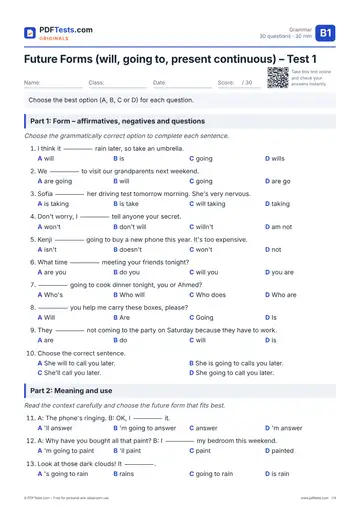
Preview of page 1 of Future Forms (will, going to, present continuous) – Worksheet 1 Open PDF
New to this topic? Read the guide first: Future Forms: Will, Going To and Present Continuous

Do the worksheet online

Type your answers, then press “Check my answers”. Alternative correct answers are accepted.

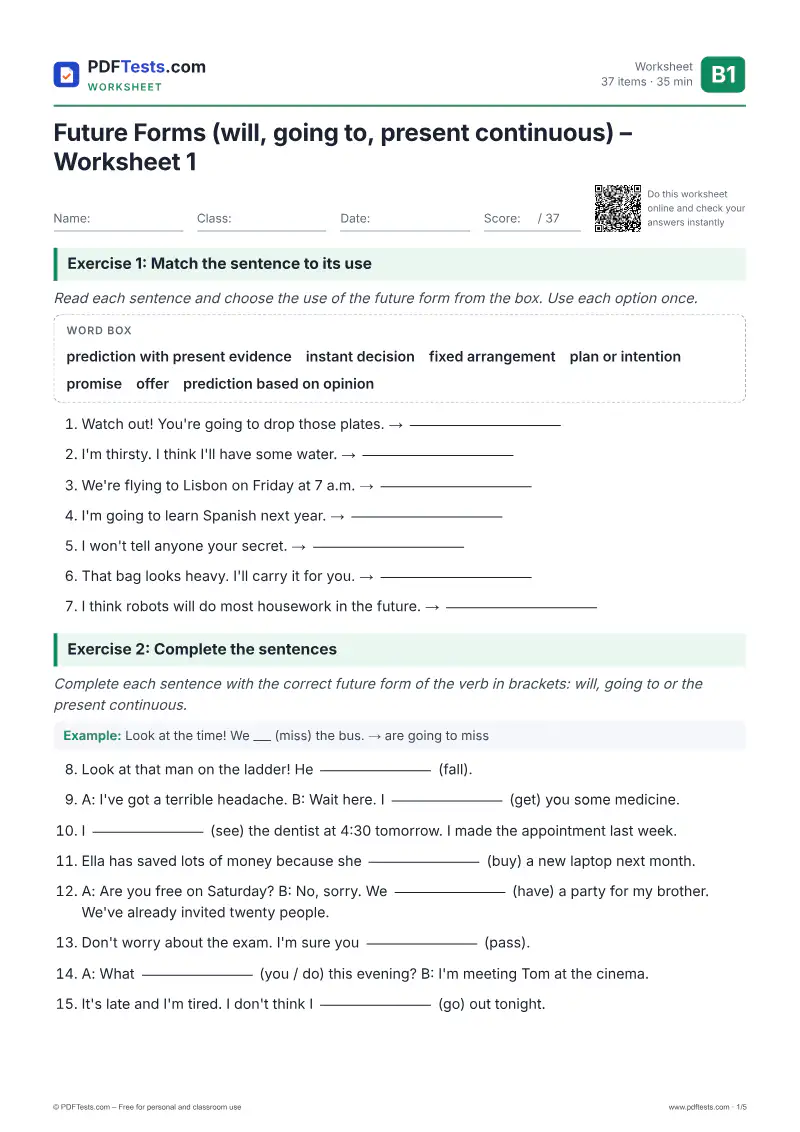
Exercise 1: Match the sentence to its use

Read each sentence and choose the use of the future form from the box. Use each option once.

Word box prediction with present evidenceinstant decisionfixed arrangementplan or intentionpromiseofferprediction based on opinion

  1. Watch out! You're going to drop those plates.

  2. I'm thirsty. I think I'll have some water.

  3. We're flying to Lisbon on Friday at 7 a.m.

  4. I'm going to learn Spanish next year.

  5. I won't tell anyone your secret.

  6. That bag looks heavy. I'll carry it for you.

  7. I think robots will do most housework in the future.

Exercise 2: Complete the sentences

Complete each sentence with the correct future form of the verb in brackets: will, going to or the present continuous.

Example: Look at the time! We ___ (miss) the bus. → are going to miss

  1. Look at that man on the ladder! He (fall).

  2. A: I've got a terrible headache. B: Wait here. I (get) you some medicine.

  3. I (see) the dentist at 4:30 tomorrow. I made the appointment last week.

  4. Ella has saved lots of money because she (buy) a new laptop next month.

  5. A: Are you free on Saturday? B: No, sorry. We (have) a party for my brother. We've already invited twenty people.

  6. Don't worry about the exam. I'm sure you (pass).

  7. A: What (you / do) this evening? B: I'm meeting Tom at the cinema.

  8. It's late and I'm tired. I don't think I (go) out tonight.

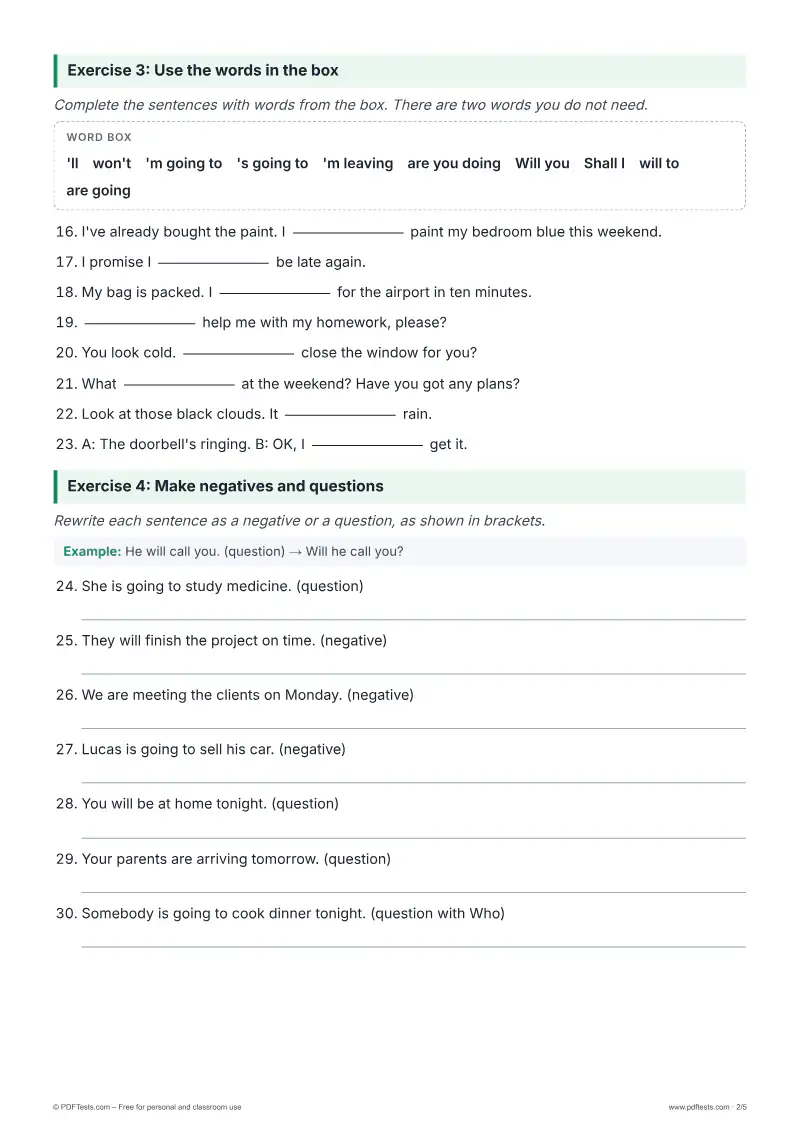
Exercise 3: Use the words in the box

Complete the sentences with words from the box. There are two words you do not need.

Word box 'llwon't'm going to's going to'm leavingare you doingWill youShall Iwill toare going

  1. I've already bought the paint. I paint my bedroom blue this weekend.

  2. I promise I be late again.

  3. My bag is packed. I for the airport in ten minutes.

  4. help me with my homework, please?

  5. You look cold. close the window for you?

  6. What at the weekend? Have you got any plans?

  7. Look at those black clouds. It rain.

  8. A: The doorbell's ringing. B: OK, I get it.

Exercise 4: Make negatives and questions

Rewrite each sentence as a negative or a question, as shown in brackets.

Example: He will call you. (question) → Will he call you?

  1. She is going to study medicine. (question)

  2. They will finish the project on time. (negative)

  3. We are meeting the clients on Monday. (negative)

  4. Lucas is going to sell his car. (negative)

  5. You will be at home tonight. (question)

  6. Your parents are arriving tomorrow. (question)

  7. Somebody is going to cook dinner tonight. (question with Who)

Exercise 5: Correct the mistakes

Each sentence has one mistake. Write the correct sentence.

Example: He will helps you. → He will help you.

  1. I will to phone you tomorrow.

  2. Look out! That car is going hit the wall!

  3. There's no milk. Don't worry, I go and buy some.

  4. Are you going come to the concert on Friday?

  5. She doesn't going to take the bus tomorrow.

  6. What time you are meeting Anna tomorrow?

  7. I'm sure you will enjoying the film.

Was this page helpful?

Report a mistake

Spotted a wrong answer, a typo or an unclear explanation? Tell us and we will fix it.

Preview

About this test

B1 English worksheet on future forms: will, going to and present continuous. Practise form, meaning, negatives and questions, with answers.

Topics covered

will for decisions, offers and promisesgoing to for plans and evidencepresent continuous for arrangementsfuture negatives and questionscommon future mistakes

Notes for teachers

Start with Exercise 1 so students focus on meaning before form, and elicit the key clues: 'Look!', 'I've decided', or a time and place already fixed. Typical mistakes are 'will to + verb', leaving out 'to' in 'going to', and using the present simple for instant decisions ('I go and get it'). As a follow-up, ask pairs to plan a weekend. They can use the present continuous for fixed arrangements and going to for intentions, then react to surprise problems with will.

All English B1 tests →