English has no single future tense. It uses several forms, and the choice depends on when you made the decision and how sure you are. Will is for predictions, instant decisions, offers and promises. Be going to is for plans and predictions based on evidence. The present continuous is for fixed arrangements.
The three main future forms at a glance
| Form | Main use | Example |
|---|---|---|
| will + verb | Decision made now, opinion-based prediction, offer, promise | I’ll get the door. |
| am/is/are going to + verb | Plan or intention decided before, prediction from evidence | I’m going to learn Spanish this year. |
| am/is/are + verb-ing | Fixed arrangement with a time, place or other people | I’m seeing the dentist on Friday. |
In many sentences more than one form is possible, with only a small change in meaning. The sections below show where the differences matter.
Will
Uses of will
1. Decisions made at the moment of speaking
- “We’ve run out of coffee.” “Oh, I’ll buy some later.”
- I’m tired. I think I’ll go to bed.
2. Predictions based on opinion or experience
We often use I think, I’m sure, probably or I expect with this use.
- I think Brazil will win the match.
- She’ll probably be late. She always is.
3. Offers, promises, requests and refusals
- I’ll help you with those bags. (offer)
- I won’t tell anyone, I promise. (promise)
- Will you send me the link? (request)
- The car won’t start. (refusal: something doesn’t work)
4. Future facts
- The new station will open in 2027.
- I’ll be 30 next month.
Form of will
Will is the same for every person and is followed by the base form of the verb (no to).
| Affirmative | Negative | Question |
|---|---|---|
| I’ll call you. | I won’t (will not) call you. | Will you call me? |
| She’ll be fine. | She won’t be late. | Will she be there? |
| They’ll win. | They won’t win. | Will they win? |
Short answers: Yes, I will. / No, I won’t.
For offers and suggestions with I and we, use shall in questions: Shall I open the window? Shall we order pizza? For more practice, see our guide to will for predictions, offers and promises.
Be going to
Uses of going to
1. Plans and intentions decided before speaking
- I’m going to start running in the mornings.
- We’re going to paint the kitchen this weekend.
- “Why did you buy flour?” “I’m going to make a cake.”
The decision already exists in your mind, even if nothing is booked yet.
2. Predictions based on present evidence
You can see or hear something now that tells you what will happen.
- Look at those black clouds. It’s going to rain.
- He’s driving too fast. He’s going to crash.
- My phone is on 2%. It’s going to die.
Form of going to
| Affirmative | Negative | Question |
|---|---|---|
| I’m going to travel. | I’m not going to travel. | Am I going to travel? |
| He’s going to quit. | He isn’t going to quit. | Is he going to quit? |
| We’re going to move. | We aren’t going to move. | Are we going to move? |
The verb be changes with the subject; going to stays the same. In fast, informal speech going to often sounds like “gonna”, but write going to. You can review the basics in our be going to guide.
Present continuous for future arrangements
Use
We use the present continuous for arrangements: plans that are fixed, usually with a time, a place or other people involved. Often something is booked, scheduled or agreed.
- I’m meeting Tom at 6 o’clock.
- We’re flying to Lisbon on Saturday.
- What are you doing this weekend?
- She’s having lunch with a client tomorrow.
There is usually a future time expression (tonight, tomorrow, next week, on Friday), or the future meaning is clear from the context. Without it, the sentence may sound like it is happening now: I’m playing tennis (now) vs I’m playing tennis tomorrow (future).
Form
| Affirmative | Negative | Question |
|---|---|---|
| I’m working tomorrow. | I’m not working tomorrow. | Am I working tomorrow? |
| She’s leaving on Monday. | She isn’t leaving on Monday. | Is she leaving on Monday? |
| They’re coming tonight. | They aren’t coming tonight. | Are they coming tonight? |
The form is exactly the same as the present continuous for actions happening now, including the -ing spelling rules (make → making, sit → sitting). Our present continuous guide covers these in detail.
Present simple for timetables
A fourth form is useful at B1. Use the present simple for timetables and official schedules: transport, films, classes and events.
- The train leaves at 7:15.
- The film starts at 8, so don’t be late.
- What time does the concert finish?
This is about a fixed public schedule, not personal plans. Compare: My flight leaves at 10 (timetable) and I’m flying to Rome on Tuesday (personal arrangement).
Choosing the right form
Will or going to?
Decisions: if you decide now, use will. If you decided before, use going to.
- “The bin is full.” “OK, I’ll take it out.” (decided now)
- “Why have you got gloves on?” “I’m going to take the bin out.” (decided before)
Predictions: if the prediction is your opinion, use will. If there is evidence now, use going to.
- I think it’ll be a cold winter. (opinion)
- Look at the ice on the road. Someone’s going to slip. (evidence)
In many predictions both forms are possible and the difference is small. When there is clear visible evidence, going to is the natural choice.
Going to or present continuous?
Both talk about plans, and often both are correct.
- I’m going to see my grandparents on Sunday. (my intention)
- I’m seeing my grandparents on Sunday. (it’s arranged with them)
Use the present continuous when the plan is organised with other people or booked. Use going to for intentions that aren’t fixed yet: One day I’m going to visit Japan is natural, but One day I’m visiting Japan sounds strange because nothing is arranged.
With the verbs go and come, speakers usually prefer the present continuous to avoid repetition: I’m going to the gym later rather than I’m going to go to the gym later. Both are correct.
Future time clauses
After when, as soon as, before, after, until and if, use the present simple, not will, even though the meaning is future.
- I’ll call you when I get home.
- We’re going to wait until the rain stops.
- As soon as she arrives, we’ll start the meeting.
- If it’s sunny tomorrow, we’ll go to the beach.
The last example is a first conditional, which you can study further in our guide to the first and second conditional.
Signal words
These words often appear with each form, but they are clues, not rules.
| Form | Typical signal words and phrases |
|---|---|
| will | I think, I’m sure, I expect, probably, definitely, perhaps, I promise |
| going to | Look!, Be careful!, plans and intentions: this year, one day, soon |
| present continuous | tonight, tomorrow, at 6 o’clock, on Friday, next week (with arranged events) |
| present simple | times from a timetable: at 7:15, the train/film/class |
Note the word order with adverbs: She’ll probably come (after will), but She probably won’t come (before won’t).
Common mistakes
✗ “Are you free tonight?” “Sorry, I will meet Sarah.” → ✓ “Sorry, I’m meeting Sarah.” The plan is already arranged, so use the present continuous.
✗ The phone’s ringing. I’m going to answer it. → ✓ The phone’s ringing. I’ll answer it. You decide at the moment of speaking, so use will.
✗ Look at those clouds. It will rain. → ✓ It’s going to rain. There is present evidence, so going to is natural.
✗ I will to call you tomorrow. → ✓ I’ll call you tomorrow. Will is followed by the base form without to.
✗ She going to start a new job. → ✓ She’s going to start a new job. Going to needs the verb be (am/is/are).
✗ I’ll text you when I will arrive. → ✓ I’ll text you when I arrive. Use the present simple after when, as soon as, until, before, after and if.
✗ I think it won’t rain. → ✓ I don’t think it will rain. English usually makes think negative, not will.
✗ Will I carry your bag? → ✓ Shall I carry your bag? For offers in question form with I or we, use shall.
Quick check
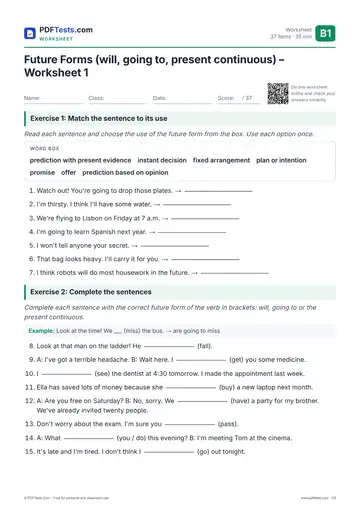
Complete each sentence with the best future form of the verb in brackets.
- “There’s no milk.” “Really? I ___ (buy) some on my way home.”
- Look at that man on the ladder. He ___ (fall).
- We ___ (have) dinner with my parents on Sunday. Mum has booked a table.
- I’ll send you a message as soon as I ___ (get) to the station.
- Hurry up. Our train ___ (leave) at 7:15.
Answers
- ’ll buy (a decision made now)
- ’s going to fall (prediction from present evidence)
- ’re having (a fixed arrangement with other people)
- get (present simple after as soon as)
- leaves (a timetable)
Next step
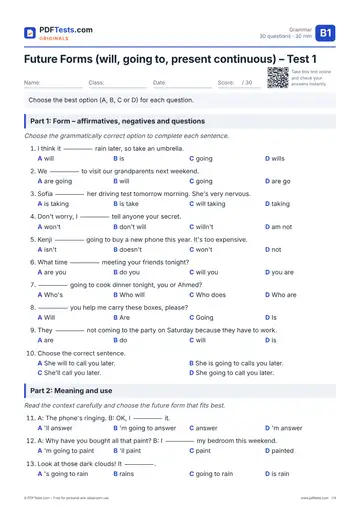
Now put the rules into practice: test yourself with our B1 Future Forms test, which mixes will, going to and the present continuous in realistic situations. As you answer, ask yourself two questions: was the decision made now or before, and is there evidence or an arrangement? When you feel confident, move on to more advanced future meanings in our guide to the future continuous and future perfect.
Was this page helpful?
What was the problem?
Thank you for your feedback!