PDFTests Originals

-ed and -ing Adjectives – Worksheet 1

B1 Intermediate WorksheetEnglish

This B1 worksheet helps learners tell the difference between -ed adjectives, which describe how people feel, and -ing adjectives, which describe the thing or situation that causes the feeling. Students practise common pairs such as bored/boring, tired/tiring and confused/confusing, along with useful collocations like interested in and frightened of. It is suitable for classroom work or self-study.
items
36
Time
30 min
PDF
5 pages
Answer key
Included
  • 100% free
  • No sign-up or email
  • Print-ready A4 PDF
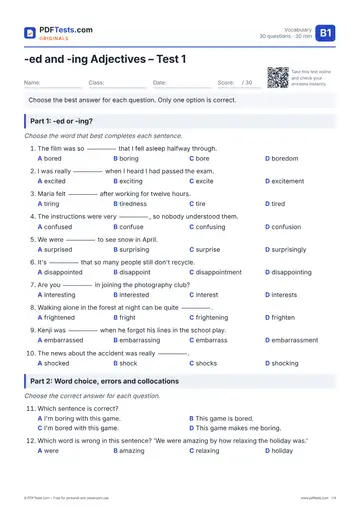
Preview of page 1 of -ed and -ing Adjectives – Worksheet 1 Open PDF

Do the worksheet online

Type your answers, then press “Check my answers”. Alternative correct answers are accepted.

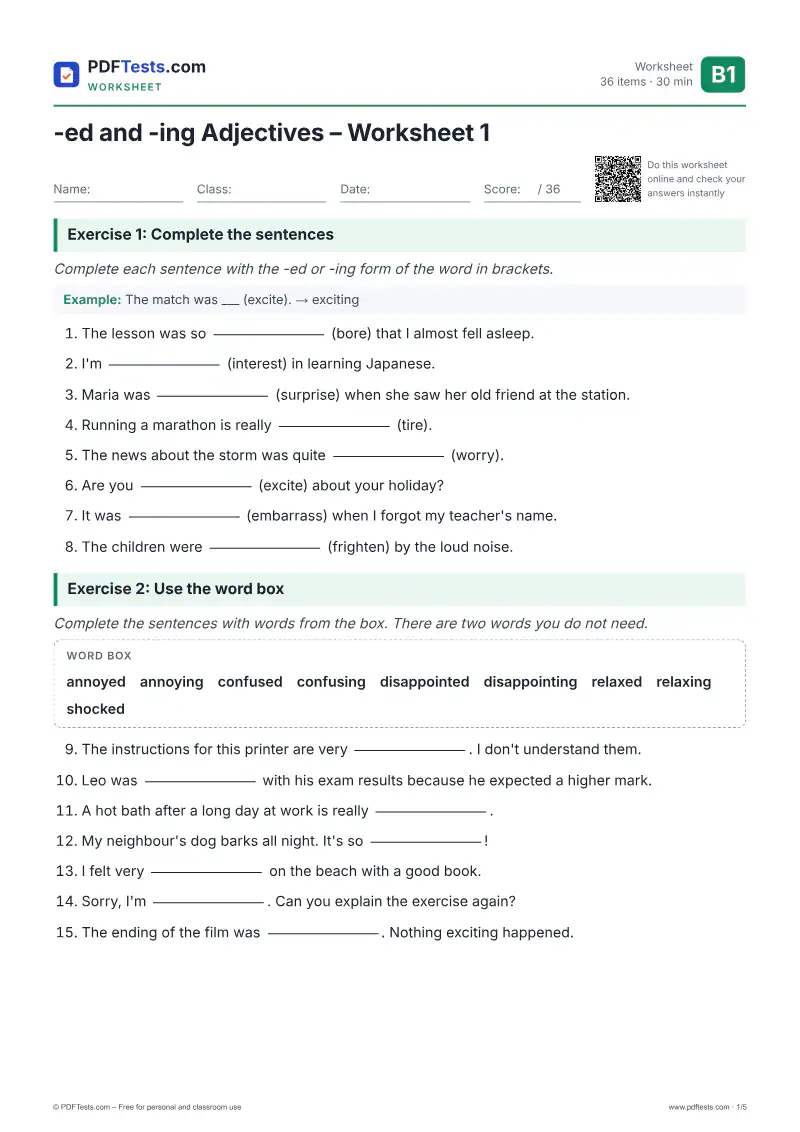
Exercise 1: Complete the sentences

Complete each sentence with the -ed or -ing form of the word in brackets.

Example: The match was ___ (excite). → exciting

  1. The lesson was so (bore) that I almost fell asleep.

  2. I'm (interest) in learning Japanese.

  3. Maria was (surprise) when she saw her old friend at the station.

  4. Running a marathon is really (tire).

  5. The news about the storm was quite (worry).

  6. Are you (excite) about your holiday?

  7. It was (embarrass) when I forgot my teacher's name.

  8. The children were (frighten) by the loud noise.

Exercise 2: Use the word box

Complete the sentences with words from the box. There are two words you do not need.

Word box annoyedannoyingconfusedconfusingdisappointeddisappointingrelaxedrelaxingshocked

  1. The instructions for this printer are very . I don't understand them.

  2. Leo was with his exam results because he expected a higher mark.

  3. A hot bath after a long day at work is really .

  4. My neighbour's dog barks all night. It's so !

  5. I felt very on the beach with a good book.

  6. Sorry, I'm . Can you explain the exercise again?

  7. The ending of the film was . Nothing exciting happened.

Exercise 3: Find the mistake

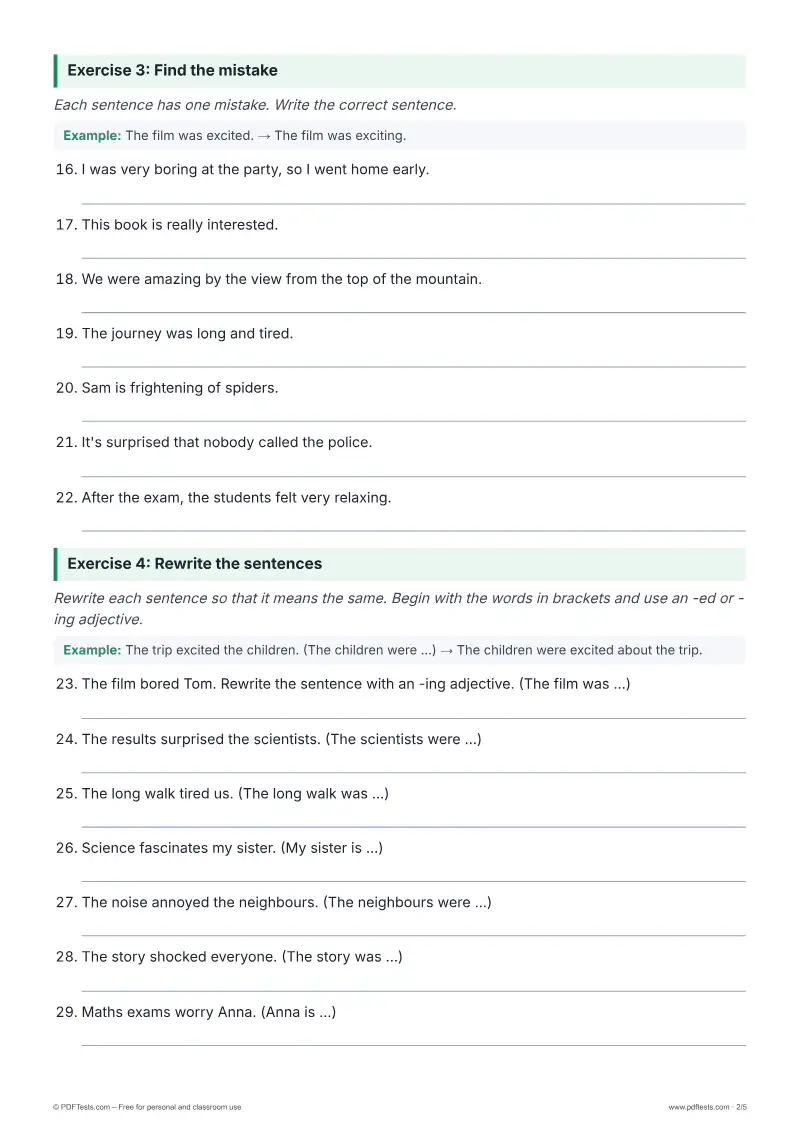
Each sentence has one mistake. Write the correct sentence.

Example: The film was excited. → The film was exciting.

  1. I was very boring at the party, so I went home early.

  2. This book is really interested.

  3. We were amazing by the view from the top of the mountain.

  4. The journey was long and tired.

  5. Sam is frightening of spiders.

  6. It's surprised that nobody called the police.

  7. After the exam, the students felt very relaxing.

Exercise 4: Rewrite the sentences

Rewrite each sentence so that it means the same. Begin with the words in brackets and use an -ed or -ing adjective.

Example: The trip excited the children. (The children were ...) → The children were excited about the trip.

  1. The film bored Tom. Rewrite the sentence with an -ing adjective. (The film was ...)

  2. The results surprised the scientists. (The scientists were ...)

  3. The long walk tired us. (The long walk was ...)

  4. Science fascinates my sister. (My sister is ...)

  5. The noise annoyed the neighbours. (The neighbours were ...)

  6. The story shocked everyone. (The story was ...)

  7. Maths exams worry Anna. (Anna is ...)

Exercise 5: How do they feel?

Read each situation and choose the best adjective from the box. There is one adjective you do not need.

Word box exhaustedembarrassedterrifiedthrilledamazeddisappointedsatisfiedconfused

  1. Kim has worked for fourteen hours without a break. She feels ...

  2. Dan fell over in front of the whole class and everyone laughed. He feels ...

  3. A huge, angry dog is running towards Ella. She feels ...

  4. Jack has just heard that he got his dream job. He is very happy and excited. He feels ...

  5. Mia watches a magician make a car disappear. She can't believe her eyes. She feels ...

  6. Omar's football team lost the final 0–1. He feels ...

  7. Lucy finished a difficult project and she is happy with the result. She feels ...

Was this page helpful?

Report a mistake

Spotted a wrong answer, a typo or an unclear explanation? Tell us and we will fix it.

Preview

About this test

Printable B1 worksheet on -ed and -ing adjectives (bored/boring, interested/interesting) with gap-fill, word box, error correction and more.

Topics covered

-ed adjectives (feelings)-ing adjectives (causes)adjective + preposition collocationsword formation from verbserror correction

Notes for teachers

Start by eliciting the rule with a quick example: 'The film was boring, so I was bored.' Students often say 'I am boring' when they mean 'I am bored', so point out that this changes the meaning completely. Exercise 4 also practises prepositions such as bored with, worried about and fascinated by. As a follow-up, ask students to write five sentences about a recent experience using one -ed and one -ing adjective in each sentence.

All English B1 tests →