PDFTests Originals

Modals of Deduction (must, might, can't) – Worksheet 1

B1 Intermediate WorksheetEnglish

This B1 worksheet practises using must, might and can't to make deductions about the present: being sure, being unsure and saying something is impossible. Learners complete, rewrite, correct and order sentences, including negatives, continuous forms and questions. It suits classroom practice and self-study.
items
36
Time
35 min
PDF
5 pages
Answer key
Included
  • 100% free
  • No sign-up or email
  • Print-ready A4 PDF
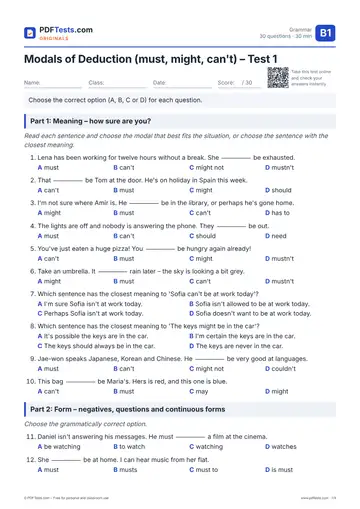
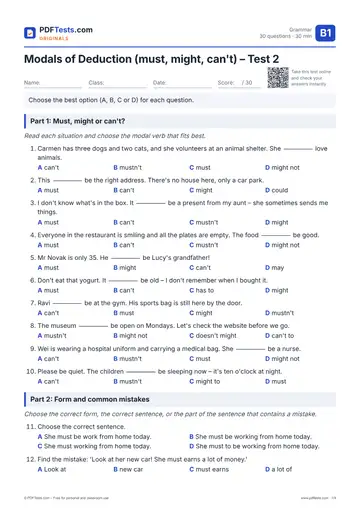
Preview of page 1 of Modals of Deduction (must, might, can't) – Worksheet 1 Open PDF
New to this topic? Read the guide first: Modals of Deduction (must, might, can't): Rules, Examples and Common Mistakes

Do the worksheet online

Type your answers, then press “Check my answers”. Alternative correct answers are accepted.

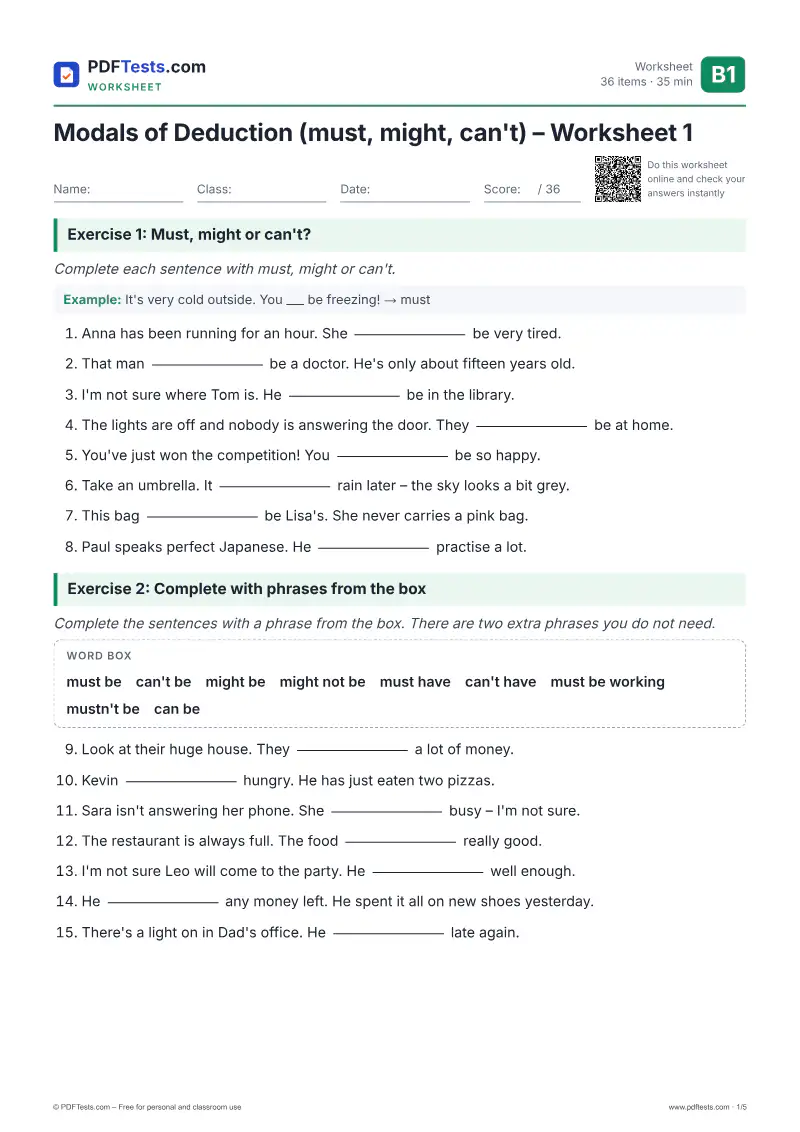
Exercise 1: Must, might or can't?

Complete each sentence with must, might or can't.

Example: It's very cold outside. You ___ be freezing! → must

  1. Anna has been running for an hour. She be very tired.

  2. That man be a doctor. He's only about fifteen years old.

  3. I'm not sure where Tom is. He be in the library.

  4. The lights are off and nobody is answering the door. They be at home.

  5. You've just won the competition! You be so happy.

  6. Take an umbrella. It rain later – the sky looks a bit grey.

  7. This bag be Lisa's. She never carries a pink bag.

  8. Paul speaks perfect Japanese. He practise a lot.

Exercise 2: Complete with phrases from the box

Complete the sentences with a phrase from the box. There are two extra phrases you do not need.

Word box must becan't bemight bemight not bemust havecan't havemust be workingmustn't becan be

  1. Look at their huge house. They a lot of money.

  2. Kevin hungry. He has just eaten two pizzas.

  3. Sara isn't answering her phone. She busy – I'm not sure.

  4. The restaurant is always full. The food really good.

  5. I'm not sure Leo will come to the party. He well enough.

  6. He any money left. He spent it all on new shoes yesterday.

  7. There's a light on in Dad's office. He late again.

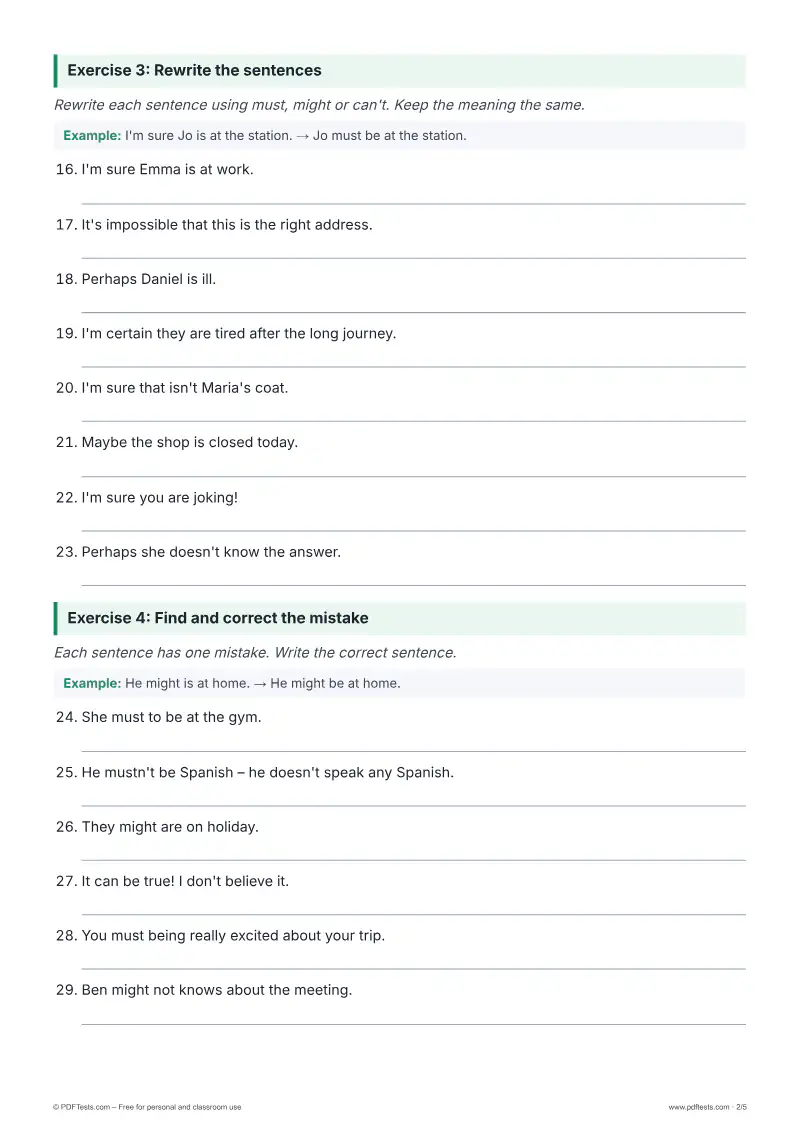
Exercise 3: Rewrite the sentences

Rewrite each sentence using must, might or can't. Keep the meaning the same.

Example: I'm sure Jo is at the station. → Jo must be at the station.

  1. I'm sure Emma is at work.

  2. It's impossible that this is the right address.

  3. Perhaps Daniel is ill.

  4. I'm certain they are tired after the long journey.

  5. I'm sure that isn't Maria's coat.

  6. Maybe the shop is closed today.

  7. I'm sure you are joking!

  8. Perhaps she doesn't know the answer.

Exercise 4: Find and correct the mistake

Each sentence has one mistake. Write the correct sentence.

Example: He might is at home. → He might be at home.

  1. She must to be at the gym.

  2. He mustn't be Spanish – he doesn't speak any Spanish.

  3. They might are on holiday.

  4. It can be true! I don't believe it.

  5. You must being really excited about your trip.

  6. Ben might not knows about the meeting.

  7. That can't is the right bus.

Exercise 5: Put the words in order

Put the words in the correct order to make sentences or questions.

Example: be / she / must / late → She must be late.

  1. be / must / tired / you

  2. be / can't / he / serious

  3. might / at / she / home / be

  4. the / keys / be / might / in / car / the

  5. must / they / a lot / be / studying

  6. who / be / that / might

Was this page helpful?

Report a mistake

Spotted a wrong answer, a typo or an unclear explanation? Tell us and we will fix it.

Preview

About this test

B1 worksheet on modals of deduction: must, might and can't. Five printable exercises with answers on form, meaning, negatives and questions.

Topics covered

Modals of deductionmust for certaintymight for possibilitycan't for impossibilityModal + base formPresent deductions

Notes for teachers

Start by showing a picture and asking learners what must, might or can't be true about it. Then work through the exercises from controlled to freer practice. Typical mistakes include adding 'to' or '-s' after the modal, and using 'mustn't' instead of 'can't' for impossibility. As a follow-up, learners can describe a mystery object or a photo of a stranger's room using all three modals.

All English B1 tests →