PDFTests Originals

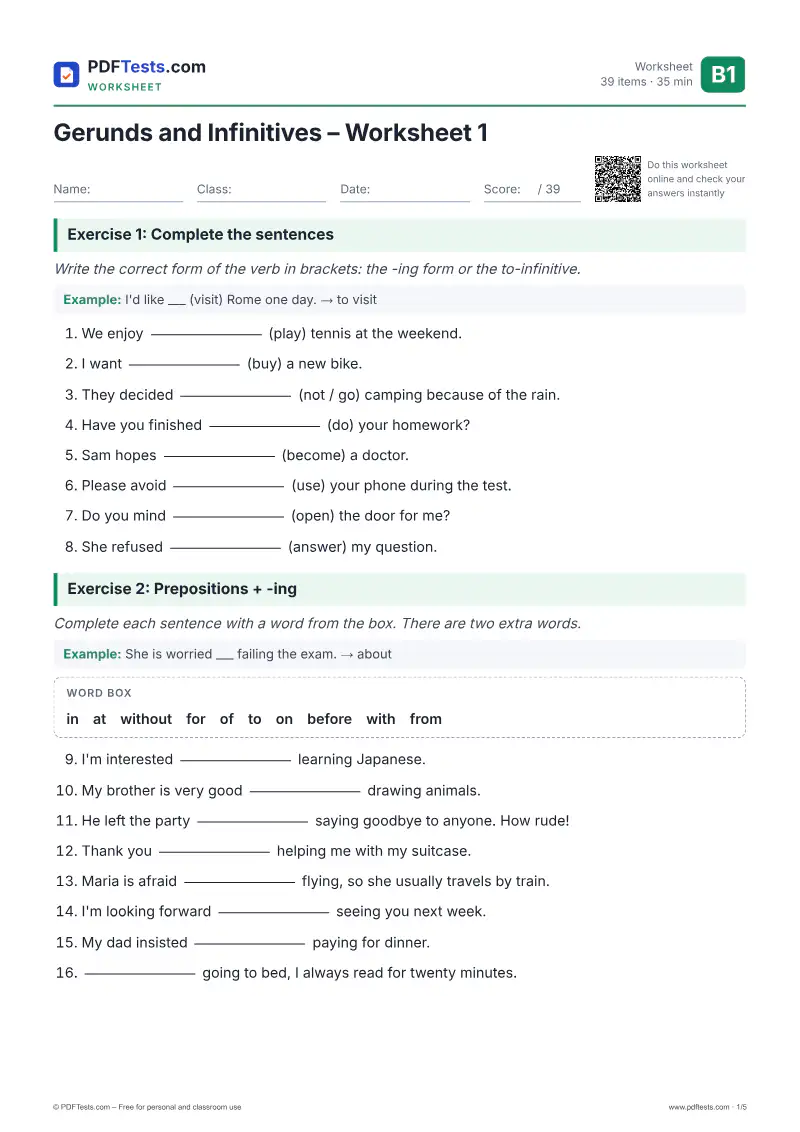
Gerunds and Infinitives – Worksheet 1

B1 Intermediate WorksheetEnglish

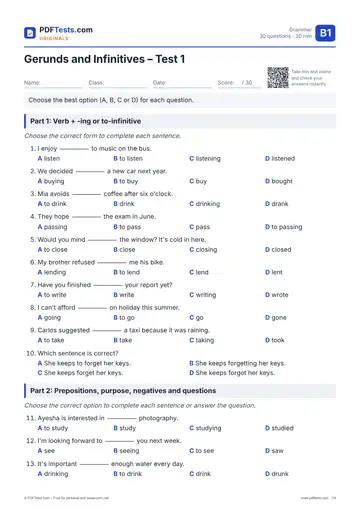
This B1 worksheet practises when to use the -ing form (gerund) and when to use the to-infinitive. Learners work with common verb patterns, prepositions followed by -ing, the infinitive of purpose, and negative forms like 'not to go'. The exercises build from controlled gap-fills to rewriting and correcting sentences, and they suit both classroom and home study.
items
39
Time
35 min
PDF
5 pages
Answer key
Included
  • 100% free
  • No sign-up or email
  • Print-ready A4 PDF
Preview of page 1 of Gerunds and Infinitives – Worksheet 1 Open PDF
New to this topic? Read the guide first: Gerunds and Infinitives: Rules, Examples and Common Mistakes

Do the worksheet online

Type your answers, then press “Check my answers”. Alternative correct answers are accepted.

Exercise 1: Complete the sentences

Write the correct form of the verb in brackets: the -ing form or the to-infinitive.

Example: I'd like ___ (visit) Rome one day. → to visit

  1. We enjoy (play) tennis at the weekend.

  2. I want (buy) a new bike.

  3. They decided (not / go) camping because of the rain.

  4. Have you finished (do) your homework?

  5. Sam hopes (become) a doctor.

  6. Please avoid (use) your phone during the test.

  7. Do you mind (open) the door for me?

  8. She refused (answer) my question.

Exercise 2: Prepositions + -ing

Complete each sentence with a word from the box. There are two extra words.

Example: She is worried ___ failing the exam. → about

Word box inatwithoutforoftoonbeforewithfrom

  1. I'm interested learning Japanese.

  2. My brother is very good drawing animals.

  3. He left the party saying goodbye to anyone. How rude!

  4. Thank you helping me with my suitcase.

  5. Maria is afraid flying, so she usually travels by train.

  6. I'm looking forward seeing you next week.

  7. My dad insisted paying for dinner.

  8. going to bed, I always read for twenty minutes.

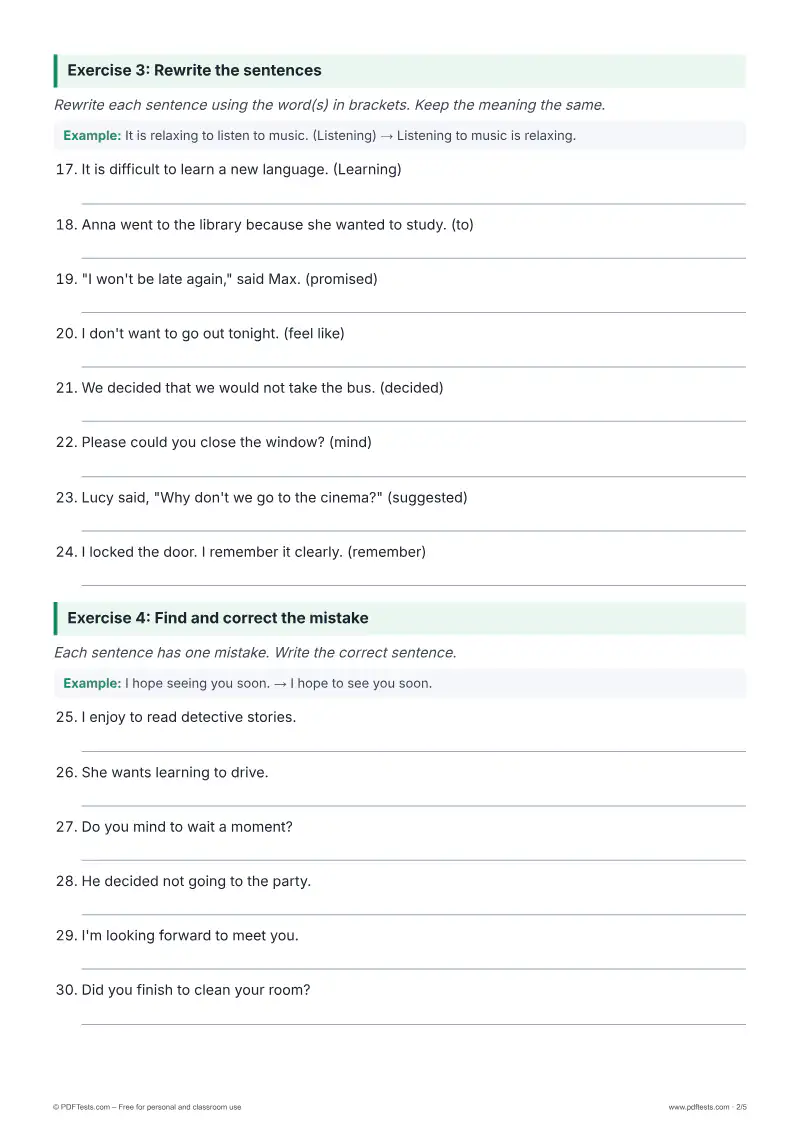
Exercise 3: Rewrite the sentences

Rewrite each sentence using the word(s) in brackets. Keep the meaning the same.

Example: It is relaxing to listen to music. (Listening) → Listening to music is relaxing.

  1. It is difficult to learn a new language. (Learning)

  2. Anna went to the library because she wanted to study. (to)

  3. "I won't be late again," said Max. (promised)

  4. I don't want to go out tonight. (feel like)

  5. We decided that we would not take the bus. (decided)

  6. Please could you close the window? (mind)

  7. Lucy said, "Why don't we go to the cinema?" (suggested)

  8. I locked the door. I remember it clearly. (remember)

Exercise 4: Find and correct the mistake

Each sentence has one mistake. Write the correct sentence.

Example: I hope seeing you soon. → I hope to see you soon.

  1. I enjoy to read detective stories.

  2. She wants learning to drive.

  3. Do you mind to wait a moment?

  4. He decided not going to the party.

  5. I'm looking forward to meet you.

  6. Did you finish to clean your room?

  7. They avoided to talk about the problem.

  8. My sister hopes visiting Canada next year.

Exercise 5: Put the words in order

Put the words in the correct order to make sentences and questions.

Example: likes / she / cooking → She likes cooking.

  1. you / would / to / like / dance / ?

  2. not / tried / I / to / laugh

  3. good / is / walking / for / you

  4. she / give up / did / eating / meat / ?

  5. me / to / he / help / offered

  6. finished / have / you / writing / the report / ?

  7. to / forget / don't / call / me

Was this page helpful?

Report a mistake

Spotted a wrong answer, a typo or an unclear explanation? Tell us and we will fix it.

Preview

About this test

B1 gerunds and infinitives worksheet: verb patterns, prepositions + -ing, purpose, negatives and questions. Printable, with answers.

Topics covered

Verb + -ingVerb + to-infinitivePreposition + -ingNegative infinitives and gerundsInfinitive of purposeQuestions with verb patterns

Notes for teachers

Start by brainstorming two lists on the board, 'verbs + -ing' (enjoy, mind, avoid, finish) and 'verbs + to' (want, hope, decide, refuse), then let students do Exercises 1 and 2. Typical mistakes are 'enjoy to do', 'looking forward to meet' and putting 'not' in the wrong place ('decided to not go' or 'decided not going'). Point out that after 'to' as a preposition (look forward to, be used to) we use -ing. As a follow-up, students write five true sentences about themselves using verbs from the worksheet, then ask a partner questions such as 'What do you enjoy doing?'.

All English B1 tests →