PDFTests Originals

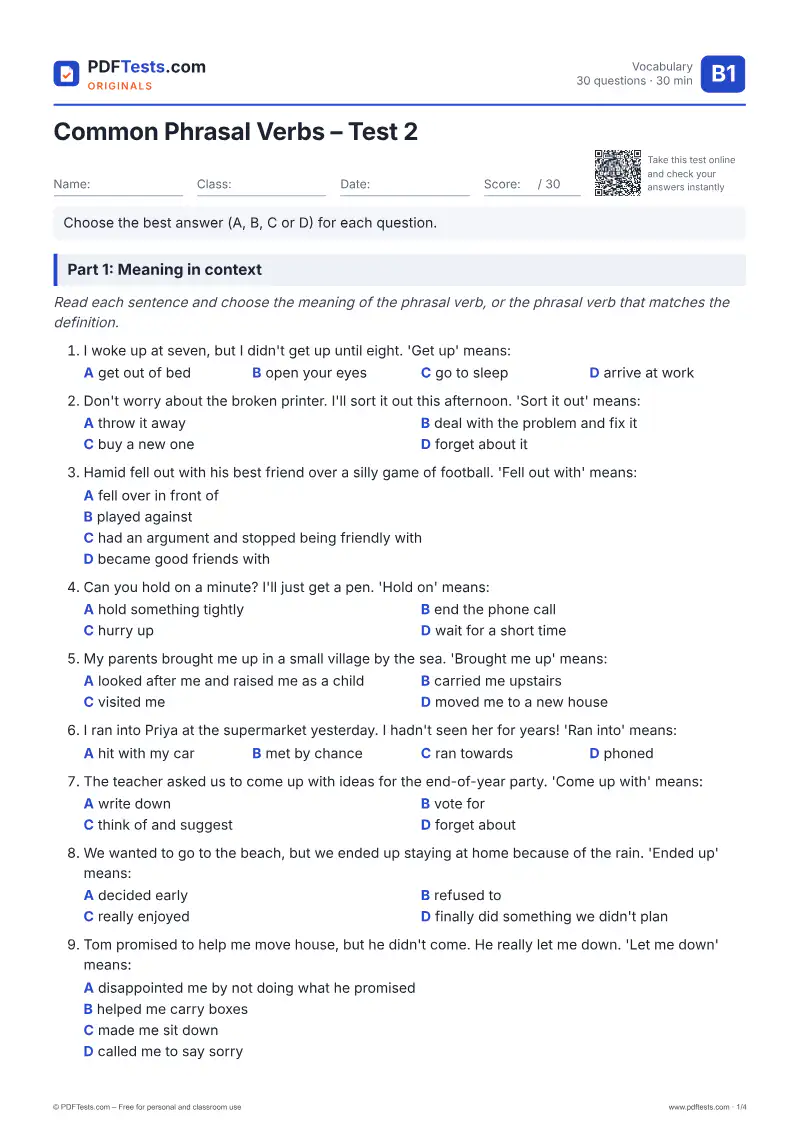
Common Phrasal Verbs – Test 2

B1 Intermediate VocabularyEnglish

This B1 vocabulary test checks how well learners understand and use common English phrasal verbs in everyday situations. It covers meaning in context, choosing the right particle or verb, word order, natural responses and nouns formed from phrasal verbs. It suits intermediate learners, classes and self-study, and every question comes with an explanation.
Questions
30
Time
30 min
PDF
4 pages
Answer key
Included
  • 100% free
  • No sign-up or email
  • Print-ready A4 PDF
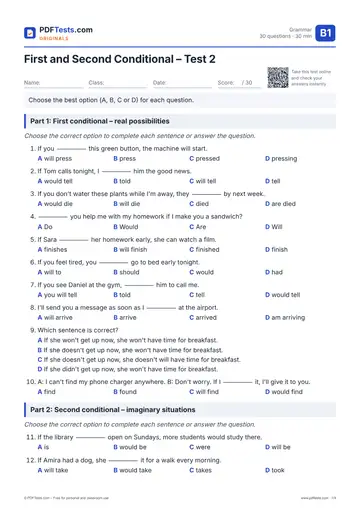
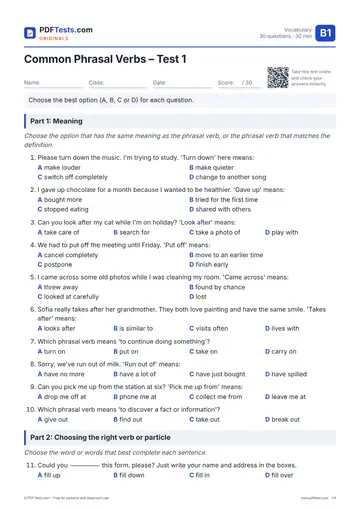
Preview of page 1 of Common Phrasal Verbs – Test 2 Open PDF

Take the test online

Choose the best answer (A, B, C or D) for each question. Choose your answers, then press “Check my answers”.

Part 1: Meaning in context

Read each sentence and choose the meaning of the phrasal verb, or the phrasal verb that matches the definition.

  1. I woke up at seven, but I didn't get up until eight. 'Get up' means:

  2. Don't worry about the broken printer. I'll sort it out this afternoon. 'Sort it out' means:

  3. Hamid fell out with his best friend over a silly game of football. 'Fell out with' means:

  4. Can you hold on a minute? I'll just get a pen. 'Hold on' means:

  5. My parents brought me up in a small village by the sea. 'Brought me up' means:

  6. I ran into Priya at the supermarket yesterday. I hadn't seen her for years! 'Ran into' means:

  7. The teacher asked us to come up with ideas for the end-of-year party. 'Come up with' means:

  8. We wanted to go to the beach, but we ended up staying at home because of the rain. 'Ended up' means:

  9. Tom promised to help me move house, but he didn't come. He really let me down. 'Let me down' means:

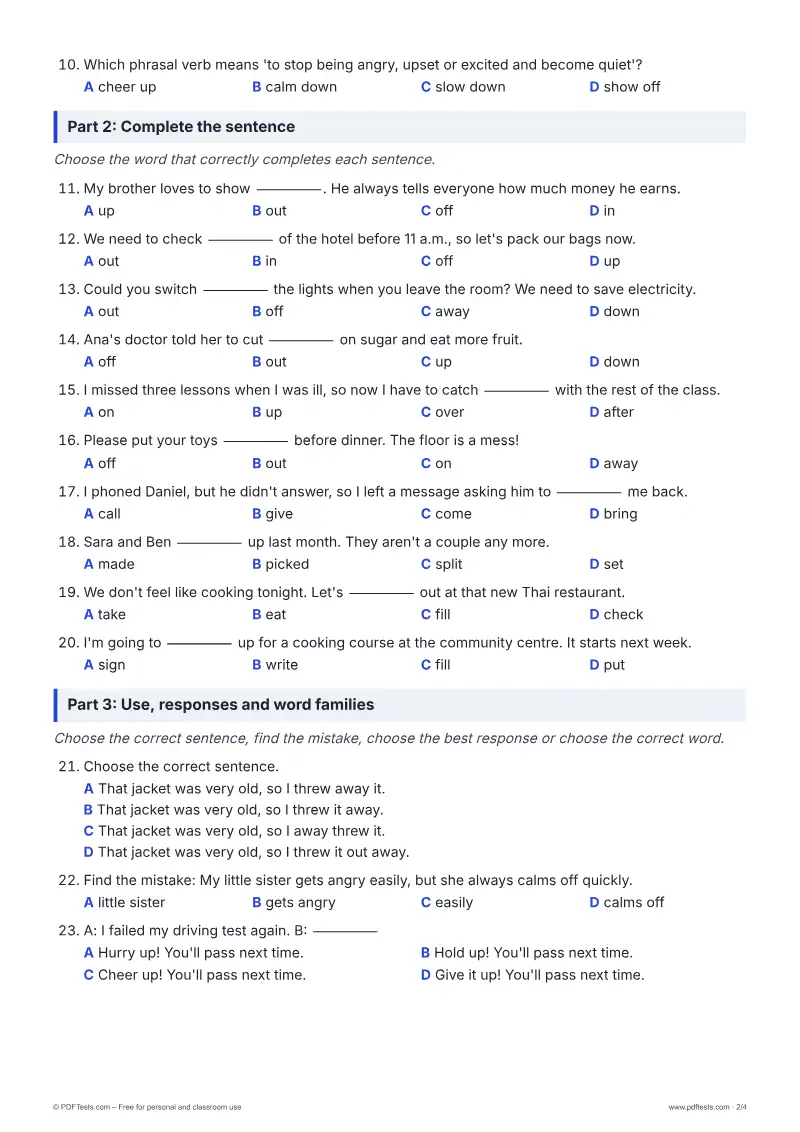
  10. Which phrasal verb means 'to stop being angry, upset or excited and become quiet'?

Part 2: Complete the sentence

Choose the word that correctly completes each sentence.

  1. My brother loves to show _____. He always tells everyone how much money he earns.

  2. We need to check _____ of the hotel before 11 a.m., so let's pack our bags now.

  3. Could you switch _____ the lights when you leave the room? We need to save electricity.

  4. Ana's doctor told her to cut _____ on sugar and eat more fruit.

  5. I missed three lessons when I was ill, so now I have to catch _____ with the rest of the class.

  6. Please put your toys _____ before dinner. The floor is a mess!

  7. I phoned Daniel, but he didn't answer, so I left a message asking him to _____ me back.

  8. Sara and Ben _____ up last month. They aren't a couple any more.

  9. We don't feel like cooking tonight. Let's _____ out at that new Thai restaurant.

  10. I'm going to _____ up for a cooking course at the community centre. It starts next week.

Part 3: Use, responses and word families

Choose the correct sentence, find the mistake, choose the best response or choose the correct word.

  1. Choose the correct sentence.

  2. Find the mistake: My little sister gets angry easily, but she always calms off quickly.

  3. A: I failed my driving test again. B: _____

  4. A: Hello, I'd like to check in, please. I have a reservation. B: _____

  5. Choose the sentence where the phrasal verb is used correctly.

  6. I can't _____ out how to use this new app. Can you help me?

  7. I go to the gym three times a week. My _____ usually lasts about an hour.

  8. The _____ desk at the airport opens two hours before the flight.

  9. Before the race, the runners did a ten-minute _____ to prepare their muscles.

  10. Jun had a happy _____. His parents always had time to play and talk with him.

Was this page helpful?

Report a mistake

Spotted a wrong answer, a typo or an unclear explanation? Tell us and we will fix it.

Practise with a worksheet: Common Phrasal Verbs – Worksheet 1

Preview

About this test

This B1 vocabulary test checks how well learners understand and use common English phrasal verbs in everyday situations. It covers meaning in context, choosing the right particle or verb, word order, natural responses and nouns formed from phrasal verbs. It suits intermediate learners, classes and self-study, and every question comes with an explanation.

Topics covered

Phrasal verbsMeaning in contextParticlesWord orderEveryday conversationWord formation

How to use this test

  1. Download the PDF and print it, or take the test online below.
  2. Answer every question without a dictionary or time pressure.
  3. Check your answers and note the topics you need to review.

Notes for teachers

Use this test after teaching everyday phrasal verbs, or as a review. It targets common errors: confusing particles (calm off for calm down), putting a pronoun after the particle (threw away it), and not knowing related nouns such as workout, check-in and warm-up. As a follow-up, ask students to write a short story about their weekend using at least eight phrasal verbs from the test.