PDFTests Originals

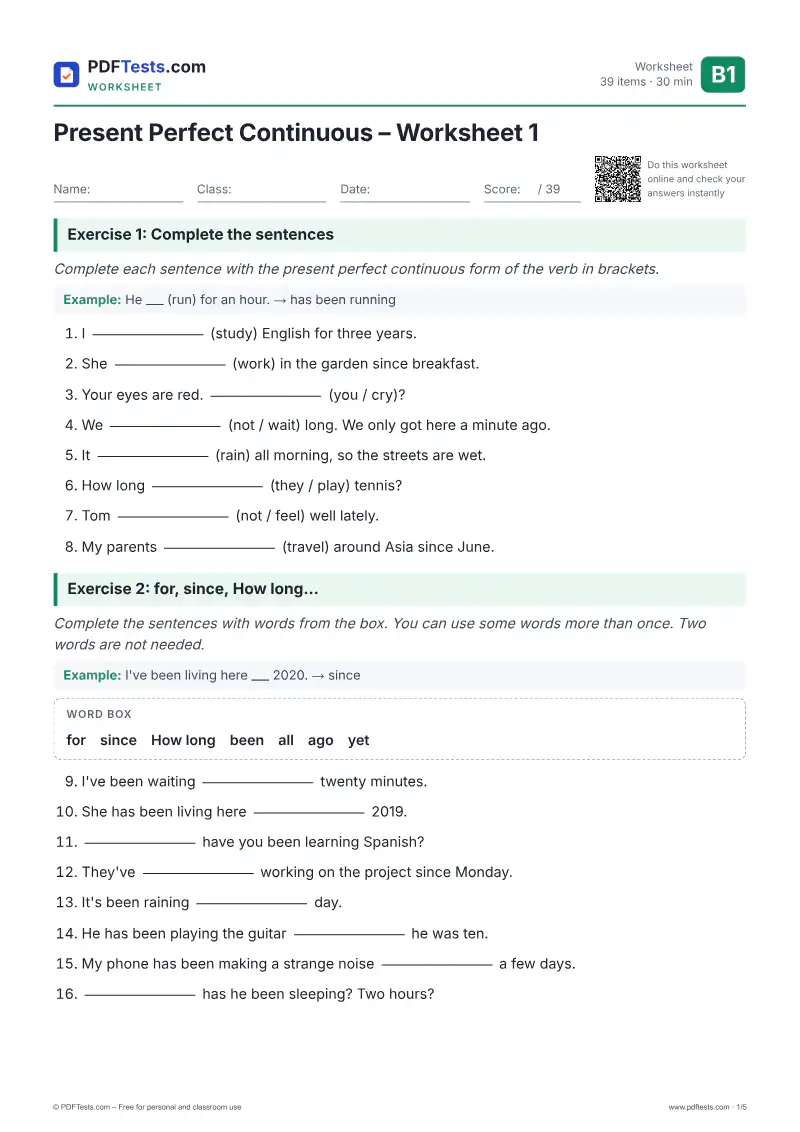
Present Perfect Continuous – Worksheet 1

B1 Intermediate WorksheetEnglish

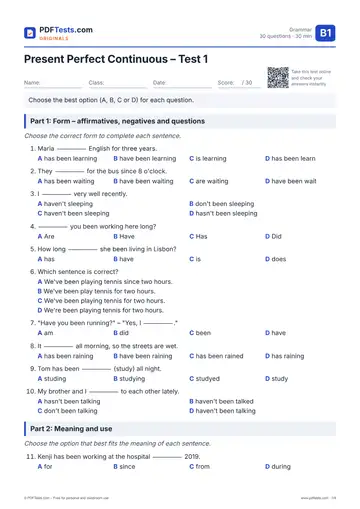
This worksheet practises the present perfect continuous (have/has been + -ing) for actions that started in the past and are still continuing or have just stopped. B1 learners build the form, use for, since and How long, make negatives and questions, correct common mistakes and order words into sentences.
items
39
Time
30 min
PDF
5 pages
Answer key
Included
  • 100% free
  • No sign-up or email
  • Print-ready A4 PDF
Preview of page 1 of Present Perfect Continuous – Worksheet 1 Open PDF
New to this topic? Read the guide first: Present Perfect Continuous: Form, Uses and Common Mistakes

Do the worksheet online

Type your answers, then press “Check my answers”. Alternative correct answers are accepted.

Exercise 1: Complete the sentences

Complete each sentence with the present perfect continuous form of the verb in brackets.

Example: He ___ (run) for an hour. → has been running

  1. I (study) English for three years.

  2. She (work) in the garden since breakfast.

  3. Your eyes are red. (you / cry)?

  4. We (not / wait) long. We only got here a minute ago.

  5. It (rain) all morning, so the streets are wet.

  6. How long (they / play) tennis?

  7. Tom (not / feel) well lately.

  8. My parents (travel) around Asia since June.

Exercise 2: for, since, How long…

Complete the sentences with words from the box. You can use some words more than once. Two words are not needed.

Example: I've been living here ___ 2020. → since

Word box forsinceHow longbeenallagoyet

  1. I've been waiting twenty minutes.

  2. She has been living here 2019.

  3. have you been learning Spanish?

  4. They've working on the project since Monday.

  5. It's been raining day.

  6. He has been playing the guitar he was ten.

  7. My phone has been making a strange noise a few days.

  8. has he been sleeping? Two hours?

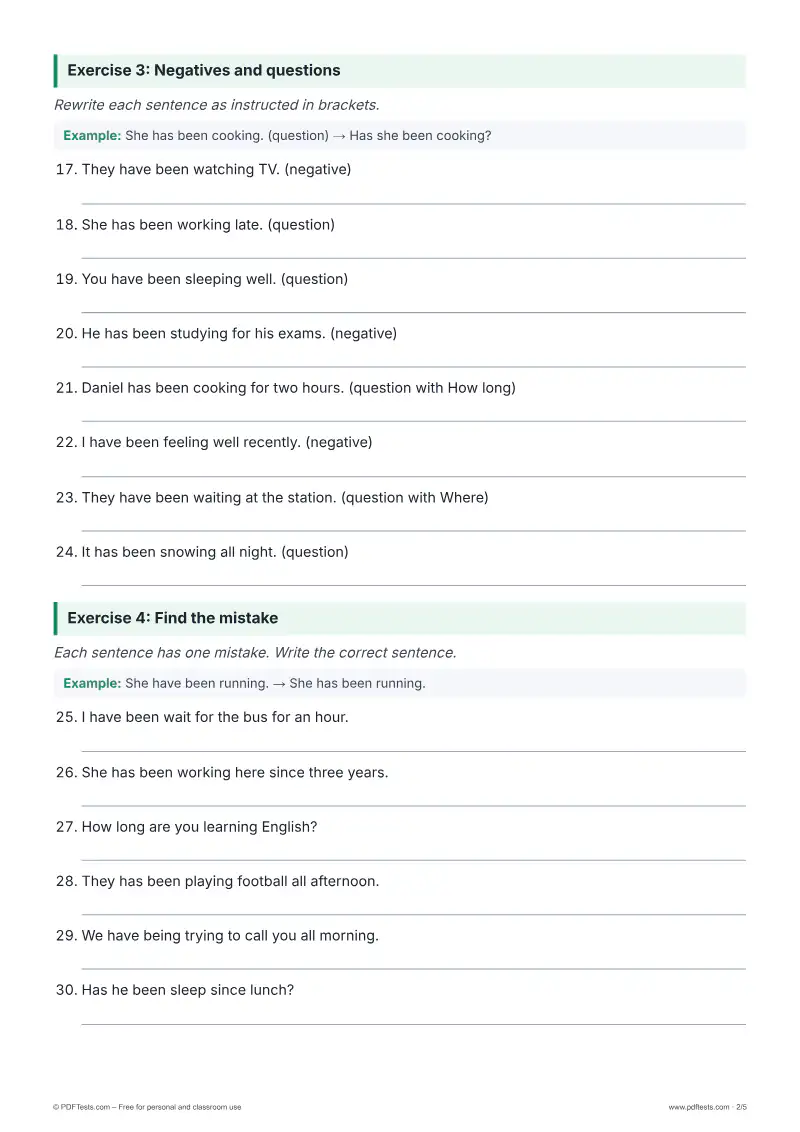
Exercise 3: Negatives and questions

Rewrite each sentence as instructed in brackets.

Example: She has been cooking. (question) → Has she been cooking?

  1. They have been watching TV. (negative)

  2. She has been working late. (question)

  3. You have been sleeping well. (question)

  4. He has been studying for his exams. (negative)

  5. Daniel has been cooking for two hours. (question with How long)

  6. I have been feeling well recently. (negative)

  7. They have been waiting at the station. (question with Where)

  8. It has been snowing all night. (question)

Exercise 4: Find the mistake

Each sentence has one mistake. Write the correct sentence.

Example: She have been running. → She has been running.

  1. I have been wait for the bus for an hour.

  2. She has been working here since three years.

  3. How long are you learning English?

  4. They has been playing football all afternoon.

  5. We have being trying to call you all morning.

  6. Has he been sleep since lunch?

  7. It's been raining for Monday.

  8. I been reading this book for a week.

Exercise 5: Put the words in order

Put the words in the correct order to make sentences or questions.

Example: been / he / has / working → He has been working.

  1. been / she / for / has / waiting / ages

  2. you / have / long / how / living / been / here

  3. hasn't / he / sleeping / been / well

  4. all / they / have / day / been / painting

  5. since / I / been / have / running / six o'clock

  6. been / what / you / doing / have

  7. raining / it / since / been / has / morning / this

Was this page helpful?

Report a mistake

Spotted a wrong answer, a typo or an unclear explanation? Tell us and we will fix it.

Preview

About this test

Printable B1 worksheet on the present perfect continuous: form, for/since, negatives, questions and error correction, with answers.

Topics covered

Present perfect continuoushave/has been + -ingfor and sinceHow long questionsNegatives and questions

Notes for teachers

Start by drawing a timeline from a past point to now and eliciting examples such as 'I've been living here since…'. Typical mistakes include leaving out 'been' or 'have', using the present continuous with How long ('How long are you learning…?') and confusing for and since. As a follow-up, ask pairs to interview each other with How long have you been…? questions and report back.

All English B1 tests →