PDFTests Originals

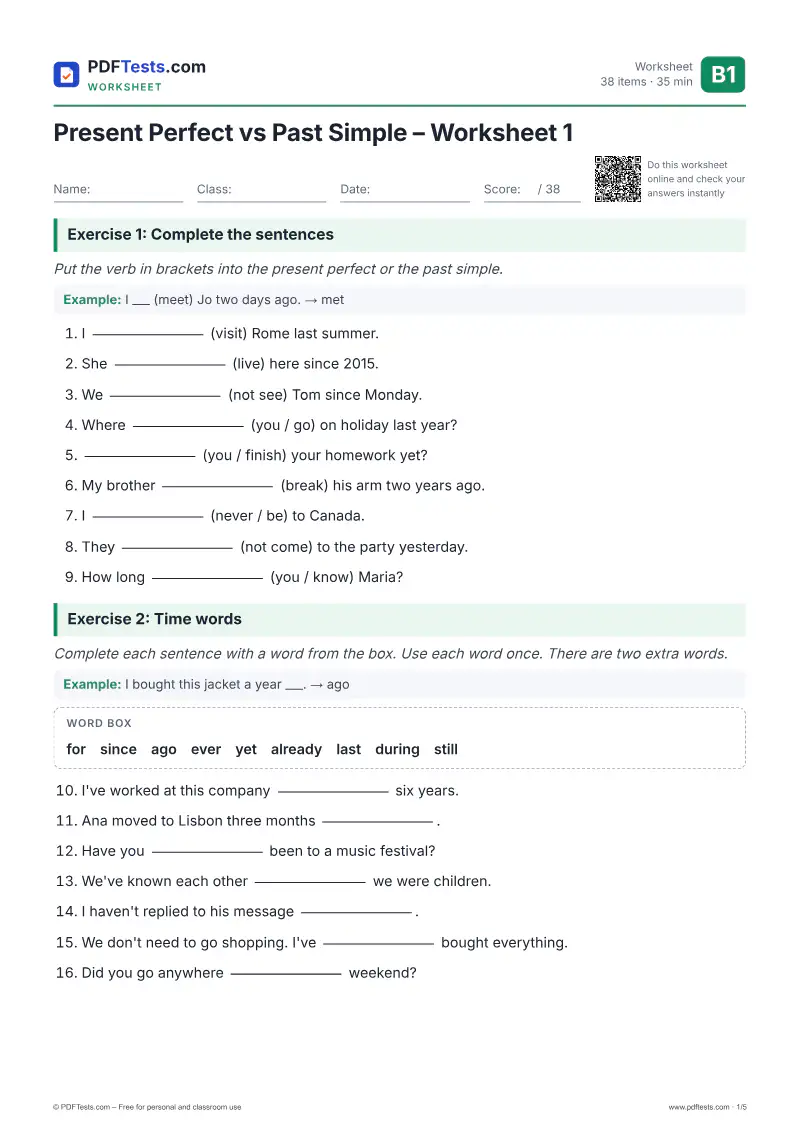
Present Perfect vs Past Simple – Worksheet 1

B1 Intermediate WorksheetEnglish

This worksheet helps B1 learners choose between the present perfect and the past simple. It covers positive forms, negatives, questions and the time expressions that go with each tense, and it moves from controlled gap-fills to rewriting, error correction and word order. It is suitable for classroom use or self-study.
items
38
Time
35 min
PDF
5 pages
Answer key
Included
  • 100% free
  • No sign-up or email
  • Print-ready A4 PDF
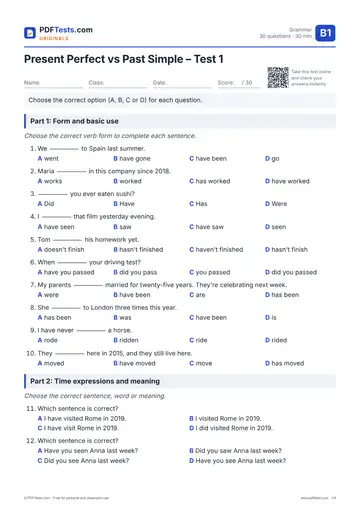
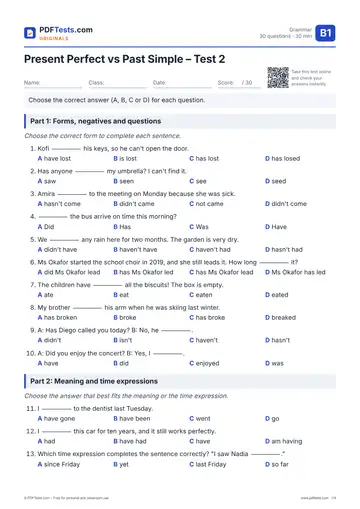
Preview of page 1 of Present Perfect vs Past Simple – Worksheet 1 Open PDF
New to this topic? Read the guide first: Present Perfect vs Past Simple: Rules, Examples and Common Mistakes

Do the worksheet online

Type your answers, then press “Check my answers”. Alternative correct answers are accepted.

Exercise 1: Complete the sentences

Put the verb in brackets into the present perfect or the past simple.

Example: I ___ (meet) Jo two days ago. → met

  1. I (visit) Rome last summer.

  2. She (live) here since 2015.

  3. We (not see) Tom since Monday.

  4. Where (you / go) on holiday last year?

  5. (you / finish) your homework yet?

  6. My brother (break) his arm two years ago.

  7. I (never / be) to Canada.

  8. They (not come) to the party yesterday.

  9. How long (you / know) Maria?

Exercise 2: Time words

Complete each sentence with a word from the box. Use each word once. There are two extra words.

Example: I bought this jacket a year ___. → ago

Word box forsinceagoeveryetalreadylastduringstill

  1. I've worked at this company six years.

  2. Ana moved to Lisbon three months .

  3. Have you been to a music festival?

  4. We've known each other we were children.

  5. I haven't replied to his message .

  6. We don't need to go shopping. I've bought everything.

  7. Did you go anywhere weekend?

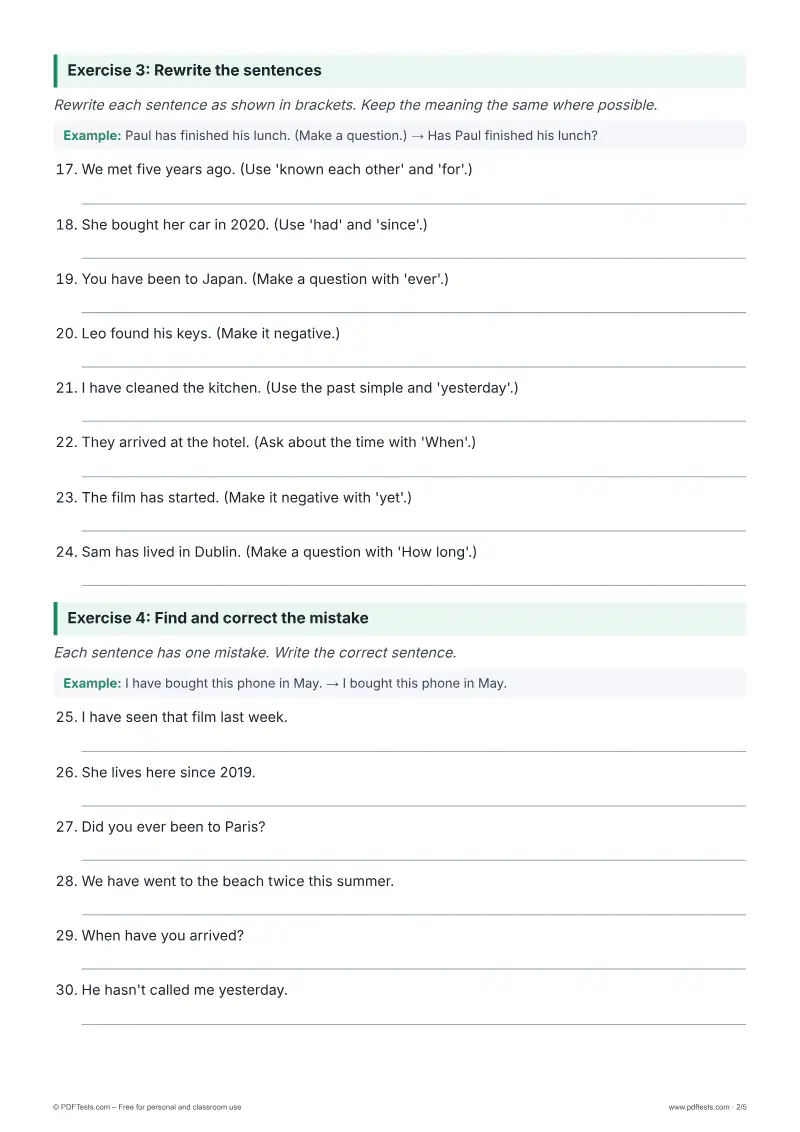
Exercise 3: Rewrite the sentences

Rewrite each sentence as shown in brackets. Keep the meaning the same where possible.

Example: Paul has finished his lunch. (Make a question.) → Has Paul finished his lunch?

  1. We met five years ago. (Use 'known each other' and 'for'.)

  2. She bought her car in 2020. (Use 'had' and 'since'.)

  3. You have been to Japan. (Make a question with 'ever'.)

  4. Leo found his keys. (Make it negative.)

  5. I have cleaned the kitchen. (Use the past simple and 'yesterday'.)

  6. They arrived at the hotel. (Ask about the time with 'When'.)

  7. The film has started. (Make it negative with 'yet'.)

  8. Sam has lived in Dublin. (Make a question with 'How long'.)

Exercise 4: Find and correct the mistake

Each sentence has one mistake. Write the correct sentence.

Example: I have bought this phone in May. → I bought this phone in May.

  1. I have seen that film last week.

  2. She lives here since 2019.

  3. Did you ever been to Paris?

  4. We have went to the beach twice this summer.

  5. When have you arrived?

  6. He hasn't called me yesterday.

  7. I have known her for ten years ago.

  8. They have finished the project two days ago.

Exercise 5: Put the words in order

Put the words in the correct order to make sentences or questions.

Example: already / have / we / eaten → We have already eaten.

  1. ever / you / have / a / horse / ridden (?)

  2. yet / haven't / I / the / email / sent

  3. did / you / where / last / go / Saturday (?)

  4. has / since / she / worked / here / March

  5. ago / we / three / moved / weeks / house

  6. how / known / long / have / you / Jack (?)

Was this page helpful?

Report a mistake

Spotted a wrong answer, a typo or an unclear explanation? Tell us and we will fix it.

Preview

About this test

B1 worksheet: Present Perfect vs Past Simple. Practise form, meaning, negatives, questions and time words like for, since, ago, yet and ever.

Topics covered

Present perfectPast simplefor / since / agoever, yet, alreadyQuestions and negativesError correction

Notes for teachers

Before starting, elicit a timeline on the board. The past simple is used with a finished time (yesterday, last week, ago, in 2019). The present perfect connects the past to now and is used with words such as ever, never, yet, already, for and since. Typical mistakes are using the present perfect with finished-time words (*I have seen it yesterday*), using the present simple instead of the present perfect with since/for (*I live here since 2019*), and asking questions with *When have you…?*. As a follow-up, students can write five 'Have you ever…?' questions, interview a partner, and then ask follow-up questions in the past simple (When did you…? Where did you go?).

All English B1 tests →