The present perfect continuous (have/has been + -ing) connects the past with the present. We use it for activities that started in the past and are still going on, or that have just stopped and left a result we can see now. It focuses on the activity itself and how long it has lasted, not on what has been completed.
When to use the present perfect continuous
1. An activity that started in the past and is still happening
This is the most common use. We often say how long with for, since or How long…?
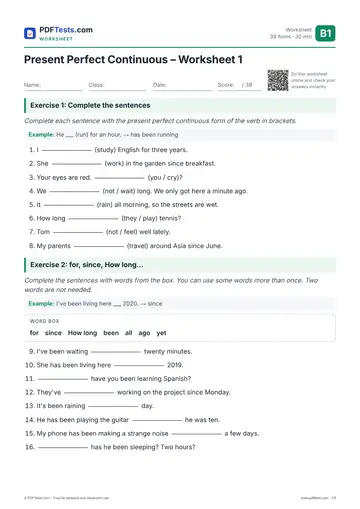
- I’ve been learning English for three years.
- She has been working at the hospital since 2021.
- How long have you been waiting?
- It’s been raining all morning.
In each sentence the action is not finished. I’m still learning, she still works there, and you’re still waiting.
2. A recent activity with a result you can see now
The activity may have stopped a moment ago, but we can still see, hear or feel the effect.
- Your eyes are red. Have you been crying?
- I’m exhausted. I’ve been cleaning the flat all day.
- The ground is wet. It’s been raining.
- Sorry I’m out of breath. I’ve been running.
- Someone’s been using my laptop. The battery is empty.
Here we often don’t give a time. The evidence in the present is what matters. The last example shows that this use can sound a little annoyed or critical.
3. Repeated actions up to now
We can also use it for something that has happened again and again over a period until now, often with recently or lately.
- I’ve been going to the gym a lot recently.
- He’s been calling me every night this week.
- We’ve been having problems with our internet lately.
Form
The structure is: subject + have/has + been + verb-ing. Only have changes for the subject; been and the -ing form stay the same.
Affirmative
| Subject | have / has | been | verb-ing | Example |
|---|---|---|---|---|
| I / you / we / they | have (’ve) | been | working | They’ve been working all night. |
| he / she / it | has (’s) | been | working | She’s been working all night. |
In this tense, ’s means has, not is: She’s been working = She has been working.
Negative
| Subject | Negative form | Example |
|---|---|---|
| I / you / we / they | haven’t been + -ing | I haven’t been sleeping well. |
| he / she / it | hasn’t been + -ing | He hasn’t been feeling well lately. |
Questions and short answers
| Question | Short answers |
|---|---|
| Have you been waiting long? | Yes, I have. / No, I haven’t. |
| Has she been studying? | Yes, she has. / No, she hasn’t. |
| What have they been doing? | They’ve been playing football. |
| How long have you been living here? | For about two years. |
Short answers use only have or has. We don’t repeat the main verb.
Spelling of the -ing form
| Rule | Examples |
|---|---|
| Most verbs: add -ing | work → working, read → reading |
| Verb ends in silent -e: drop the e | make → making, write → writing |
| One stressed vowel + one consonant: double the consonant | run → running, sit → sitting, begin → beginning |
| Verb ends in -ie: change to -ying | lie → lying, die → dying |
| Verb ends in -y: keep the y | play → playing, study → studying |
British English doubles final l after one vowel (travel → travelling); American English usually doesn’t (traveling).
Signal words
These words and phrases often appear with the present perfect continuous:
- for + a period of time: for two hours, for ages, for a long time
- since + a starting point: since Monday, since 9 o’clock, since I was a child
- How long…? How long have you been driving?
- all day / all morning / all week: I’ve been revising all week.
- recently / lately: She’s been working late recently.
- just: I’ve just been talking to your teacher.
Remember: for goes with a length of time, since goes with a point in time.
Present perfect continuous vs present perfect simple
Both tenses link the past and the present, so learners often mix them up. The key difference is focus. If you need a refresher on the simple form, see our guide to the present perfect with ever, never, just, already and yet.
| Present perfect continuous | Present perfect simple |
|---|---|
| Focus on the activity and its duration | Focus on the result or completion |
| I’ve been painting the kitchen. (maybe not finished; there’s paint on my clothes) | I’ve painted the kitchen. (it’s finished) |
| Answers How long? | Answers How much? How many? How many times? |
| I’ve been writing emails all morning. | I’ve written twenty emails this morning. |
| Often a temporary situation | Often a permanent or long-term situation |
| I’ve been staying with friends this week. | I’ve lived in this town all my life. |
Some practical rules:
- With numbers and quantities, use the simple form. I’ve read 50 pages. not I’ve been reading 50 pages.
- For a single finished action, use the simple form. I’ve lost my keys. not I’ve been losing my keys.
- With live, work, study and teach + for/since, both forms are usually possible. I’ve lived here for five years and I’ve been living here for five years mean almost the same. The continuous can sound more temporary.
Verbs we don’t usually use in the continuous
State verbs describe states, not actions, so they are not normally used in continuous tenses. With these verbs, use the present perfect simple, even with for and since.
- knowledge and opinion: know, believe, understand, remember, think (= have an opinion)
- feelings and wants: like, love, hate, prefer, want, need
- possession: have (= own), own, belong
- others: be, seem, mean
Examples:
- I’ve known Sam since primary school.
- They’ve had that car for ten years.
- He’s been ill all week.
Some of these verbs have an action meaning too, and then the continuous is fine:
- We’ve been having lunch. (have = eat)
- I’ve been thinking about your idea. (think = consider)
Present perfect continuous vs present continuous
The present continuous describes what is happening now. It can’t tell us how long something has been happening up to now. Many languages use a present tense with since or for, but English uses the present perfect continuous.
- I’m waiting for the bus. (happening now)
- I’ve been waiting for the bus for twenty minutes. (from the past until now)
And if the period is finished, use the past simple: I waited for an hour yesterday. Our guide to present perfect vs past simple explains this contrast in detail.
Common mistakes
- ✗ I am living here since 2019. → ✓ I have been living here since 2019.
With since or for up to now, use a perfect tense, not the present continuous. - ✗ How long are you learning English? → ✓ How long have you been learning English?
How long + up to now needs the present perfect continuous. - ✗ I’ve been waiting since two hours. → ✓ I’ve been waiting for two hours.
Two hours is a period, so use for. - ✗ She’s been working here for 2020. → ✓ She’s been working here since 2020.
2020 is a starting point, so use since. - ✗ He have been working all day. → ✓ He has been working all day.
Use has with he, she and it. - ✗ Have you been wait long? → ✓ Have you been waiting long?
The main verb always takes -ing. - ✗ I’ve been knowing her for years. → ✓ I’ve known her for years.
Know is a state verb and isn’t used in the continuous. - ✗ I’ve been drinking four coffees today. → ✓ I’ve drunk four coffees today.
A number of completed actions needs the present perfect simple. - ✗ I’ve been finishing my report, so I can go home. → ✓ I’ve finished my report, so I can go home.
A completed result uses the simple form.
Quick check
Complete or correct each sentence.
- I’m tired because I ___ (study) all night.
- How long ___ you ___ (wait) for me?
- She ___ (know) him since 2015.
- We’ve been living in this flat ___ six months. (for or since?)
- Correct the mistake: I’ve been reading three books this month.
Answers
- ’ve been studying – an activity with a result you can see now (tiredness).
- have … been waiting – How long + an activity up to now.
- has known – know is a state verb, so we use the simple form.
- for – six months is a period of time.
- I’ve read three books this month. – a number of completed things needs the present perfect simple.
Next step
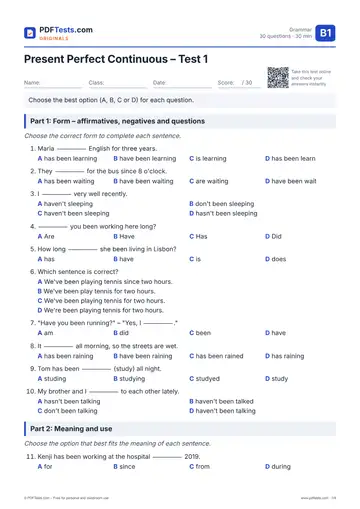
Now put the rules into practice with our B1 Present Perfect Continuous test, which checks form, for and since, and the choice between simple and continuous. When you feel confident, move on to the B1 Present Perfect vs Past Simple test to make sure you can also decide when a finished time in the past needs the past simple instead.
Was this page helpful?
What was the problem?
Thank you for your feedback!