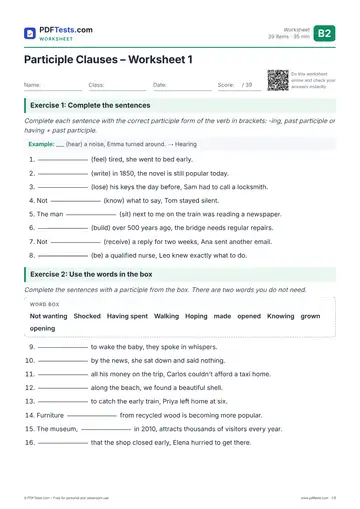
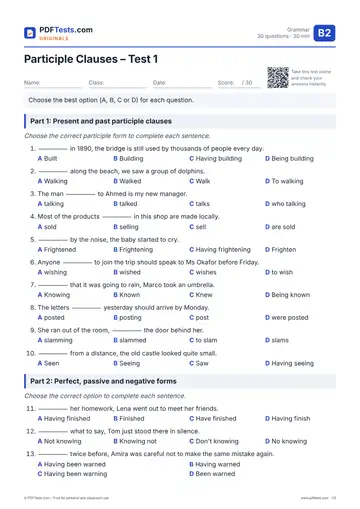
A participle clause is a short clause that starts with a participle (walking, built, having finished) instead of a subject and a full verb. Participle clauses make sentences shorter and more fluent. They can replace clauses with when, because, if, so or who/which. They are common in writing, news reports and formal speech, and they appear regularly in B2 exams.
What is a participle clause?
Compare these two sentences:
- Because I felt tired, I went to bed early.
- Feeling tired, I went to bed early.
The second sentence drops the conjunction and the subject and uses a participle. The meaning is the same, but the style is more compact.
There are three main types of participle:
| Type | Form | Meaning | Example |
|---|---|---|---|
| Present participle | verb + -ing | active, usually at the same time | Smiling politely, she shook his hand. |
| Past participle | 3rd form (-ed or irregular) | passive | Built in 1890, the bridge is still in use. |
| Perfect participle | having + past participle | active, earlier action | Having finished the report, he went home. |
| Perfect passive | having been + past participle | passive, earlier action | Having been warned about the traffic, we left early. |
Uses of participle clauses
1. Time
Participle clauses can show that two actions happen at the same time or one after the other.
- Walking home last night, I bumped into an old friend. (= while I was walking)
- Opening the fridge, she realised there was no milk. (= when she opened)
- Having checked in, we went straight to our room. (= after we had checked in)
2. Reason
They often explain why something happens. This is especially common with being, knowing, feeling and having.
- Being the oldest, Maria looked after her younger brothers. (= because she was)
- Not knowing the area, we used our phones to find the hotel.
- Having lost my keys, I had to wait for my flatmate. (= because I had lost)
3. Result
A participle clause at the end of a sentence can describe a result or consequence. A comma usually comes before it.
- The storm hit the coast overnight, causing serious damage.
- Prices rose sharply, forcing many families to cut back on spending.
4. Condition
Past participle clauses can replace an if clause, often in instructions and advice.
- Used correctly, this app can save you hours every week. (= if it is used correctly)
- Stored in a cool place, the cheese will last for weeks.
5. Adding information to a noun (reduced relative clauses)
Participle clauses can follow a noun and work like a relative clause without who, which or that.
- The woman sitting next to me on the train was a doctor. (= who was sitting)
- Most of the products sold in this shop are handmade. (= which are sold)
- Anyone wanting a refund should keep the receipt. (= who wants)
If you need to review full relative clauses first, see our guide to relative clauses with who, which, that and where.
Form: active, passive and time
Choose the participle according to two questions: Is the meaning active or passive? Does the action happen at the same time or earlier?
| Time relation | Active | Passive |
|---|---|---|
| Same time | Reading the email, she frowned. | Seen from above, the city looks tiny. |
| Earlier action | Having read the email, she replied. | Having been told the news, he called his mum. |
The past participle on its own is always passive in meaning. Written by a teenager, the novel became a bestseller means the novel was written. For more on active and passive meaning, see our passive voice guide.
Negative participle clauses
Put not before the participle. Do not use don’t or didn’t.
| Positive | Negative |
|---|---|
| Knowing the answer, he raised his hand. | Not knowing the answer, he stayed quiet. |
| Having received a reply, she relaxed. | Not having received a reply, she wrote again. |
| Having been invited, they came. | Not having been invited, they stayed at home. |
Participle clauses with conjunctions
Sometimes we keep the conjunction to make the meaning clearer. This is very common with time words and contrast words.
| Conjunction | Example |
|---|---|
| after | After finishing university, she moved to Berlin. |
| before | Switch off the lights before leaving the office. |
| while | While waiting for the bus, I listened to a podcast. |
| when | When asked about the delay, the manager apologised. |
| since | Since moving to the countryside, he has felt much calmer. |
| once | Once opened, keep the jar in the fridge. |
| although / though | Although invited, Tom didn’t come to the party. |
| if / unless | Unless stated otherwise, all prices include VAT. |
Note that after, before, since and while are followed by the -ing form for active meaning. After having finished is possible but usually unnecessary, because after already shows the order: After finishing is enough.
The subject rule
This is the most important rule. The participle clause has no subject of its own, so its subject must be the same as the subject of the main clause.
- ✓ Turning the corner, I saw the sea. (I turned the corner and I saw the sea.)
- ✗ Turning the corner, the sea came into view. (This suggests the sea turned the corner.)
This error is called a dangling participle. It often sounds funny to native speakers, and examiners notice it. If the subjects are different, use a full clause: As I turned the corner, the sea came into view.
In formal English, a participle clause can have its own subject, but only in fixed patterns: The weather being fine, we ate outside. / All things considered, it was a good year. At B2, it is safest to use these only as set phrases.
Present participle or perfect participle?
Use the present participle (-ing) when the two actions happen at the same time, or when the first action is short and the second follows immediately:
- Picking up his bag, he walked out of the room.
Use the perfect participle (having done) when the first action is clearly completed before the second, especially if it takes some time or causes the second action:
- Having worked there for ten years, she knew everyone in the company.
- ✗ Working there for ten years, she knew everyone. (This sounds like the ten years and the knowing are simultaneous.)
The perfect participle works like the past perfect in a full clause. If that tense is still unclear, review our past perfect guide.
Participle clauses vs relative clauses
Reduced relative clauses are useful, but they have limits.
| Full relative clause | Participle clause | Possible? |
|---|---|---|
| The man who is talking to Anna is my boss. | The man talking to Anna is my boss. | ✓ |
| The cars which were made in this factory are exported. | The cars made in this factory are exported. | ✓ |
| The man who stole my bike was caught. | The man stealing my bike was caught. | ✗ |
| The student who has won the prize is from Lisbon. | The student having won the prize is from Lisbon. | ✗ |
Two points to remember:
- An -ing relative clause describes an ongoing action, a state or a general situation (people living nearby, a road leading to the beach). It is not normally used for a single completed action in the past.
- The perfect participle (having done) is not used to replace a relative clause. Use who/which + verb instead.
For a deeper look at commas and extra information, see our guide to defining and non-defining relative clauses.
Common mistakes
✗ Walking along the beach, a dog started following me. → ✓ Walking along the beach, I noticed a dog following me. The subject of both clauses must be the same person or thing.
✗ Having missed the bus, so I was late for work. → ✓ Having missed the bus, I was late for work. The participle clause replaces the conjunction; do not add so or because as well.
✗ Finished my homework, I went out. → ✓ Having finished my homework, I went out. A past participle alone has a passive meaning; for an earlier active action use having + past participle.
✗ Writing in 1949, the novel still feels modern today. → ✓ Written in 1949, the novel still feels modern today. The novel did not write anything, so the meaning is passive.
✗ Don’t knowing what to say, she smiled. → ✓ Not knowing what to say, she smiled. Make participle clauses negative with not, never with don’t or didn’t.
✗ Since arrived in London, she has made lots of friends. → ✓ Since arriving in London, she has made lots of friends. After since, after, before and while, use the -ing form for active meaning.
✗ The woman having called yesterday is my aunt. → ✓ The woman who called yesterday is my aunt. Perfect participles cannot replace relative clauses, and one completed past action needs a full clause.
Quick check
Complete the sentences with the correct participle form, or correct the mistake.
- ______ (finish) the report, she emailed it to her manager.
- ______ (make) by hand, these shoes are quite expensive.
- The girl ______ (wear) the red coat is my cousin.
- ______ (not / know) anyone at the party, he left early.
- Correct the mistake: Looking out of the window, the mountains were beautiful.
Answers
- Having finished – the first action was completed before the second.
- Made – passive meaning: the shoes are made by hand.
- wearing – reduced relative clause: the girl who is wearing.
- Not knowing – negative reason clause with not + -ing.
- Looking out of the window, I saw the beautiful mountains. – the person looking must be the subject of the main clause.
Next step
Now put the rules into practice with our B2 Participle Clauses test. As you work through it, ask yourself the same two questions each time: is the meaning active or passive, and does the action happen at the same time or earlier? Then check that the subject of the participle clause matches the subject of the main clause. If you make mistakes with time order, revise the past perfect before trying the test again.
Practise this topic: Participle Clauses
Was this page helpful?
What was the problem?
Thank you for your feedback!