PDFTests Originals

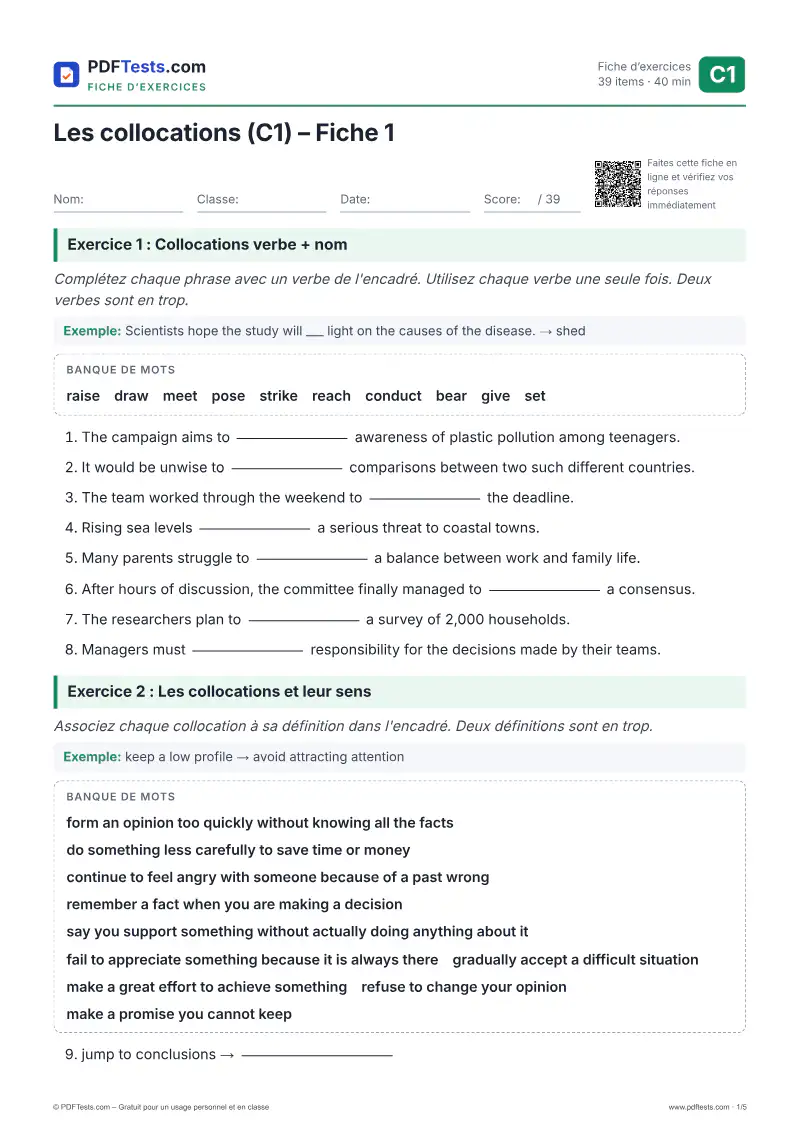
Les collocations (C1) – Fiche 1

C1 Avancé FicheAnglais

Cette fiche de niveau C1 fait travailler en contexte des collocations anglaises courantes, comme « strike a balance », « jump to conclusions » ou « an overwhelming majority ». À travers cinq exercices allant de la pratique guidée à une pratique plus libre, les apprenants travaillent le sens, les associations de mots naturelles et la formation des mots. Elle s'adresse aux apprenants de niveau intermédiaire supérieur et avancé qui préparent un examen ou souhaitent s'exprimer en anglais de façon plus naturelle et plus précise.
items
39
Durée
40 min
PDF
5 pages
Corrigé
Inclus
  • 100 % gratuit
  • Sans inscription
  • PDF A4 prêt à imprimer
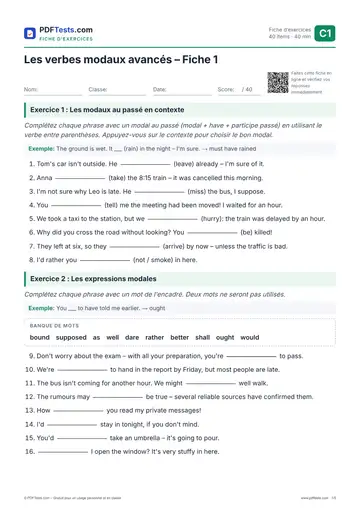
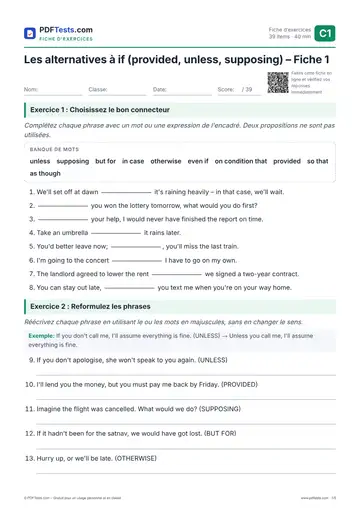
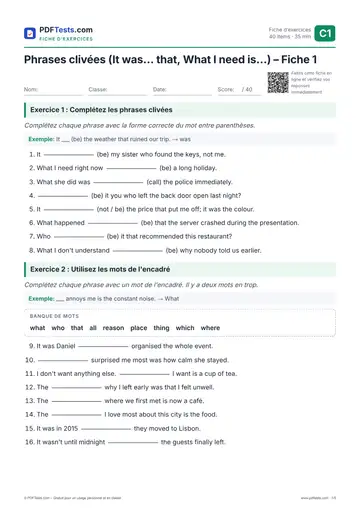
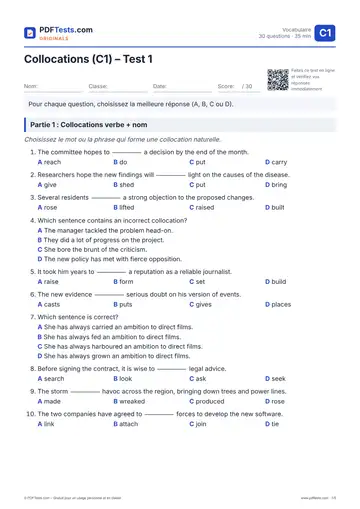
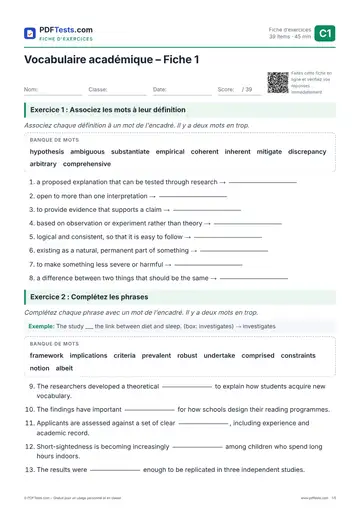
Aperçu de la page 1 : Les collocations (C1) – Fiche 1 Ouvrir le PDF

Faire la fiche en ligne

Tapez vos réponses puis cliquez sur « Vérifier mes réponses ». Les autres réponses correctes sont acceptées.

Exercice 1 : Collocations verbe + nom

Complétez chaque phrase avec un verbe de l'encadré. Utilisez chaque verbe une seule fois. Deux verbes sont en trop.

Exemple: Scientists hope the study will ___ light on the causes of the disease. → shed

Banque de mots raisedrawmeetposestrikereachconductbeargiveset

  1. The campaign aims to awareness of plastic pollution among teenagers.

  2. It would be unwise to comparisons between two such different countries.

  3. The team worked through the weekend to the deadline.

  4. Rising sea levels a serious threat to coastal towns.

  5. Many parents struggle to a balance between work and family life.

  6. After hours of discussion, the committee finally managed to a consensus.

  7. The researchers plan to a survey of 2,000 households.

  8. Managers must responsibility for the decisions made by their teams.

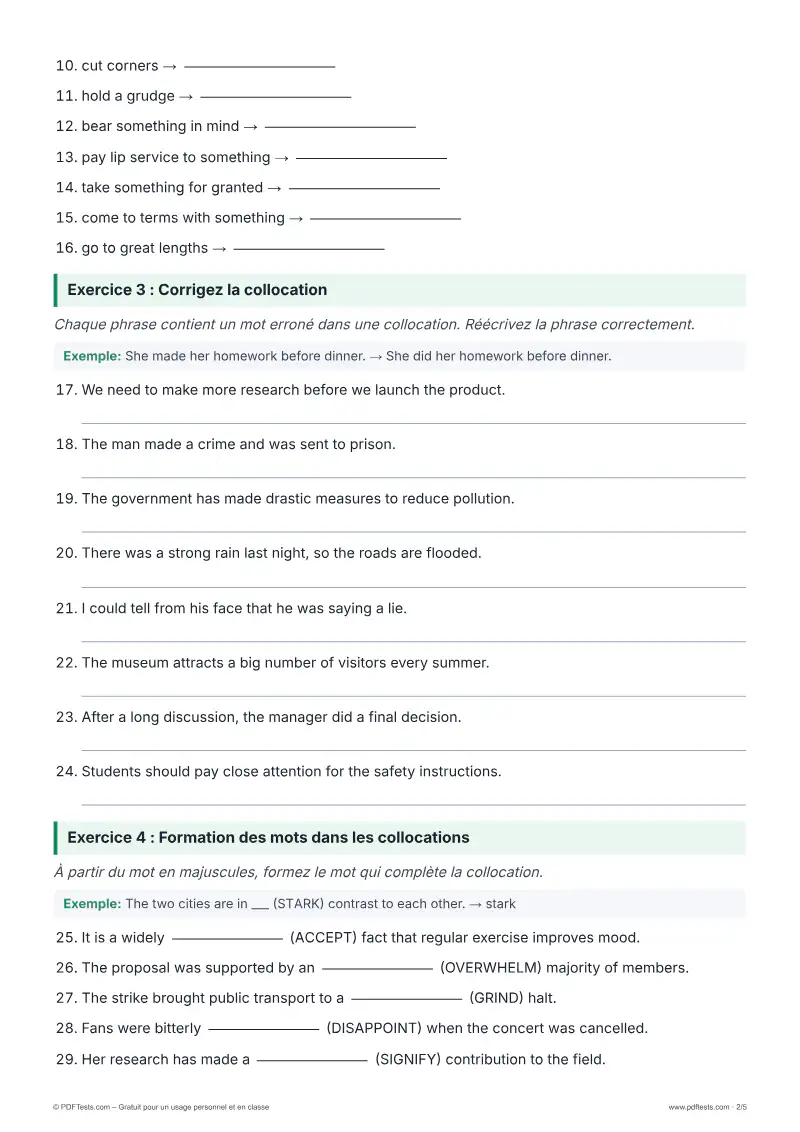
Exercice 2 : Les collocations et leur sens

Associez chaque collocation à sa définition dans l'encadré. Deux définitions sont en trop.

Exemple: keep a low profile → avoid attracting attention

Banque de mots form an opinion too quickly without knowing all the factsdo something less carefully to save time or moneycontinue to feel angry with someone because of a past wrongremember a fact when you are making a decisionsay you support something without actually doing anything about itfail to appreciate something because it is always theregradually accept a difficult situationmake a great effort to achieve somethingrefuse to change your opinionmake a promise you cannot keep

  1. jump to conclusions

  2. cut corners

  3. hold a grudge

  4. bear something in mind

  5. pay lip service to something

  6. take something for granted

  7. come to terms with something

  8. go to great lengths

Exercice 3 : Corrigez la collocation

Chaque phrase contient un mot erroné dans une collocation. Réécrivez la phrase correctement.

Exemple: She made her homework before dinner. → She did her homework before dinner.

  1. We need to make more research before we launch the product.

  2. The man made a crime and was sent to prison.

  3. The government has made drastic measures to reduce pollution.

  4. There was a strong rain last night, so the roads are flooded.

  5. I could tell from his face that he was saying a lie.

  6. The museum attracts a big number of visitors every summer.

  7. After a long discussion, the manager did a final decision.

  8. Students should pay close attention for the safety instructions.

Exercice 4 : Formation des mots dans les collocations

À partir du mot en majuscules, formez le mot qui complète la collocation.

Exemple: The two cities are in ___ (STARK) contrast to each other. → stark

  1. It is a widely (ACCEPT) fact that regular exercise improves mood.

  2. The proposal was supported by an (OVERWHELM) majority of members.

  3. The strike brought public transport to a (GRIND) halt.

  4. Fans were bitterly (DISAPPOINT) when the concert was cancelled.

  5. Her research has made a (SIGNIFY) contribution to the field.

  6. In this storm, it is highly (LIKE) that the match will go ahead.

  7. After years of neglect, the old castle has fallen into (REPAIR).

  8. It is important to draw a clear (DISTINGUISH) between facts and opinions.

Exercice 5 : Reformulez avec une collocation

Réécrivez chaque phrase en utilisant le mot entre parenthèses, sans en changer le sens.

Exemple: He wants to avoid attracting attention. (PROFILE) → He wants to keep a low profile.

  1. Remember that the shop closes early on Sundays. (MIND)

  2. The new rules will start to apply in January. (FORCE)

  3. I think you are forming an opinion too quickly. (CONCLUSIONS)

  4. She eventually accepted that she had lost her job. (TERMS)

  5. He made a huge effort to keep the project a secret. (LENGTHS)

  6. Many people don't appreciate clean water because it is always available. (GRANTED)

  7. The two sides finally agreed. (CONSENSUS)

Cette page vous a-t-elle été utile ?

Signaler une erreur

Une mauvaise réponse, une faute de frappe ou une explication peu claire ? Dites-le-nous, nous corrigerons.

Aperçu

À propos de ce test

Fiche d'exercices anglais C1 PDF sur les collocations : verbe + nom, sens, formation des mots, correction d'erreurs, reformulations. Avec corrigé.

Thèmes abordés

Collocations verbe + nomCollocations adverbe + adjectifCollocations et sensFormation des motsErreurs de collocation fréquentes

Notes pour l’enseignant

Commencez par l'exercice 1 en guise d'échauffement, puis demandez aux élèves de comparer leurs réponses à l'exercice 2 en binômes avant la correction collective. Une erreur fréquente consiste à traduire mot à mot les collocations depuis la langue maternelle, ce qui donne des formes comme « make research » ou « say a lie » : attirez donc l'attention sur le verbe de chaque association. En prolongement, demandez aux apprenants de rédiger un court paragraphe argumentatif sur le sujet de leur choix en utilisant au moins six collocations de la fiche.

Tous les tests Anglais C1 →