PDFTests Originals

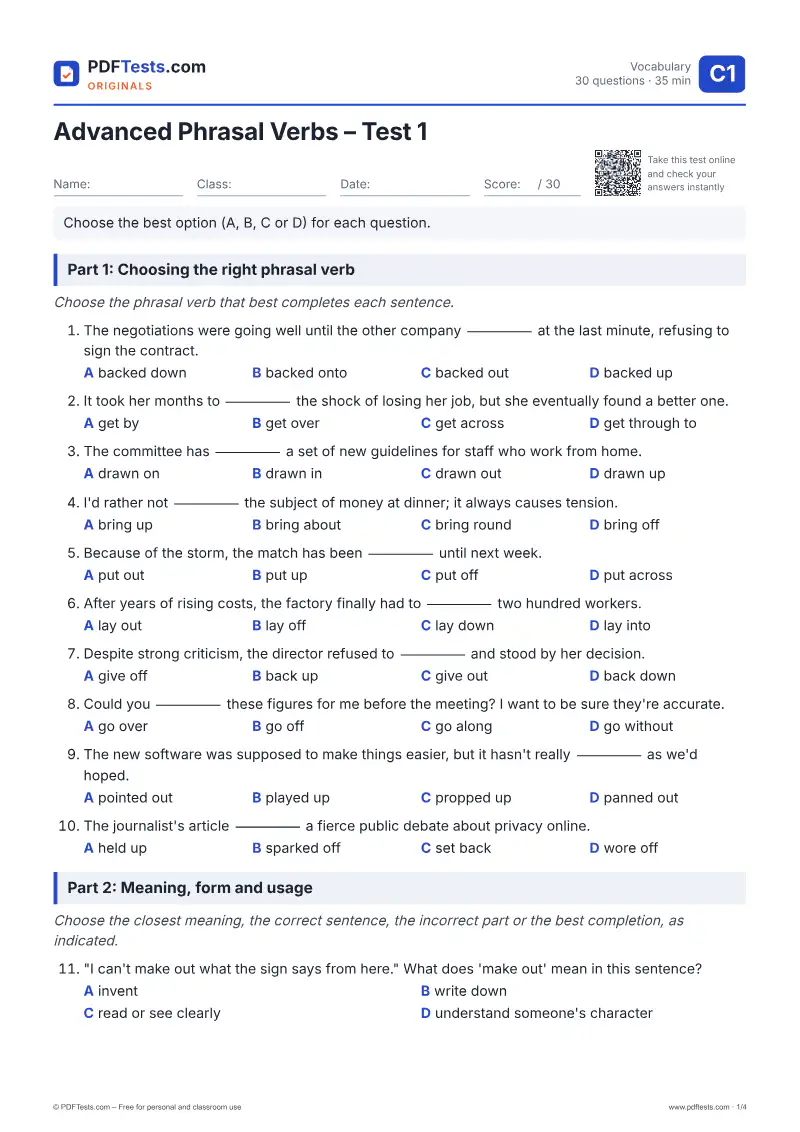
Advanced Phrasal Verbs – Test 1

C1 Advanced VocabularyEnglish

This 30-question C1 vocabulary test checks how well you understand and use advanced English phrasal verbs. It covers choosing the right verb in context, meaning, word order, error spotting, nouns formed from phrasal verbs and a gapped reading text. It suits upper-intermediate and advanced learners, exam candidates and teachers who need a ready-made printable assessment.
Questions
30
Time
35 min
PDF
4 pages
Answer key
Included
  • 100% free
  • No sign-up or email
  • Print-ready A4 PDF
Preview of page 1 of Advanced Phrasal Verbs – Test 1 Open PDF

Take the test online

Choose the best option (A, B, C or D) for each question. Choose your answers, then press “Check my answers”.

Part 1: Choosing the right phrasal verb

Choose the phrasal verb that best completes each sentence.

  1. The negotiations were going well until the other company _____ at the last minute, refusing to sign the contract.

  2. It took her months to _____ the shock of losing her job, but she eventually found a better one.

  3. The committee has _____ a set of new guidelines for staff who work from home.

  4. I'd rather not _____ the subject of money at dinner; it always causes tension.

  5. Because of the storm, the match has been _____ until next week.

  6. After years of rising costs, the factory finally had to _____ two hundred workers.

  7. Despite strong criticism, the director refused to _____ and stood by her decision.

  8. Could you _____ these figures for me before the meeting? I want to be sure they're accurate.

  9. The new software was supposed to make things easier, but it hasn't really _____ as we'd hoped.

  10. The journalist's article _____ a fierce public debate about privacy online.

Part 2: Meaning, form and usage

Choose the closest meaning, the correct sentence, the incorrect part or the best completion, as indicated.

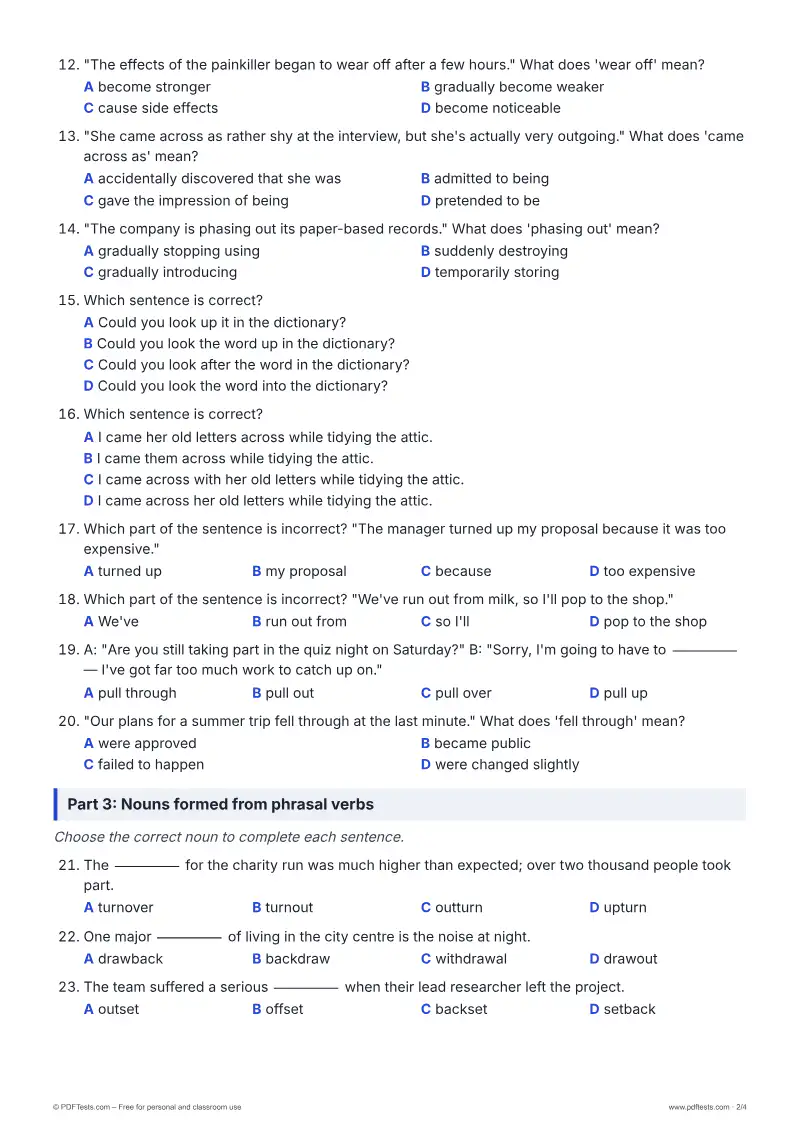
  1. "I can't make out what the sign says from here." What does 'make out' mean in this sentence?

  2. "The effects of the painkiller began to wear off after a few hours." What does 'wear off' mean?

  3. "She came across as rather shy at the interview, but she's actually very outgoing." What does 'came across as' mean?

  4. "The company is phasing out its paper-based records." What does 'phasing out' mean?

  5. Which sentence is correct?

  6. Which sentence is correct?

  7. Which part of the sentence is incorrect? "The manager turned up my proposal because it was too expensive."

  8. Which part of the sentence is incorrect? "We've run out from milk, so I'll pop to the shop."

  9. A: "Are you still taking part in the quiz night on Saturday?" B: "Sorry, I'm going to have to _____ — I've got far too much work to catch up on."

  10. "Our plans for a summer trip fell through at the last minute." What does 'fell through' mean?

Part 3: Nouns formed from phrasal verbs

Choose the correct noun to complete each sentence.

  1. The _____ for the charity run was much higher than expected; over two thousand people took part.

  2. One major _____ of living in the city centre is the noise at night.

  3. The team suffered a serious _____ when their lead researcher left the project.

  4. There was a _____ in communication between the two departments, and the order was never sent.

  5. Her strict _____ in a small village shaped her attitude to hard work.

Part 4: Phrasal verbs in a reading text

Read the text and choose the best option for each numbered gap.

When Amara Osei decided to set up her own catering business, friends warned her that the first year would be tough. They turned out to be right. Within weeks, her main supplier went bankrupt, and she had to (26) ___ a replacement at very short notice.

Money was tight, so Amara (27) ___ her savings to keep the business running. She also had to (28) ___ several large orders because she simply did not have enough staff. 'It was painful to say no,' she admits, 'but I couldn't risk letting people down.'

Slowly, however, things began to (29) ___. Word spread about the quality of her food, and by the end of the second year she had taken on four employees. Looking back, Amara believes the difficult start taught her valuable lessons. 'If you're going to run a business, you have to be prepared to (30) ___ creative solutions to problems you never expected.'

  1. (26) ... she had to _____ a replacement at very short notice.

  2. (27) Money was tight, so Amara _____ her savings to keep the business running.

  3. (28) She also had to _____ several large orders because she simply did not have enough staff.

  4. (29) Slowly, however, things began to _____.

  5. (30) ... you have to be prepared to _____ creative solutions to problems you never expected.

Was this page helpful?

Report a mistake

Spotted a wrong answer, a typo or an unclear explanation? Tell us and we will fix it.

Practise with a worksheet: Advanced Phrasal Verbs – Worksheet 1

Preview

About this test

This 30-question C1 vocabulary test checks how well you understand and use advanced English phrasal verbs. It covers choosing the right verb in context, meaning, word order, error spotting, nouns formed from phrasal verbs and a gapped reading text. It suits upper-intermediate and advanced learners, exam candidates and teachers who need a ready-made printable assessment.

Topics covered

Phrasal verbs in contextMeaning and paraphraseSeparable and inseparable verbsError correctionNouns from phrasal verbsReading in context

How to use this test

  1. Download the PDF and print it, or take the test online below.
  2. Answer every question without a dictionary or time pressure.
  3. Check your answers and note the topics you need to review.

Notes for teachers

Use this test as a diagnostic or review after a unit on phrasal verbs at C1 level. It targets common errors: confusing particles with the same base verb (back down / back out), pronoun placement with separable verbs, wrong prepositions after multi-word verbs (run out of), and confusion between similar compound nouns (turnout / turnover). As follow-up, ask learners to write their own sentences with the verbs they got wrong, or to retell the reading text using as many phrasal verbs as possible.