PDFTests Originals

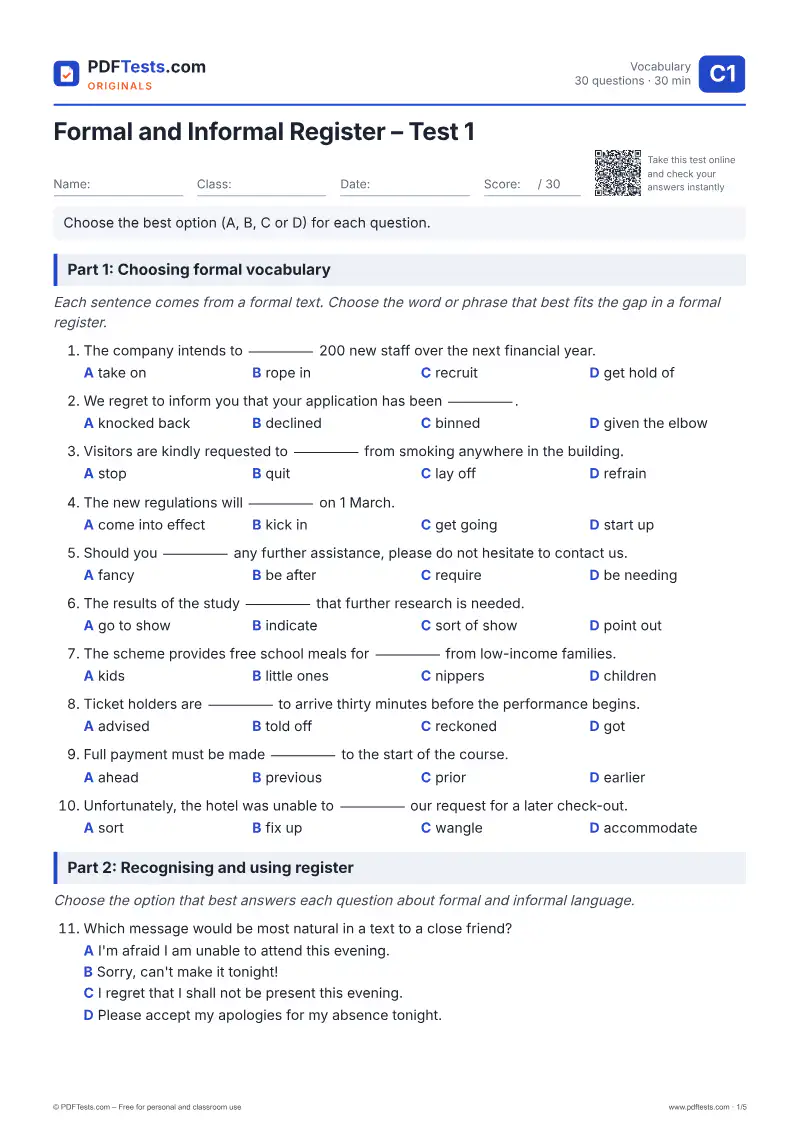
Formal and Informal Register – Test 1

C1 Advanced VocabularyEnglish

This C1 vocabulary test checks how well you can move between formal and informal English. It covers formal equivalents of everyday words, informal expressions and phrasal verbs, register mismatches, and the fixed collocations and word families of formal correspondence. It suits advanced learners preparing for exams or professional writing, and teachers who want a ready-made register check.
Questions
30
Time
30 min
PDF
5 pages
Answer key
Included
  • 100% free
  • No sign-up or email
  • Print-ready A4 PDF
Preview of page 1 of Formal and Informal Register – Test 1 Open PDF

Take the test online

Choose the best option (A, B, C or D) for each question. Choose your answers, then press “Check my answers”.

Part 1: Choosing formal vocabulary

Each sentence comes from a formal text. Choose the word or phrase that best fits the gap in a formal register.

  1. The company intends to _____ 200 new staff over the next financial year.

  2. We regret to inform you that your application has been _____.

  3. Visitors are kindly requested to _____ from smoking anywhere in the building.

  4. The new regulations will _____ on 1 March.

  5. Should you _____ any further assistance, please do not hesitate to contact us.

  6. The results of the study _____ that further research is needed.

  7. The scheme provides free school meals for _____ from low-income families.

  8. Ticket holders are _____ to arrive thirty minutes before the performance begins.

  9. Full payment must be made _____ to the start of the course.

  10. Unfortunately, the hotel was unable to _____ our request for a later check-out.

Part 2: Recognising and using register

Choose the option that best answers each question about formal and informal language.

  1. Which message would be most natural in a text to a close friend?

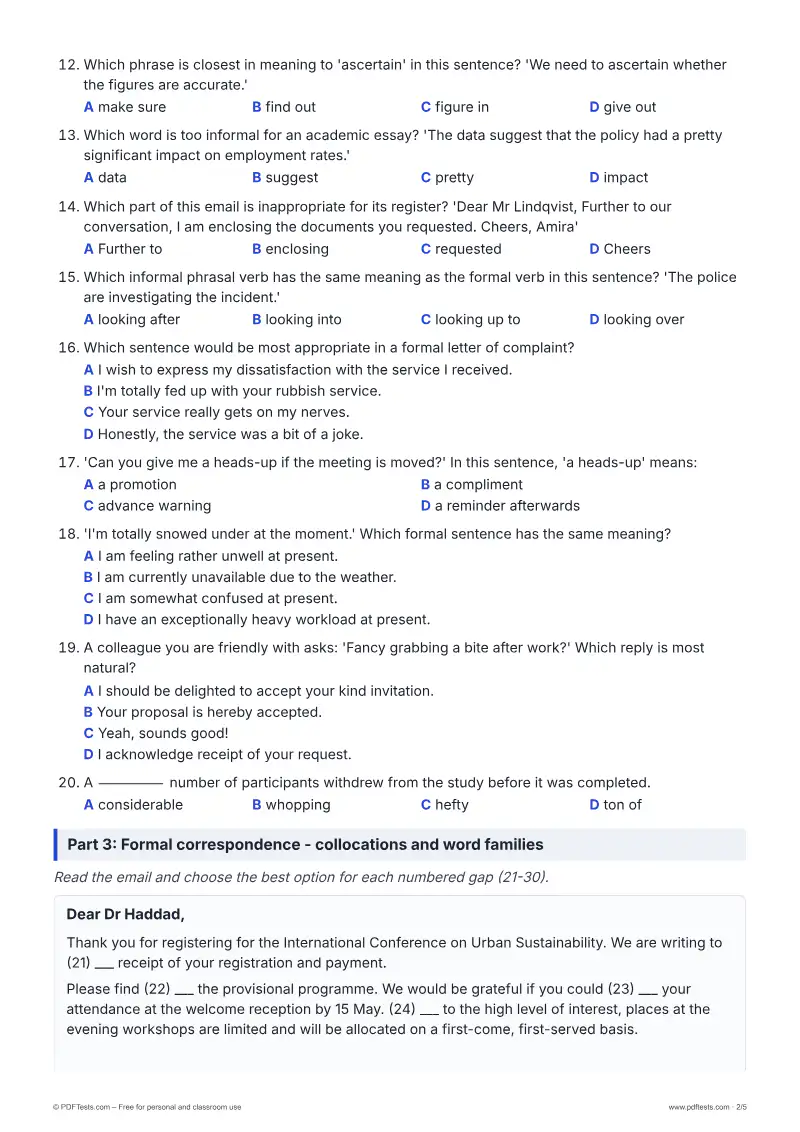
  2. Which phrase is closest in meaning to 'ascertain' in this sentence? 'We need to ascertain whether the figures are accurate.'

  3. Which word is too informal for an academic essay? 'The data suggest that the policy had a pretty significant impact on employment rates.'

  4. Which part of this email is inappropriate for its register? 'Dear Mr Lindqvist, Further to our conversation, I am enclosing the documents you requested. Cheers, Amira'

  5. Which informal phrasal verb has the same meaning as the formal verb in this sentence? 'The police are investigating the incident.'

  6. Which sentence would be most appropriate in a formal letter of complaint?

  7. 'Can you give me a heads-up if the meeting is moved?' In this sentence, 'a heads-up' means:

  8. 'I'm totally snowed under at the moment.' Which formal sentence has the same meaning?

  9. A colleague you are friendly with asks: 'Fancy grabbing a bite after work?' Which reply is most natural?

  10. A _____ number of participants withdrew from the study before it was completed.

Part 3: Formal correspondence - collocations and word families

Read the email and choose the best option for each numbered gap (21-30).

Dear Dr Haddad,

Thank you for registering for the International Conference on Urban Sustainability. We are writing to (21) ___ receipt of your registration and payment.

Please find (22) ___ the provisional programme. We would be grateful if you could (23) ___ your attendance at the welcome reception by 15 May. (24) ___ to the high level of interest, places at the evening workshops are limited and will be allocated on a first-come, first-served basis.

Delegates who require (25) ___ are advised to book directly with one of our partner hotels, details of which are available on the conference website. Please note that the organisers cannot accept (26) ___ for the loss of personal belongings during the event.

Should you have any dietary requirements or accessibility needs, kindly (27) ___ the registration team at your earliest (28) ___. We will make every effort to (29) ___ your needs.

We look forward to welcoming you in June.

Yours (30) ___,

Elena Moreau

Conference Coordinator

  1. (21) We are writing to _____ receipt of your registration and payment.

  2. (22) Please find _____ the provisional programme.

  3. (23) We would be grateful if you could _____ your attendance at the welcome reception by 15 May.

  4. (24) _____ to the high level of interest, places at the evening workshops are limited.

  5. (25) Delegates who require _____ are advised to book directly with one of our partner hotels.

  6. (26) Please note that the organisers cannot accept _____ for the loss of personal belongings.

  7. (27) Kindly _____ the registration team at your earliest convenience.

  8. (28) Kindly contact the registration team at your earliest _____.

  9. (29) We will make every effort to _____ your needs.

  10. (30) Yours _____, (letter to Dr Haddad)

Was this page helpful?

Report a mistake

Spotted a wrong answer, a typo or an unclear explanation? Tell us and we will fix it.

Practise with a worksheet: Formal and Informal Register – Worksheet 1

Preview

About this test

This C1 vocabulary test checks how well you can move between formal and informal English. It covers formal equivalents of everyday words, informal expressions and phrasal verbs, register mismatches, and the fixed collocations and word families of formal correspondence. It suits advanced learners preparing for exams or professional writing, and teachers who want a ready-made register check.

Topics covered

Formal vs informal vocabularyFormal equivalents of phrasal verbsRegister mismatchInformal idiomsCollocations in formal lettersWord families

How to use this test

  1. Download the PDF and print it, or take the test online below.
  2. Answer every question without a dictionary or time pressure.
  3. Check your answers and note the topics you need to review.

Notes for teachers

Use this test after work on email and report writing, or as a diagnostic before a formal writing task. It targets common C1 errors: phrasal verbs and slang in formal texts, overly stiff language in casual contexts, wrong dependent prepositions (refrain from, prior to), and confusion within word families (responsible/responsibility, convenient/convenience). As a follow-up, ask students to rewrite the Part 3 email as an informal message to a friend, then compare the vocabulary they chose.