The first and second conditional are sentences with if that describe a situation and its result. Use the first conditional (If it rains, we’ll stay in) for real possibilities in the future. Use the second conditional (If I had more time, I’d learn Japanese) for imaginary or unlikely situations in the present or future.
The first conditional
When to use it
The first conditional describes a situation that could really happen, and the result we expect if it does. The speaker believes there is a real chance of the condition coming true.
- Real future possibilities: If the train is late, I’ll take a taxi.
- Warnings: If you touch that cable, you’ll get a shock.
- Promises and offers: If you help me move on Saturday, I’ll buy you dinner.
- Plans that depend on something: If we finish early, we’ll go for a coffee.
Form
If + present simple, will + infinitive
| Type | If clause | Main clause |
|---|---|---|
| Affirmative | If it rains tomorrow, | we’ll stay at home. |
| Negative | If you don’t hurry, | you won’t catch the bus. |
| Question | If she calls, | will you answer? |
You can also put the question word first: What will you do if you fail the exam?
Key points:
- The if clause uses the present simple, even though the meaning is future. Remember the third-person -s: If he misses the bus, he’ll be late.
- In speech and informal writing, will becomes ’ll and will not becomes won’t.
- If you need a refresher on will itself, see our guide to will for predictions, offers and promises.
The second conditional
When to use it
The second conditional talks about situations that are not true now, or that we think are unlikely to happen. The verb looks like the past, but the meaning is present or future.
- Imaginary present situations: If I lived near the sea, I’d go swimming every morning. (I don’t live near the sea.)
- Unlikely future events: If I won the lottery, I’d travel around South America.
- Advice: If I were you, I’d talk to your manager.
- Hypothetical questions: What would you do if you lost your phone abroad?
Form
If + past simple, would + infinitive
| Type | If clause | Main clause |
|---|---|---|
| Affirmative | If I had a car, | I’d drive to work. |
| Negative | If she didn’t work so late, | she wouldn’t be so tired. |
| Question | If you could live anywhere, | where would you live? |
Key points:
- The if clause uses the past simple, so you need the correct past forms of irregular verbs (had, went, knew, could). Our Past Simple guide lists the most common ones.
- Would becomes ’d in speech: I’d, you’d, she’d, we’d. Would not becomes wouldn’t.
- Pronunciation tip: I’d sounds like “eyed” and we’d like “weed”. Listen carefully, because the ’d is short and easy to miss.
Was or were?
In the second conditional, were is traditionally used for all persons, including I, he, she and it:
- If I were taller, I’d play basketball.
- If it were cheaper, more people would buy it.
In everyday conversation, many speakers say was (If I was taller…), and this is common and acceptable in informal English. However, the fixed phrase for giving advice is always If I were you, and were is the safest choice in exams.
Clause order and commas
Both conditionals have two clauses, and either one can come first. The meaning does not change.
- If clause first: use a comma. If you’re hungry, I’ll make a sandwich.
- Main clause first: usually no comma. I’ll make a sandwich if you’re hungry.
The same rule applies to the second conditional: If I knew her number, I’d call her. / I’d call her if I knew her number.
Other verbs in the main clause
Will and would are the most common choices, but other modal verbs and forms are possible.
First conditional:
- Imperative: If you see Anna, tell her I said hello.
- can (permission or possibility): If you finish your homework, you can watch a film.
- may / might (less certain): If the weather’s good, we might go to the beach.
- should (advice): If you feel ill, you should stay at home.
Second conditional:
- could (= would be able to): If I had more money, I could buy a better laptop.
- might (= would possibly): If we left now, we might catch the earlier train.
If, unless, when and as long as
A few other words work in a similar way to if. They follow the same tense rules: no will or would in the condition clause.
- unless = if not: You won’t pass unless you study. = You won’t pass if you don’t study. Do not add another negative after unless.
- when is for things you are sure will happen: When I get home, I’ll call you. (I will definitely get home.) Compare: If I get home before ten, I’ll call you. (Maybe I will, maybe I won’t.)
- as long as means “only if”: You can borrow my bike as long as you bring it back tonight.
You will meet more formal options such as provided that and supposing at higher levels; our guide to alternatives to if covers them.
First or second conditional: how to choose
The grammar is not decided by the situation itself, but by how real the speaker thinks it is.
| First conditional | Second conditional | |
|---|---|---|
| Form | If + present simple, will + infinitive | If + past simple, would + infinitive |
| Time | Future | Present or future |
| How real? | Possible, likely | Imaginary, unlikely or impossible |
| Example | If I see Tom, I’ll give him your message. | If I saw a ghost, I’d scream. |
The same situation can take either form, depending on the speaker’s view:
- If I get the job, I’ll move to London. (I had a good interview. It’s a real possibility.)
- If I got the job, I’d move to London. (I don’t really expect to get it.)
Clues that help you decide
- Facts that can’t change now point to the second conditional: I’m not rich, so… If I were rich, I’d buy a house by the sea.
- Questions that ask you to imagine usually take the second conditional: What would you do if…? Imagine you could…
- Concrete plans, arrangements and time expressions such as tomorrow, this weekend, next month often point to the first conditional: If it’s sunny this weekend, we’ll have a barbecue.
Related conditionals
For general truths that are always true, English uses the zero conditional (If you heat ice, it melts). For imaginary situations in the past, it uses the third conditional (If I had left earlier, I would have caught the train). Third and mixed conditionals are a B2 topic; you can try them later in our B2 Third and Mixed Conditionals test.
Common mistakes
✗ If it will rain, we’ll stay at home. → ✓ If it rains, we’ll stay at home. Use the present simple, not will*, in the if clause.*
✗ If I would have more money, I would buy a car. → ✓ If I had more money, I would buy a car. Use the past simple, not would*, in the if clause.*
✗ If I won the lottery, I will buy a house. → ✓ If I won the lottery, I would buy a house. Don’t mix the forms: a past simple condition needs would in the result.
✗ If I am you, I’d apologise. → ✓ If I were you, I’d apologise. You can never be another person, so advice uses the second conditional.
✗ Unless you don’t hurry, you’ll be late. → ✓ Unless you hurry, you’ll be late. Unless already means “if not”, so don’t add another negative.
✗ I’ll call you if I get home. → ✓ I’ll call you when I get home. Use when for something you are sure will happen.
✗ If she calls me I’ll answer. → ✓ If she calls me**,** I’ll answer. Put a comma after the if clause when it comes first.
Quick check
Complete each sentence.
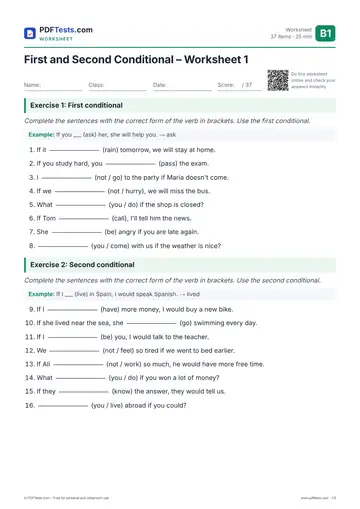
- If you ___ (leave) now, you’ll catch the train.
- If I ___ (be) you, I wouldn’t buy that phone.
- If she had more free time, she ___ (join) a gym.
- We won’t go out ___ the rain stops. (if or unless?)
- I’ve got a job interview tomorrow. If I ___ the job, I ___ celebrate. (get / got; ’ll / ’d)
Answers
- leave – first conditional: present simple in the if clause.
- were – the fixed phrase for advice is If I were you.
- would join / ’d join – second conditional: past simple condition, would in the result.
- unless – We won’t go out if the rain doesn’t stop.
- get, ’ll – the interview is real, so getting the job is a genuine possibility: If I get the job, I’ll celebrate.
Next step
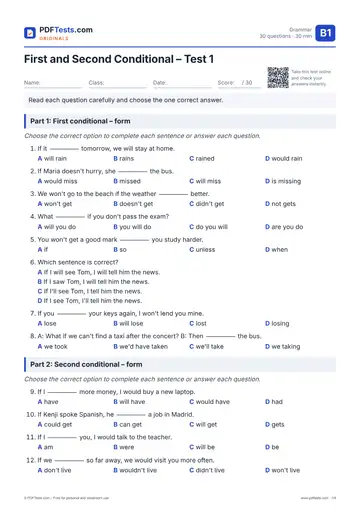
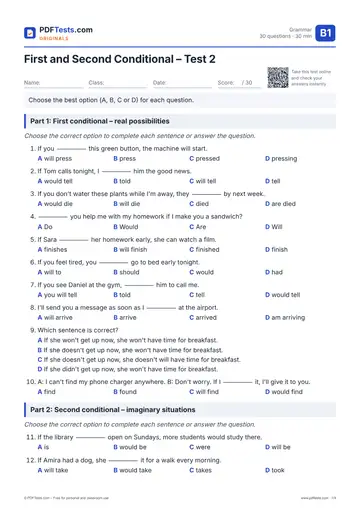
Now put the rules into practice with our B1 First and Second Conditional test, which mixes real and imaginary situations so you have to choose the right form each time. If you make mistakes with the past forms in the second conditional, review irregular verbs before trying again. When you feel confident, move on to wish and if only, which uses the same past-simple-for-unreal-situations idea to talk about regrets and things you want to change.
Was this page helpful?
What was the problem?
Thank you for your feedback!