A relative clause is part of a sentence that gives more information about a noun. It usually starts with who, which, that or where. Relative clauses let you join two short sentences into one, and they tell the listener exactly which person, thing or place you mean: The woman who lives next door is a nurse.
What is a relative clause?
Compare these two short sentences:
- I have a friend. She speaks four languages.
You can join them with a relative pronoun:
- I have a friend who speaks four languages.
The relative clause (who speaks four languages) comes directly after the noun it describes (a friend). The relative pronoun replaces a word from the second sentence. Here, who replaces she, so you don’t repeat she.
More examples:
- That’s the bus that goes to the airport.
- I’m looking for a job which pays a bit more.
- This is the café where we first met.
Which relative word should I use?
| Relative word | Used for | Example |
|---|---|---|
| who | people | The man who fixed my car was very helpful. |
| which | things, animals, ideas | The phone which I bought last week has stopped working. |
| that | people or things (less formal) | The teacher that I liked most was Ms Lee. / The film that won the prize was French. |
| where | places | That’s the hospital where I was born. |
| whose | possession (people and things) | I met a girl whose brother plays for Arsenal. |
Who for people
Use who when the noun is a person or a group of people.
- The students who passed the exam got a certificate.
- Do you know anyone who can fix a laptop?
Which for things and animals
Use which for objects, animals, ideas and situations.
- The train which leaves at 8:15 is usually late.
- We adopted a dog which was found on the street.
That for people and things
That can replace who or which in defining relative clauses (clauses without commas). It is very common in everyday spoken English.
- The guy that sold me this bike was really nice.
- Have you seen the photos that I posted?
Pronunciation note: in relative clauses, that is usually unstressed and pronounced /ðət/, not /ðæt/. The film that we saw sounds like “the film thət we saw”.
Where for places
Use where for places when it means in which, at which or on which.
- This is the street where I grew up. (= the street in which I grew up)
- I’d love to visit the town where my grandparents lived.
Important: where replaces a place + preposition. If the verb takes the place as a direct object (visit, see, like, build), use which or that instead.
- ✓ The city where we stayed was beautiful. (we stayed in the city)
- ✓ The city which/that we visited was beautiful. (we visited the city – no preposition)
Whose for possession
Whose replaces his, her, its, their. It is followed by a noun.
- That’s the woman whose car was stolen. (= her car was stolen)
- It’s a company whose products are sold worldwide.
Subject and object relative clauses
This is the key rule for deciding whether you can leave out the relative pronoun.
Subject relative clauses
The relative pronoun is the subject of the verb that follows. You cannot leave it out.
- The man who called you is waiting outside. (who = the person who called)
- The shop that sells vintage clothes has closed.
Object relative clauses
The relative pronoun is the object of the verb – there is already a different subject after it. You can leave it out, and in speaking people usually do.
- The man (who/that) you met is my uncle. (you is the subject)
- The book (which/that) I’m reading is brilliant.
| Type | Pattern | Can you omit the pronoun? | Example |
|---|---|---|---|
| Subject | noun + who/which/that + verb | No | The girl who works here is Spanish. |
| Object | noun + who/which/that + subject + verb | Yes | The girl (who) I work with is Spanish. |
A quick test: look at the word right after the relative pronoun. If it is a verb, keep the pronoun. If it is a noun or subject pronoun (I, you, my sister), you can drop it.
Where and whose cannot normally be left out: the café where we met, not the café we met.
If you need a refresher on subject and object forms, see our guide to subject and object pronouns.
Prepositions in relative clauses
When a verb goes with a preposition (live in, talk to, listen to, work with), the preposition usually goes at the end of the relative clause in everyday English.
- That’s the flat (which/that) I lived in.
- She’s the person (who/that) I was talking to.
- This is the song (that) I’ve been listening to all week.
With places, you have two natural options:
- The house where I grew up.
- The house (that) I grew up in.
Don’t use both: ✗ the house where I grew up in.
In formal English, the preposition can come before which or whom: the house in which I grew up, the person to whom I spoke. You’ll see this in written texts, but you don’t need it much in conversation. Note that that and who cannot follow a preposition: ✗ the house in that I grew up.
Defining and non-defining relative clauses
Everything above describes defining relative clauses. They give essential information – without them, we don’t know who or what you mean.
- The students who failed the test must take it again. (only those students)
Non-defining relative clauses add extra information about something already clear. They go between commas, and you cannot use that or leave out the pronoun.
- My brother, who lives in Leeds, is visiting next week.
- The Eiffel Tower, which was built in 1889, is in Paris.
Compare:
- My sister who lives in Canada is a doctor. (I have more than one sister – this one)
- My sister, who lives in Canada, is a doctor. (I have one sister; this is extra information)
At B1, focus on defining clauses and recognise the commas. For a full explanation, read our guide to defining and non-defining relative clauses.
Relative pronouns vs question words
Who, which and where are also question words, so learners sometimes mix up the word order. In a question, the auxiliary often comes before the subject. In a relative clause, normal statement word order is used.
| Question | Relative clause |
|---|---|
| Where did you buy it? | That’s the shop where you bought it. |
| Who did she invite? | The people who she invited were all from work. |
| Which bus goes to the centre? | The bus which goes to the centre is the number 12. |
If question forms still feel unsure, review question words.
Common mistakes
✗ The man who he lives next door is a doctor. → ✓ The man who lives next door is a doctor. The relative pronoun replaces the subject, so don’t add another pronoun.
✗ The film I watched it last night was boring. → ✓ The film I watched last night was boring. The object is already the film; don’t repeat it with it.
✗ The laptop who I bought is very fast. → ✓ The laptop which/that I bought is very fast. Use who only for people.
✗ The woman lives upstairs is a pilot. → ✓ The woman who lives upstairs is a pilot. You can’t omit the pronoun when it is the subject of the clause.
✗ This is the museum where we visited last year. → ✓ This is the museum which/that we visited last year. Visit has a direct object, so there’s no preposition for where to replace.
✗ The hotel where we stayed in was cheap. → ✓ The hotel where we stayed was cheap. / The hotel we stayed in was cheap. Where already includes the meaning of in.
✗ That’s the town I grew up. → ✓ That’s the town I grew up in. Grow up needs in before a place, so keep it at the end.
✗ People who works here get free lunch. → ✓ People who work here get free lunch. The verb agrees with the noun the clause describes (people = plural).
✗ My mum, that is a teacher, loves reading. → ✓ My mum, who is a teacher, loves reading. Don’t use that in a non-defining clause with commas.
Quick check
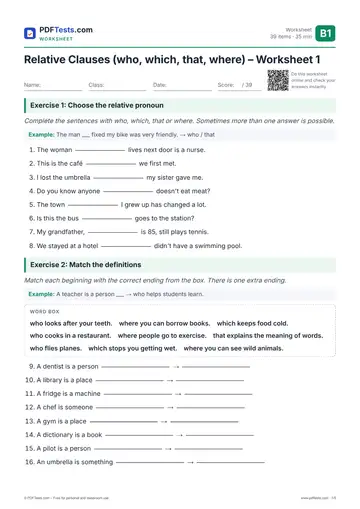
Choose or write the correct word. Write – if no word is needed.
- The woman ___ cut my hair was really friendly.
- Is this the restaurant ___ you had your birthday party?
- I’ve lost the umbrella ___ you lent me.
- Which is correct? a) The phone I bought it is broken. b) The phone I bought is broken.
- My grandfather, ___ is 90, still goes swimming every day.
Answers
- who or that – it is the subject, so it can’t be left out.
- where – you had the party in the restaurant.
- which, that or – – it is the object (you is the subject).
- b – don’t repeat the object with it.
- who – this is a non-defining clause with commas, so that is not possible.
Next step
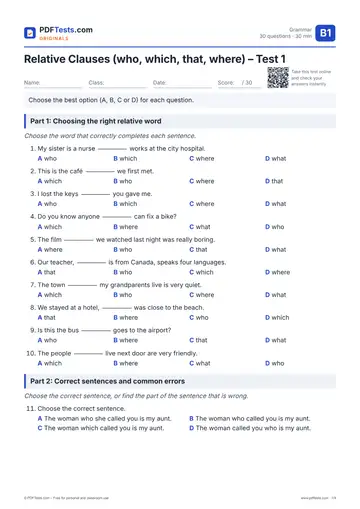
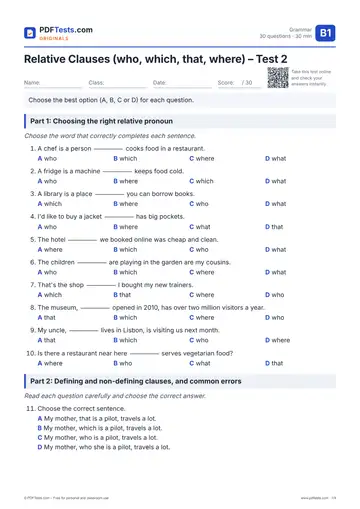
Now put the rules into practice: test yourself with our B1 Relative Clauses test, and pay special attention to questions where you must decide between where and which, or whether the pronoun can be left out. When you feel confident, move on to the B2 topic of defining and non-defining relative clauses to master commas, whom and more formal structures.
Was this page helpful?
What was the problem?
Thank you for your feedback!