Question tags are short questions added to the end of a statement, like isn’t it?, don’t you? or have they? We use them in conversation to check that something is true or to ask the listener to agree with us. The basic rule is simple: a positive statement takes a negative tag, and a negative statement takes a positive tag.
- It’s cold today, isn’t it?
- You haven’t seen my keys, have you?
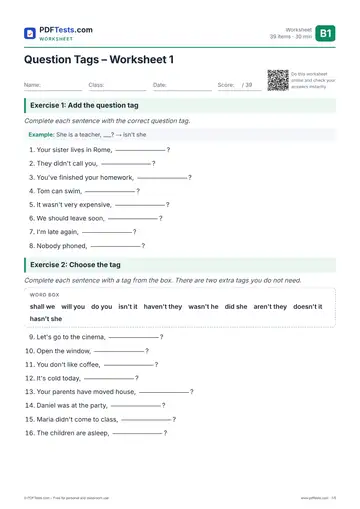
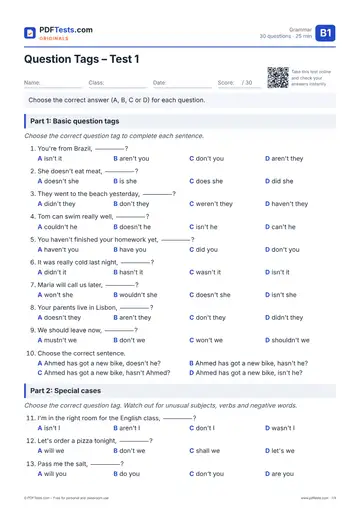
When you’ve read this guide, test yourself with our B1 Question Tags test.
Why we use question tags
Question tags have two main uses.
1. To check information. You think something is true, but you aren’t completely sure.
- The meeting starts at ten, doesn’t it?
- You’re from Manchester, aren’t you?
2. To invite agreement. You are fairly sure, and you want the other person to agree or to keep the conversation going.
- That was a great film, wasn’t it?
- The traffic is terrible this morning, isn’t it?
Question tags are very common in spoken English and in informal writing, such as messages to friends. They are rare in formal writing like reports or essays.
How to form question tags
Follow three steps:
- Find the auxiliary or modal verb in the statement (be, have, will, can, should, would…).
- Change positive to negative, or negative to positive.
- Use a subject pronoun (I, you, he, she, it, we, they), not a noun.
Example: The train is late. → verb: is → negative: isn’t → pronoun: it → The train is late, isn’t it?
Positive statement + negative tag
| Statement | Tag |
|---|---|
| She is a doctor, | isn’t she? |
| They were at home, | weren’t they? |
| You’ve finished, | haven’t you? |
| He had already left, | hadn’t he? |
| We’ll be on time, | won’t we? |
| You can swim, | can’t you? |
| I should call her, | shouldn’t I? |
| They would help, | wouldn’t they? |
Negative tags are almost always contracted: isn’t, haven’t, won’t. The full form (is she not?) sounds very formal and old-fashioned.
Negative statement + positive tag
| Statement | Tag |
|---|---|
| She isn’t ready, | is she? |
| You weren’t listening, | were you? |
| They haven’t arrived, | have they? |
| It won’t rain, | will it? |
| He can’t drive, | can he? |
| We shouldn’t wait, | should we? |
Statements with no auxiliary: do, does, did
Affirmative sentences in the present simple and past simple have no auxiliary verb, so the tag uses do, does or did. If you need to review these forms, see our Present Simple guide.
| Statement | Tag |
|---|---|
| You live near here, | don’t you? |
| She works from home, | doesn’t she? |
| They moved last year, | didn’t they? |
| He doesn’t eat fish, | does he? |
| You didn’t forget, | did you? |
Be careful: when the main verb is be, we never use do. He’s tired, isn’t he? (not doesn’t he?). For a refresher on am, is, are, read our guide to the verb to be.
Watch out for ’s and ’d
Contractions can hide which verb you need.
- ’s = is or has. She’s working today, isn’t she? / She’s worked here for years, hasn’t she?
- ’d = had or would. You’d seen it before, hadn’t you? / You’d like a coffee, wouldn’t you?
Tip: if a past participle follows (’s worked, ’d seen), it’s has or had.
Have as a main verb
When have means possess, use do in the tag: You have a car, don’t you? With have got, use have: You’ve got a car, haven’t you? Our guide to have got / has got explains the difference.
Special cases
I am → aren’t I?
The negative tag for I am is aren’t I. There is no form amn’t I in standard English.
- I’m late again, aren’t I?
- I’m not late, am I? (negative statement: normal positive tag)
Let’s → shall we?
- Let’s order pizza, shall we?
- Let’s not argue about it, shall we?
Imperatives → will you? / could you? / won’t you?
After an instruction or request, we often add a tag to make it softer.
- Close the door, will you? (quite direct)
- Pass me the salt, could you? (more polite)
- Sit down, won’t you? (friendly invitation)
- Don’t tell anyone, will you? (negative imperative)
There is / there are → there
There stays in the tag as the subject.
- There’s a pharmacy near here, isn’t there?
- There weren’t many people, were there?
Negative words: never, nobody, nothing, hardly
Words like never, no, nobody, nothing, hardly and rarely make the statement negative, so the tag is positive.
- He never replies to emails, does he?
- Nobody called, did they?
- Nothing happened, did it?
- She hardly ever goes out, does she?
Indefinite pronouns and this / that
| Subject | Pronoun in tag | Example |
|---|---|---|
| everyone, someone, nobody | they | Everyone enjoyed the party, didn’t they? |
| everything, something, nothing | it | Something is wrong, isn’t it? |
| this, that | it | This is your bag, isn’t it? |
| these, those | they | Those shoes are new, aren’t they? |
Used to
Used to behaves like a past simple verb: You used to live in Spain, didn’t you?
Intonation: real question or checking?
The same tag can mean different things depending on your voice.
- Rising intonation ↗: you are not sure and want real information. You’re coming tomorrow, aren’t you? ↗ (I don’t know – please tell me.)
- Falling intonation ↘: you are almost sure and expect agreement. You’re coming tomorrow, aren’t you? ↘ (I think you are – just confirm.)
Small talk usually uses a falling tone: Lovely day, isn’t it? ↘
Answering question tags
Answer about the facts, not about the tag. Use yes with a positive verb and no with a negative verb.
- “You don’t eat meat, do you?” – “No, I don’t.” (I don’t eat meat.)
- “You don’t eat meat, do you?” – “Yes, I do.” (Actually, I eat meat.)
- “It isn’t far, is it?” – “No, it isn’t. It’s five minutes away.”
In some languages, people say yes to agree with a negative statement. In English, yes always goes with a positive fact.
Question tags vs other ways of asking
| Form | Example | Meaning |
|---|---|---|
| Normal question | Is the shop open? | Neutral – no expectation |
| Question tag | The shop is open, isn’t it? | I think it’s open |
| Negative question | Isn’t the shop open? | I’m surprised – I expected it to be open |
| Informal right? | The shop’s open, right? | Like a tag, very casual |
Right? and yeah? are common in casual speech, but they don’t change with the verb. Exams test real question tags, so learn the full system.
You may also hear positive statement + positive tag: So you’re moving to London, are you? This shows interest or surprise at new information. It is less common – for tests, follow the main rule.
Common mistakes
- ✗ He works here, isn’t he? → ✓ He works here, doesn’t he? – Present simple uses do/does in the tag.
- ✗ You’re coming, aren’t they? → ✓ You’re coming, aren’t you? – The pronoun must match the subject.
- ✗ Your sister lives in Rome, doesn’t your sister? → ✓ … doesn’t she? – Use a pronoun, not the noun.
- ✗ I’m right, amn’t I? → ✓ I’m right, aren’t I? – Aren’t I is the standard form.
- ✗ Nobody came, didn’t they? → ✓ Nobody came, did they? – Nobody makes the statement negative.
- ✗ They didn’t call, didn’t they? → ✓ They didn’t call, did they? – Negative statement, positive tag.
- ✗ Let’s start, don’t we? → ✓ Let’s start, shall we? – Let’s always takes shall we.
- ✗ She’s been to Japan, isn’t she? → ✓ She’s been to Japan, hasn’t she? – Here ’s means has.
- ✗ There’s a bus at six, isn’t it? → ✓ There’s a bus at six, isn’t there? – Keep there as the subject.
- ✗ “You aren’t tired, are you?” – “Yes, I’m not.” → ✓ “No, I’m not.” – No goes with a negative fact.
Quick check
Complete each sentence with the correct question tag.
- You’ve met Tom before, ___?
- She doesn’t like coffee, ___?
- Let’s take a taxi, ___?
- Nobody saw us, ___?
- I’m on the guest list, ___?
Answers: 1. haven’t you 2. does she 3. shall we 4. did they 5. aren’t I
Next step
Now put the rules into practice: take our Question Tags test for B1 and pay special attention to the tricky cases – aren’t I, shall we, negative words like never and nobody, and the hidden verbs in ’s and ’d. If you get a question wrong, come back to the matching section above, then try a few more topics from our B1 English tests to keep building your intermediate grammar.
Was this page helpful?
What was the problem?
Thank you for your feedback!