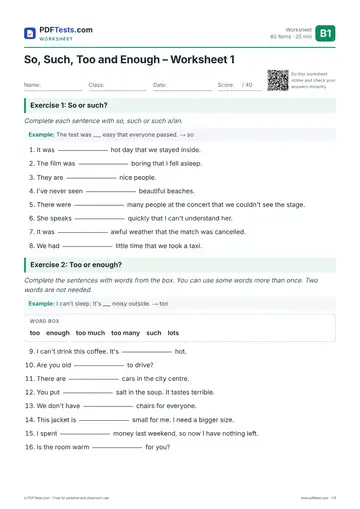
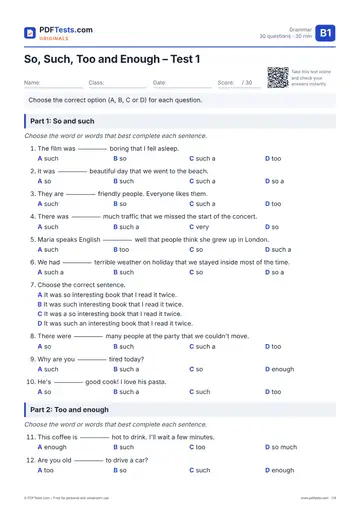
So and such make an adjective or noun stronger (It was so cold. It was such a cold day.). Too means more than is good or possible, and enough means the right amount (It’s too cold to swim. It isn’t warm enough to swim.). The main challenge is word order: each word goes in a different position in the sentence.
So and such: the basic difference
Both words add emphasis. They often describe something surprising, very good or very bad. The difference is grammatical: so goes before an adjective or adverb, and such goes before a noun phrase.
So + adjective or adverb
- The exam was so difficult.
- You look so tired today.
- She speaks so quickly that I can’t follow her.
- Thanks, that’s so kind of you.
There is no noun directly after the adjective. The adjective usually follows a verb like be, look, seem or feel.
Such + (a/an) + adjective + noun
- It was such a difficult exam.
- They’re such nice people.
- We had such terrible weather on holiday.
- He’s such an idiot sometimes.
Use such a/an with singular countable nouns. Use such without an article with plural nouns and uncountable nouns. The article always comes after such, never before it.
| Structure | Example |
|---|---|
| so + adjective | The film was so boring. |
| so + adverb | He drives so carefully. |
| such a/an + adjective + singular noun | It was such a boring film. |
| such + adjective + plural noun | They were such boring films. |
| such + adjective + uncountable noun | We had such bad luck. |
| such a/an + singular noun (no adjective) | It was such a mess. |
One sentence can often be written both ways:
- The hotel was so comfortable. = It was such a comfortable hotel.
- Your children are so polite. = You have such polite children.
So much, so many, so few, so little
To talk about quantity with emphasis, use so + much/many/few/little. These follow the normal countable and uncountable rules (see our guide to much, many, a lot of, a few and a little).
- There were so many people at the concert.
- I’ve got so much work this week.
- So few students came that the class was cancelled.
In informal English, such a lot of means the same as so much/so many:
- We’ve had such a lot of rain this month.
So … that and such … that
Add a that clause to show the result of something.
- It was so hot that we stayed inside all day.
- It was such a hot day that we stayed inside.
- She was so nervous that she forgot her lines.
- There was so much traffic that we missed the start.
In everyday speech, that is often left out: I was so tired I fell asleep on the sofa.
Too and enough
Too and enough are about whether something is the right amount for a purpose. They are covered at A2 in our Too and Enough guide; here is a B1 summary with the patterns you need.
Too + adjective or adverb
Too means more than necessary or acceptable. It almost always shows a problem.
- This jacket is too expensive. (I can’t or won’t buy it.)
- You’re driving too fast. Slow down.
- It’s too late to call him now.
Too much and too many
Use too much with uncountable nouns and too many with plural nouns. Use too much alone after a verb.
- I drink too much coffee.
- There are too many cars in the city centre.
- He works too much.
Do not use too much before an adjective: too tired, not too much tired.
Enough: after adjectives, before nouns
Enough means as much as necessary. Its position depends on the word it describes.
| Structure | Example |
|---|---|
| adjective + enough | Is the water warm enough? |
| adverb + enough | You didn’t run fast enough. |
| enough + plural noun | We don’t have enough chairs. |
| enough + uncountable noun | Is there enough milk for everyone? |
| verb + enough | Are you sleeping enough? |
In negative sentences, not … enough shows that something is less than necessary:
- The room isn’t big enough for a party.
- I didn’t study enough.
Adding for + person and to + infinitive
Both too and enough can be followed by for someone and/or a to-infinitive to say who is affected and what the purpose is.
- The box is too heavy for me to lift.
- She’s old enough to vote.
- The instructions were clear enough for the kids to follow.
- We left too late to catch the train.
When the subject of the sentence is also the object of the infinitive, don’t repeat it with a pronoun: The soup was too hot to eat. (not to eat it).
Often you can say the same idea with either word:
- He’s too young to drive. = He isn’t old enough to drive.
- The bag is too small. = The bag isn’t big enough.
So vs too vs very
Learners often mix these three. The key question is: is there a problem?
| Word | Meaning | Example |
|---|---|---|
| very | a lot; neutral | The test was very hard, but I passed. |
| so | a lot; emotional or surprising | The test was so hard. I was exhausted. |
| too | more than possible or acceptable | The test was too hard. Nobody passed. |
Because too suggests a negative result, it sounds strange with positive feelings. If you love a meal, say It was so delicious, not It was too delicious.
Also note that so and such are common in exclamations, while very is more neutral: You’re so funny. / What a day — it was such a nightmare.
Summary of word order
| Word | Position | Example |
|---|---|---|
| so | before adjective/adverb | so cold, so slowly |
| such | before (a/an) + (adjective) + noun | such a cold night, such cold weather |
| too | before adjective/adverb; too much/many + noun | too cold, too many cars |
| enough | after adjective/adverb; before noun | cold enough, enough time |
Common mistakes
- ✗ It was so a good film. → ✓ It was such a good film. Use such before a noun phrase.
- ✗ It was a such good film. → ✓ It was such a good film. The article comes after such.
- ✗ It was such good film. → ✓ It was such a good film. Singular countable nouns need a/an.
- ✗ Your friends are such kind. → ✓ Your friends are so kind. No noun follows, so use so.
- ✗ The weather was such nice. → ✓ The weather was so nice. / We had such nice weather. Such needs a noun after the adjective.
- ✗ She isn’t enough old to drive. → ✓ She isn’t old enough to drive. Enough goes after adjectives.
- ✗ We don’t have time enough. → ✓ We don’t have enough time. Enough usually goes before nouns.
- ✗ I’m too much tired. → ✓ I’m too tired. Use too alone before adjectives.
- ✗ There are too much people here. → ✓ There are too many people here. People is plural, so use many.
- ✗ The coffee was too hot to drink it. → ✓ The coffee was too hot to drink. Don’t repeat the subject as an object.
- ✗ Your cake is too delicious. → ✓ Your cake is so delicious. Too suggests a problem; so is positive emphasis.
Quick check
Choose or complete the correct form.
- It was ___ beautiful day that we went to the beach. (so / such a)
- I can’t reach the shelf. I’m not ___. (tall enough / enough tall)
- There were ___ people that we couldn’t get in. (so much / so many)
- This suitcase is ___ heavy for me to carry. (too / enough)
- Correct the mistake: They have such a big house that it has six bedrooms, and their garden is such big too.
Answers
- such a — beautiful day is a singular noun phrase.
- tall enough — enough follows the adjective.
- so many — people is plural and countable.
- too — the weight is a problem; enough would need light enough.
- their garden is so big too — no noun follows big, so use so.
Next step
Once you are confident with the word order, practise these structures in context: test yourself with our B1 So, Such, Too and Enough test. If too and enough still feel unsure, start with the simpler A2 Too and Enough test, and then explore more ways to connect ideas and results in our guide to linking words.
Practise this topic: So, Such, Too and Enough
Was this page helpful?
What was the problem?
Thank you for your feedback!