PDFTests Originals

Englisch für das US-Einbürgerungsinterview B1 – Test 1

B1 Mittelstufe WortschatzEnglisch

Mit diesem Wortschatztest auf Niveau B1 üben Lernende das Englisch, das beim Einbürgerungsinterview (naturalization interview) in den USA gebraucht wird. Der Test behandelt das Verstehen der Fragen des Beamten, wichtige Begriffe aus dem Antragsverfahren, höfliche Formulierungen, um um Wiederholung zu bitten oder Angaben zu korrigieren, sowie einen kurzen Lesetext über den Tag des Interviews. Er richtet sich an erwachsene Lernende und an Lehrkräfte in Einbürgerungs- oder ESL-Kursen.
Fragen
32
Zeit
35 Min.
PDF
6 Seiten
Lösungen
Enthalten
  • 100 % kostenlos
  • Ohne Anmeldung
  • Druckfertiges A4-PDF
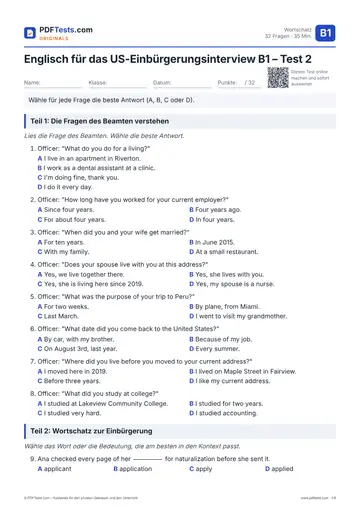
Vorschau von Seite 1: Englisch für das US-Einbürgerungsinterview B1 – Test 1 PDF öffnen
US-Einbürgerung: Englischtest · alle Übungstests, Niveaus und Tipps

Test online machen

Wähle bei jeder Frage die beste Antwort (A, B, C oder D). Wählen Sie Ihre Antworten und klicken Sie auf „Antworten prüfen“.

Teil 1: Fragen im Interview verstehen

Lies die Frage des Beamten. Wähle die beste Antwort.

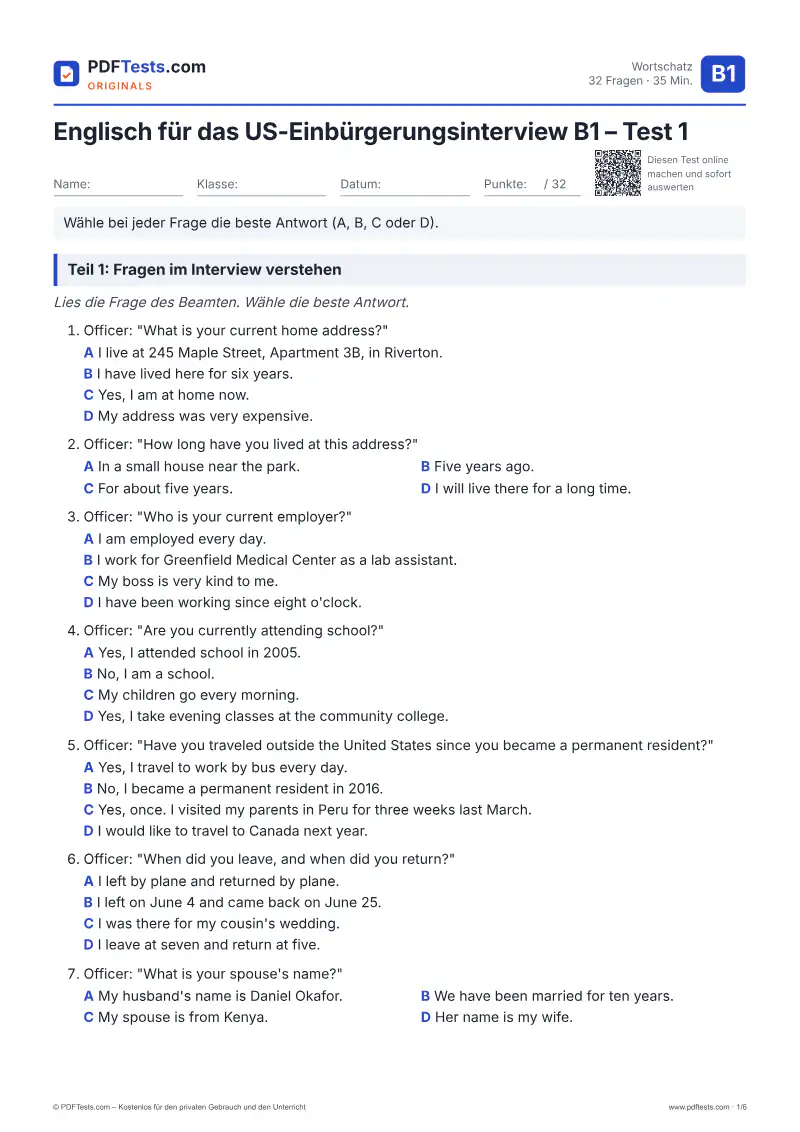
  1. Officer: "What is your current home address?"

  2. Officer: "How long have you lived at this address?"

  3. Officer: "Who is your current employer?"

  4. Officer: "Are you currently attending school?"

  5. Officer: "Have you traveled outside the United States since you became a permanent resident?"

  6. Officer: "When did you leave, and when did you return?"

  7. Officer: "What is your spouse's name?"

  8. Officer: "How many children do you have?"

Teil 2: Wortschatz zu Interview und Antrag

Wähle das Wort oder die Bedeutung, die am besten in den Kontext passt.

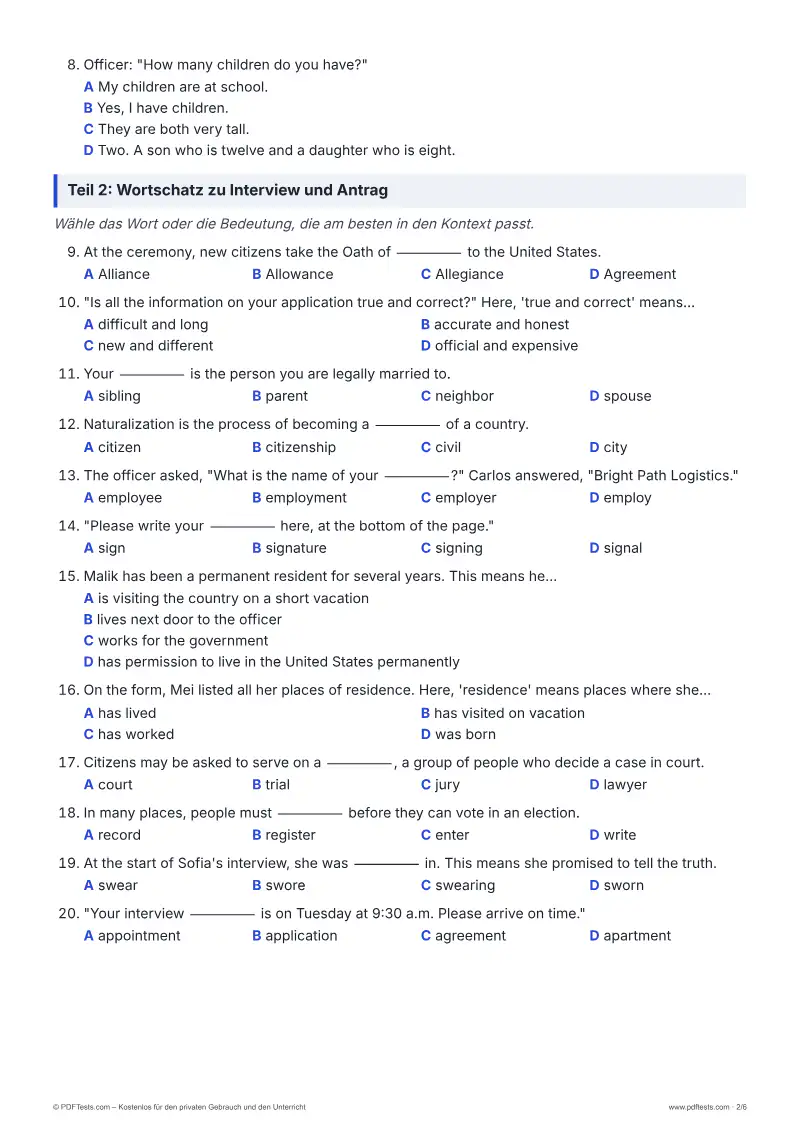
  1. At the ceremony, new citizens take the Oath of _____ to the United States.

  2. "Is all the information on your application true and correct?" Here, 'true and correct' means…

  3. Your _____ is the person you are legally married to.

  4. Naturalization is the process of becoming a _____ of a country.

  5. The officer asked, "What is the name of your _____?" Carlos answered, "Bright Path Logistics."

  6. "Please write your _____ here, at the bottom of the page."

  7. Malik has been a permanent resident for several years. This means he…

  8. On the form, Mei listed all her places of residence. Here, 'residence' means places where she…

  9. Citizens may be asked to serve on a _____, a group of people who decide a case in court.

  10. In many places, people must _____ before they can vote in an election.

  11. At the start of Sofia's interview, she was _____ in. This means she promised to tell the truth.

  12. "Your interview _____ is on Tuesday at 9:30 a.m. Please arrive on time."

Teil 3: Nachfragen und höfliche Bitten

Wähle für jede Situation die beste bzw. richtige Möglichkeit.

  1. The officer speaks very quickly and you miss the question. You say: "I'm sorry, could you _____ that, please?"

  2. You do not understand the word 'reside' in the officer's question. What is the most polite and correct way to ask?

  3. Officer: "So you moved to Oakdale in 2018, correct?" (You actually moved there in 2017.) What do you say?

  4. Find the sentence with a mistake.

  5. Officer: "Your date of birth is April 9, 1988?" You agree. You say: "Yes, _____."

  6. Officer: "Do you understand the question?" You do not understand it fully. What do you say?

  7. You want to check what the officer is asking: "When you say 'trips', do you _____ all trips, even short ones?"

Teil 4: Lesen – Vorbereitung auf den Tag des Interviews

Lies den Text. Wähle dann bei jeder Frage die beste Antwort.

When Sofia Reyes received her appointment notice, she read it carefully twice. The letter showed the date, the time and the address of the office. It also listed the documents she needed to bring. That evening, she put everything into one folder: the notice, her permanent resident card, her passport and copies of some other papers. She did not want to search for anything on the morning of the interview.

The night before, Sofia checked the bus timetable and went to bed early. She left home with plenty of time and arrived at the office about thirty minutes before her appointment. At the front desk, she showed her notice and waited until someone called her name.

The officer was polite and spoke clearly. First, he asked Sofia to stand and promise to tell the truth. Then they sat down, and he asked questions about the information on her application: her address, her job, her trips abroad and her family. When Sofia did not understand one question, she asked, "Could you repeat that, please?" The officer said it again more slowly.

Afterwards, Sofia told her friend, "It felt like a serious but friendly conversation. Being organized helped me stay calm."

  1. Why did Sofia put everything into one folder?

  2. What did Sofia do the night before the interview?

  3. When did Sofia arrive at the office?

  4. What did the officer do first?

  5. In the last paragraph, 'organized' is closest in meaning to…

War diese Seite hilfreich?

Fehler melden

Falsche Lösung, Tippfehler oder unklare Erklärung? Schreiben Sie uns, wir korrigieren es.

Mit einem Arbeitsblatt üben: Englisch für das US-Einbürgerungsinterview B1 – Arbeitsblatt 1

Vorschau

Über diesen Test

Mit diesem Wortschatztest auf Niveau B1 üben Lernende das Englisch, das beim Einbürgerungsinterview (naturalization interview) in den USA gebraucht wird. Der Test behandelt das Verstehen der Fragen des Beamten, wichtige Begriffe aus dem Antragsverfahren, höfliche Formulierungen, um um Wiederholung zu bitten oder Angaben zu korrigieren, sowie einen kurzen Lesetext über den Tag des Interviews. Er richtet sich an erwachsene Lernende und an Lehrkräfte in Einbürgerungs- oder ESL-Kursen.

Themen

Fragen im InterviewWortschatz zur EinbürgerungWortfamilienNachfragen und um Klärung bittenAngaben bestätigen und korrigierenLeseverstehen

So nutzen Sie diesen Test

  1. Laden Sie das PDF herunter und drucken Sie es aus – oder machen Sie den Test unten online.
  2. Beantworten Sie alle Fragen ohne Wörterbuch und ohne Zeitdruck.
  3. Prüfen Sie Ihre Antworten und notieren Sie, was Sie wiederholen sollten.

Hinweise für Lehrkräfte

Setzen Sie den Test ein, nachdem Fragen und Antworten im Interviewstil laut geübt wurden; als Sprechübung im Anschluss können sich die Lernenden die Fragen des Beamten gegenseitig vorlesen. Der Test zielt auf typische Fehler ab, etwa die Antwort auf „how long“ mit „ago“, die Verwechslung innerhalb von Wortfamilien (employer/employee, sign/signature, swear/sworn) sowie unhöfliche oder grammatisch falsche Rückfragen. Es handelt sich ausschließlich um Sprachübung und nicht um Rechtsberatung; verweisen Sie die Lernenden für Informationen zum Verfahren bitte an offizielle Stellen.