PDFTests Originals

US Citizenship Interview English B1 – Test 1

B1 Intermediate VocabularyEnglish

This B1 vocabulary test helps learners practice the English used at a US naturalization interview. It covers understanding an officer's questions, key words from the application process, polite ways to ask for repetition or correct information, and a short reading about interview day. It is for adult learners and teachers in citizenship or ESL classes.
Questions
32
Time
35 min
PDF
6 pages
Answer key
Included
  • 100% free
  • No sign-up or email
  • Print-ready A4 PDF
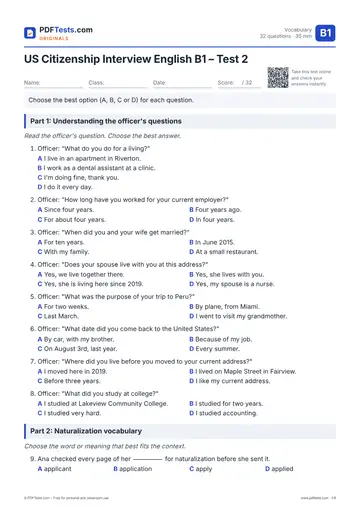
Preview of page 1 of US Citizenship Interview English B1 – Test 1 Open PDF
US citizenship English test · all practice tests, levels and tips

Take the test online

Choose the best option (A, B, C or D) for each question. Choose your answers, then press “Check my answers”.

Part 1: Understanding interview questions

Read the officer's question. Choose the best answer.

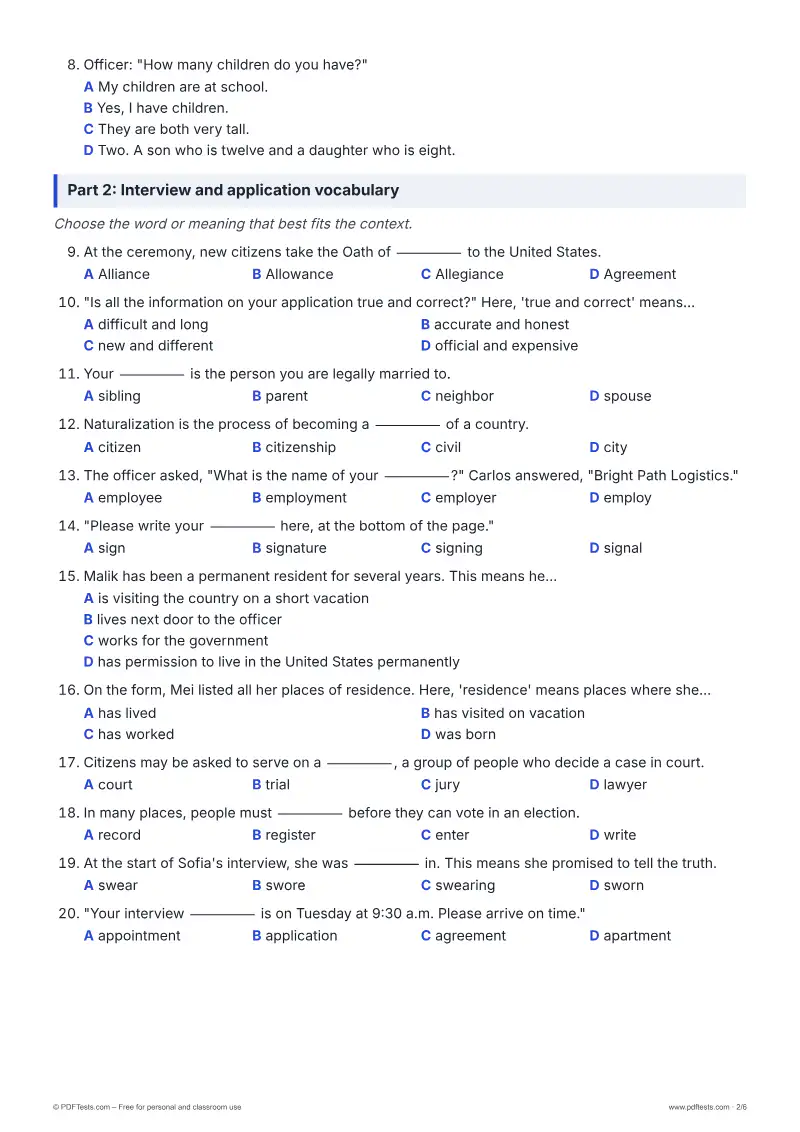
  1. Officer: "What is your current home address?"

  2. Officer: "How long have you lived at this address?"

  3. Officer: "Who is your current employer?"

  4. Officer: "Are you currently attending school?"

  5. Officer: "Have you traveled outside the United States since you became a permanent resident?"

  6. Officer: "When did you leave, and when did you return?"

  7. Officer: "What is your spouse's name?"

  8. Officer: "How many children do you have?"

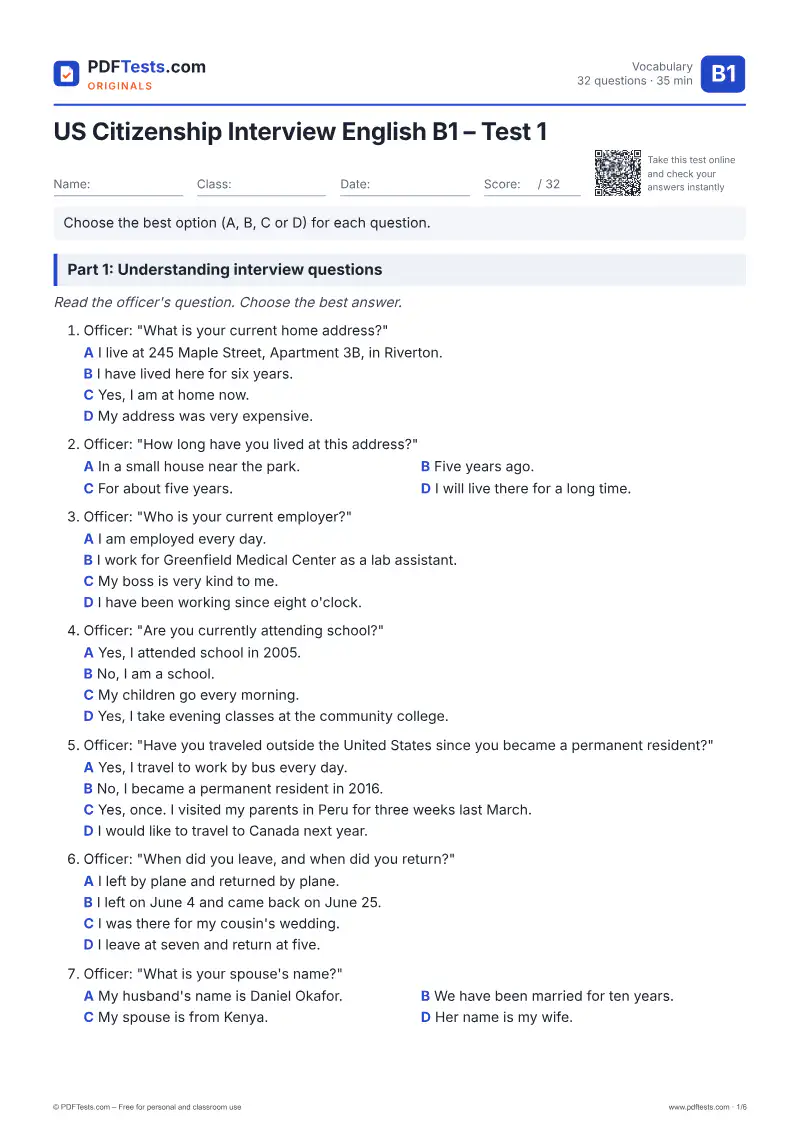
Part 2: Interview and application vocabulary

Choose the word or meaning that best fits the context.

  1. At the ceremony, new citizens take the Oath of _____ to the United States.

  2. "Is all the information on your application true and correct?" Here, 'true and correct' means…

  3. Your _____ is the person you are legally married to.

  4. Naturalization is the process of becoming a _____ of a country.

  5. The officer asked, "What is the name of your _____?" Carlos answered, "Bright Path Logistics."

  6. "Please write your _____ here, at the bottom of the page."

  7. Malik has been a permanent resident for several years. This means he…

  8. On the form, Mei listed all her places of residence. Here, 'residence' means places where she…

  9. Citizens may be asked to serve on a _____, a group of people who decide a case in court.

  10. In many places, people must _____ before they can vote in an election.

  11. At the start of Sofia's interview, she was _____ in. This means she promised to tell the truth.

  12. "Your interview _____ is on Tuesday at 9:30 a.m. Please arrive on time."

Part 3: Clarification and polite requests

Choose the best or correct option for each situation.

  1. The officer speaks very quickly and you miss the question. You say: "I'm sorry, could you _____ that, please?"

  2. You do not understand the word 'reside' in the officer's question. What is the most polite and correct way to ask?

  3. Officer: "So you moved to Oakdale in 2018, correct?" (You actually moved there in 2017.) What do you say?

  4. Find the sentence with a mistake.

  5. Officer: "Your date of birth is April 9, 1988?" You agree. You say: "Yes, _____."

  6. Officer: "Do you understand the question?" You do not understand it fully. What do you say?

  7. You want to check what the officer is asking: "When you say 'trips', do you _____ all trips, even short ones?"

Part 4: Reading – Getting ready for interview day

Read the text. Then choose the best answer to each question.

When Sofia Reyes received her appointment notice, she read it carefully twice. The letter showed the date, the time and the address of the office. It also listed the documents she needed to bring. That evening, she put everything into one folder: the notice, her permanent resident card, her passport and copies of some other papers. She did not want to search for anything on the morning of the interview.

The night before, Sofia checked the bus timetable and went to bed early. She left home with plenty of time and arrived at the office about thirty minutes before her appointment. At the front desk, she showed her notice and waited until someone called her name.

The officer was polite and spoke clearly. First, he asked Sofia to stand and promise to tell the truth. Then they sat down, and he asked questions about the information on her application: her address, her job, her trips abroad and her family. When Sofia did not understand one question, she asked, "Could you repeat that, please?" The officer said it again more slowly.

Afterwards, Sofia told her friend, "It felt like a serious but friendly conversation. Being organized helped me stay calm."

  1. Why did Sofia put everything into one folder?

  2. What did Sofia do the night before the interview?

  3. When did Sofia arrive at the office?

  4. What did the officer do first?

  5. In the last paragraph, 'organized' is closest in meaning to…

Was this page helpful?

Report a mistake

Spotted a wrong answer, a typo or an unclear explanation? Tell us and we will fix it.

Practise with a worksheet: US Citizenship Interview English B1 – Worksheet 1

Preview

About this test

This B1 vocabulary test helps learners practice the English used at a US naturalization interview. It covers understanding an officer's questions, key words from the application process, polite ways to ask for repetition or correct information, and a short reading about interview day. It is for adult learners and teachers in citizenship or ESL classes.

Topics covered

Interview questionsNaturalization vocabularyWord familiesAsking for clarificationConfirming and correcting informationReading comprehension

How to use this test

  1. Download the PDF and print it, or take the test online below.
  2. Answer every question without a dictionary or time pressure.
  3. Check your answers and note the topics you need to review.

Notes for teachers

Use this test after practicing interview-style questions and answers aloud; students can read the officer's questions to each other as a speaking follow-up. It targets typical errors such as answering 'how long' with 'ago', confusing word families (employer/employee, sign/signature, swear/sworn) and impolite or ungrammatical clarification requests. This is language practice only and does not give legal advice, so direct learners to official sources for procedural information.