PDFTests Originals

Used to y would – Test 1

B1 Intermedio GramáticaInglés

Este test de gramática de nivel B1 comprueba si el alumno sabe usar «used to» y «would» para hablar de hábitos y estados del pasado. Trabaja las formas afirmativa, negativa e interrogativa, la diferencia entre «used to» y «would», cuándo hay que usar el pasado simple (Past Simple) y en qué se diferencian de «be/get used to». Es ideal para alumnos de nivel intermedio, para repasar en clase o para estudiar por tu cuenta.
Preguntas
30
Tiempo
35 min
PDF
5 páginas
Soluciones
Incluidas
  • 100 % gratis
  • Sin registro
  • PDF A4 listo para imprimir
Vista previa de la página 1: Used to y would – Test 1 Abrir PDF

Haz el examen en línea

Elige la opción correcta (A, B, C o D) en cada pregunta. Elige tus respuestas y pulsa «Comprobar respuestas».

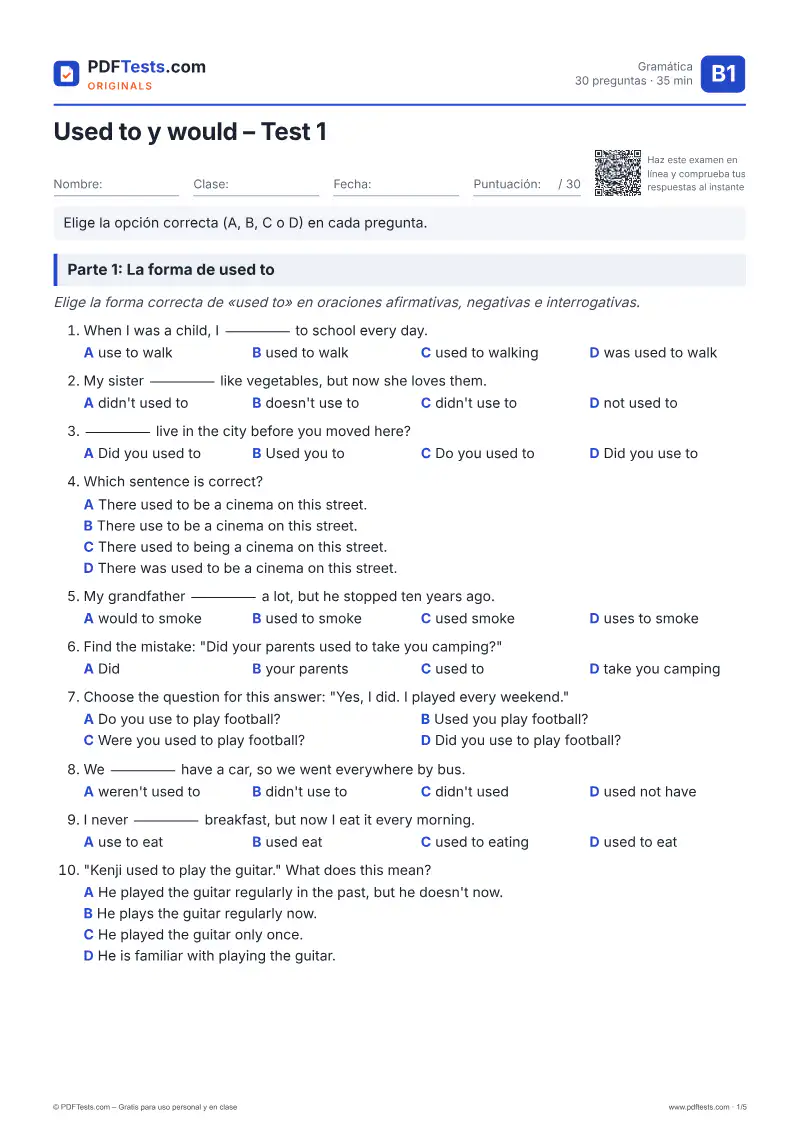
Parte 1: La forma de used to

Elige la forma correcta de «used to» en oraciones afirmativas, negativas e interrogativas.

  1. When I was a child, I _____ to school every day.

  2. My sister _____ like vegetables, but now she loves them.

  3. _____ live in the city before you moved here?

  4. Which sentence is correct?

  5. My grandfather _____ a lot, but he stopped ten years ago.

  6. Find the mistake: "Did your parents used to take you camping?"

  7. Choose the question for this answer: "Yes, I did. I played every weekend."

  8. We _____ have a car, so we went everywhere by bus.

  9. I never _____ breakfast, but now I eat it every morning.

  10. "Kenji used to play the guitar." What does this mean?

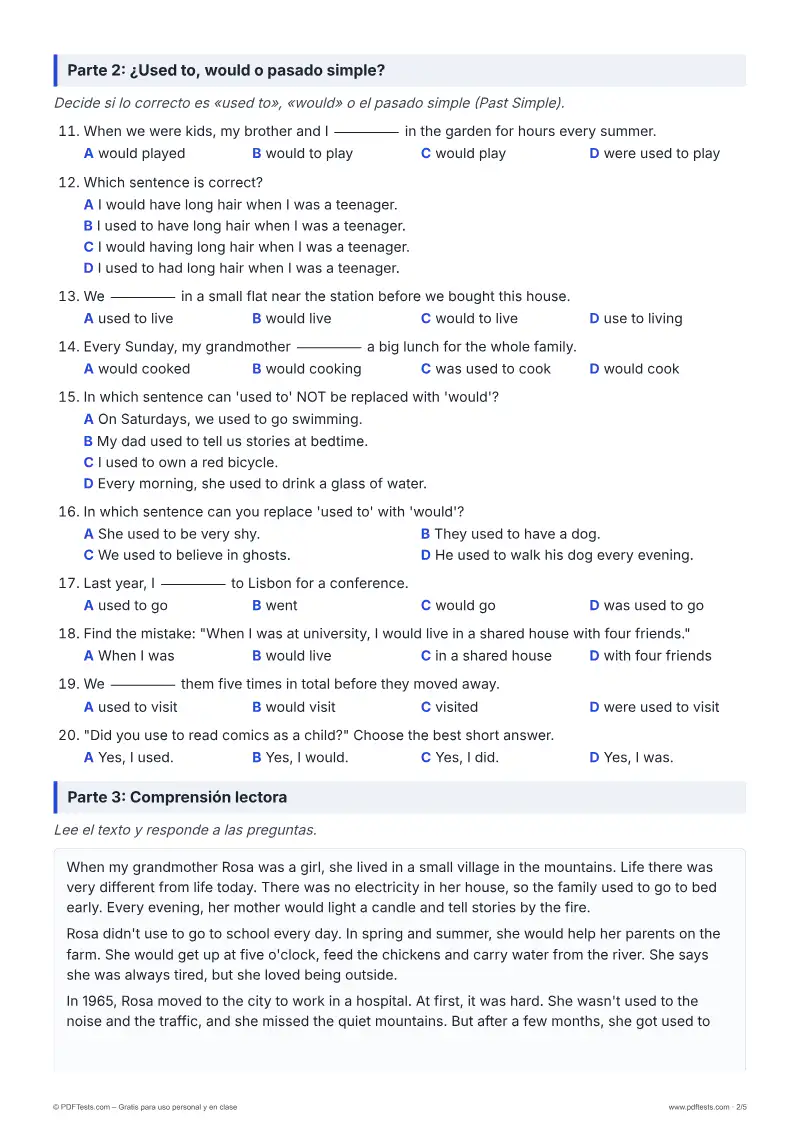
Parte 2: ¿Used to, would o pasado simple?

Decide si lo correcto es «used to», «would» o el pasado simple (Past Simple).

  1. When we were kids, my brother and I _____ in the garden for hours every summer.

  2. Which sentence is correct?

  3. We _____ in a small flat near the station before we bought this house.

  4. Every Sunday, my grandmother _____ a big lunch for the whole family.

  5. In which sentence can 'used to' NOT be replaced with 'would'?

  6. In which sentence can you replace 'used to' with 'would'?

  7. Last year, I _____ to Lisbon for a conference.

  8. Find the mistake: "When I was at university, I would live in a shared house with four friends."

  9. We _____ them five times in total before they moved away.

  10. "Did you use to read comics as a child?" Choose the best short answer.

Parte 3: Comprensión lectora

Lee el texto y responde a las preguntas.

When my grandmother Rosa was a girl, she lived in a small village in the mountains. Life there was very different from life today. There was no electricity in her house, so the family used to go to bed early. Every evening, her mother would light a candle and tell stories by the fire.

Rosa didn't use to go to school every day. In spring and summer, she would help her parents on the farm. She would get up at five o'clock, feed the chickens and carry water from the river. She says she was always tired, but she loved being outside.

In 1965, Rosa moved to the city to work in a hospital. At first, it was hard. She wasn't used to the noise and the traffic, and she missed the quiet mountains. But after a few months, she got used to her new life. Now she is eighty-two, and she is used to living in a busy city. She still visits the village every summer, but she says, "It isn't the place it used to be. Most of the young people have left."

  1. Why did Rosa's family use to go to bed early?

  2. "Her mother would light a candle and tell stories." What does 'would' show here?

  3. Which of these did Rosa NOT do regularly as a child?

  4. "She wasn't used to the noise and the traffic." What does this mean?

  5. Why does the writer say "In 1965, Rosa moved to the city" and not "Rosa used to move to the city"?

  6. "It isn't the place it used to be." What does Rosa mean?

Parte 4: Used to, be used to y get used to

Elige la opción correcta. Presta atención a la diferencia entre «used to do», «be used to doing» y «get used to doing».

  1. I've lived in London for years, so I'm used to _____ on the left side of the road.

  2. When Tom started his new job, it took him a few weeks to _____ early.

  3. Which sentence is correct?

  4. Find the mistake: "My little brother would be afraid of the dark, but now he sleeps without a light."

Vista previa

Sobre este examen

Este test de gramática de nivel B1 comprueba si el alumno sabe usar «used to» y «would» para hablar de hábitos y estados del pasado. Trabaja las formas afirmativa, negativa e interrogativa, la diferencia entre «used to» y «would», cuándo hay que usar el pasado simple (Past Simple) y en qué se diferencian de «be/get used to». Es ideal para alumnos de nivel intermedio, para repasar en clase o para estudiar por tu cuenta.

Temas

used to: oraciones afirmativasdidn't use to: oraciones negativaspreguntas con Did you use to...?would para acciones repetidas en el pasadoverbos de estado frente a verbos de acciónpasado simple (Past Simple) para hechos puntualesbe used to / get used to

Cómo usar este examen

  1. Descarga el PDF e imprímelo, o haz el examen en línea más abajo.
  2. Responde todas las preguntas sin diccionario y sin prisas.
  3. Comprueba tus respuestas y apunta los temas que debes repasar.

Notas para el profesor

Utilice las partes 1 y 2 para comprobar la forma y el contraste entre used to y would antes de pasar a la lectura de la parte 3 y a las preguntas sobre «be/get used to» de la parte 4. El test se centra en errores típicos del nivel B1: «didn't used to», «Did you used to», «would» con verbos de estado (have, live, be), «use to» para hábitos del presente y «used to» para hechos puntuales o cuando se indica un número concreto de veces. Como actividad de refuerzo, pida a los alumnos que escriban un breve párrafo sobre su infancia con al menos tres ejemplos de «used to» y otros tres de «would».